
Pulp Fiction, 1920 · page 163 of 232
Argosy All-Story Weekly, Vol. 123, No. 3 — page 163: what you’re looking at
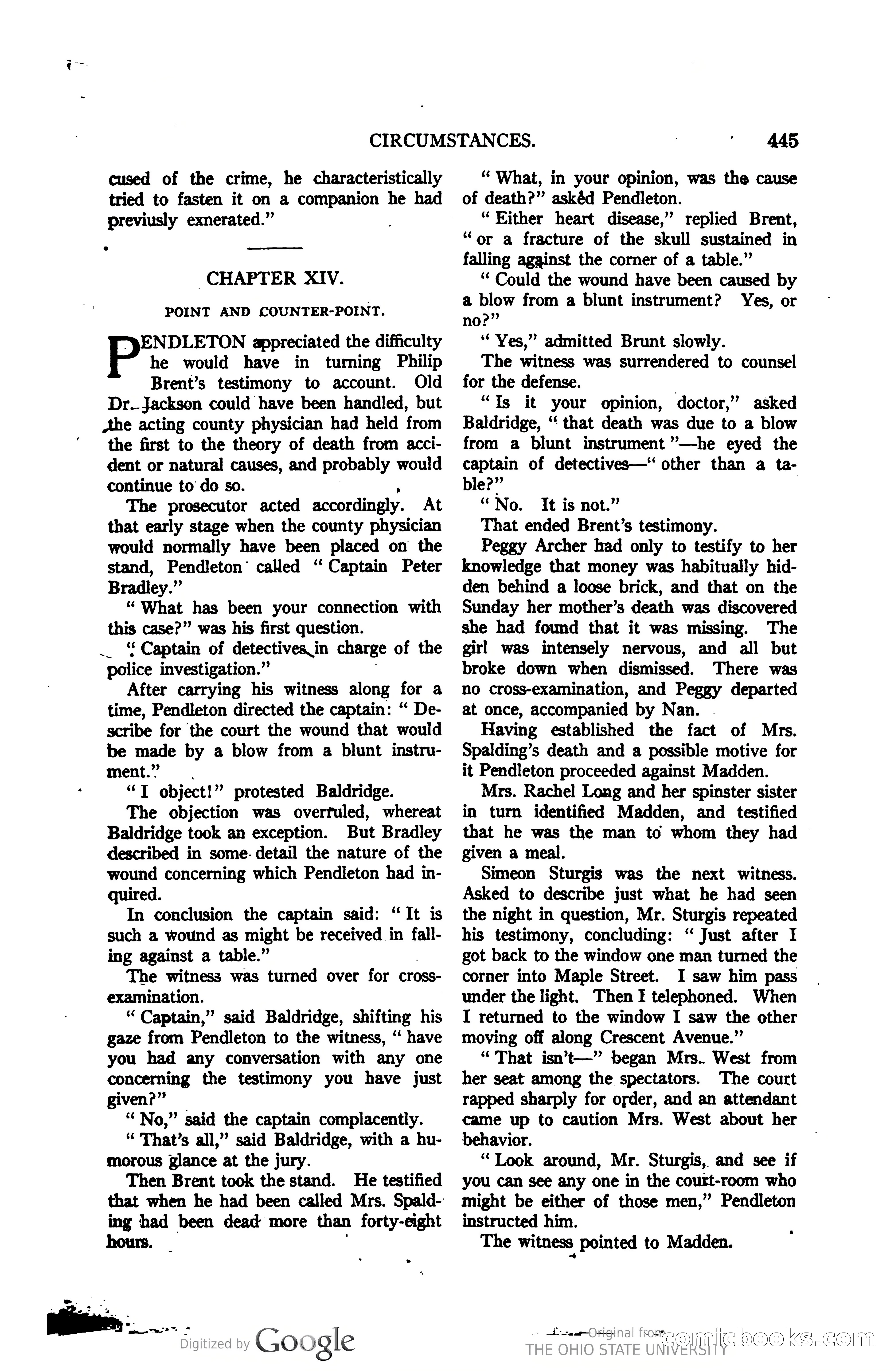
A restored page from Pulp Fiction, 1920. Page through the whole issue in the reader above.
📄 Transcribed text from this page (OCR, searchable)
Machine-transcribed from the original scan — historical spelling and the odd misread are preserved.
CIRCUMSTANCES. cused of the crime, he characteristically tried to fasten it on a companion he had previusly exnerated.” CHAPTER XIV. POINT AND COUNTER-POINT. ENDLETON appreciated the difficulty he would have in turning Philip Brent’s testimony to account. Old Dr.. Jackson could have been handled, but the acting county physician had held from the first to the theory of death from acci- dent or natural causes, and probably would continue to’ do so. The prosecutor acted accordingly. At that early stage when the county physician would normally have been placed on the stand, Pendleton’ caled ‘‘ Captain Peter Bradley.” “ What has been your connection with this case?” was his first question. ._. “Captain of detectivesin charge of the police investigation. ” After carrying his witness along for a time, Pendleton directed the captain: “ De- scribe for the court the wound that would be made by a blow from a blunt instru- ment.” “TI object!” protested Baldridge. The objection was overfuled, whereat Baldridge took an exception. But Bradley described in some. detail the nature of the wound concerning which Pendleton had in- quired. In conclusion the captain said: “It is such a wound as might be received in fall- ing against a table.” The witness was turned over for cross- examination. ‘“‘ Captain,”’ said Baldridge, shifting his gaze from Pendleton to the witness, ‘“‘ have you had any conversation with any one concerning the testimony you have just given?” “No,” said the captain complacently. “ That’s all,” said Baldridge, with a hu- morous glance at the jury. Then Brent took the stand. He testified that when he had been called Mrs. Spald- ing had been dead more than forty-eight . ~" ions» Google 445 “What, in your opinion, was the cause of death?” askéd Pendleton. ‘“‘ Fither heart disease,” replied Brent, “or a fracture of the skull sustained in falling against the corner of a table.” ‘‘ Could the wound have been caused by a blow from a blunt instrument? Yes, or no?” ‘* Yes,” admitted Brunt slowly. The witness was surrendered to counsel for the defense. | “Is it your opinion, doctor,” asked Baldridge, ‘“ that death was due to a blow from a blunt instrument ”—he eyed the captain of detectives—‘ other than a ta- ble?” “No. It is not.” That ended Brent’s testimony. Peggy Archer had only to testify to her knowledge that money was habitually hid- den behind a loose brick, and that on the Sunday her mother’s death was discovered she had found that it was missing. The girl was intensely nervous, and all but broke down when dismissed. There was no cross-examination, and Peggy departed at once, accompanied by Nan. Having established the fact of Mrs. Spalding’s death and a possible motive for it Pendleton proceeded against Madden. Mrs. Rachel Long and her spinster sister in turn identified Madden, and testified that he was the man to whom they had ~ given a meal. Simeon Sturgis was the next witness. Asked to describe just what he had seen the night in question, Mr. Sturgis repeated his testimony, concluding: “ Just after I got back to the window one man turned the corner into Maple Street. I saw him pass under the light. Then I telephoned. When I returned to the window I saw the other moving off along Crescent Avenue.” “ That isn’t—” began Mrs.. West from her seat among the spectators. The court rapped sharply for order, and an attendant came up to caution Mrs. West about her behavior. “Look around, Mr. Sturgis, and see if you can see any one in the court-room who might be either of those men,” Pendleton instructed him. The witness pointed to Madden. PCL ONTO SS CO