
Pulp Fiction, 1920 · page 127 of 232
Argosy All-Story Weekly, Vol. 123, No. 3 — page 127: what you’re looking at
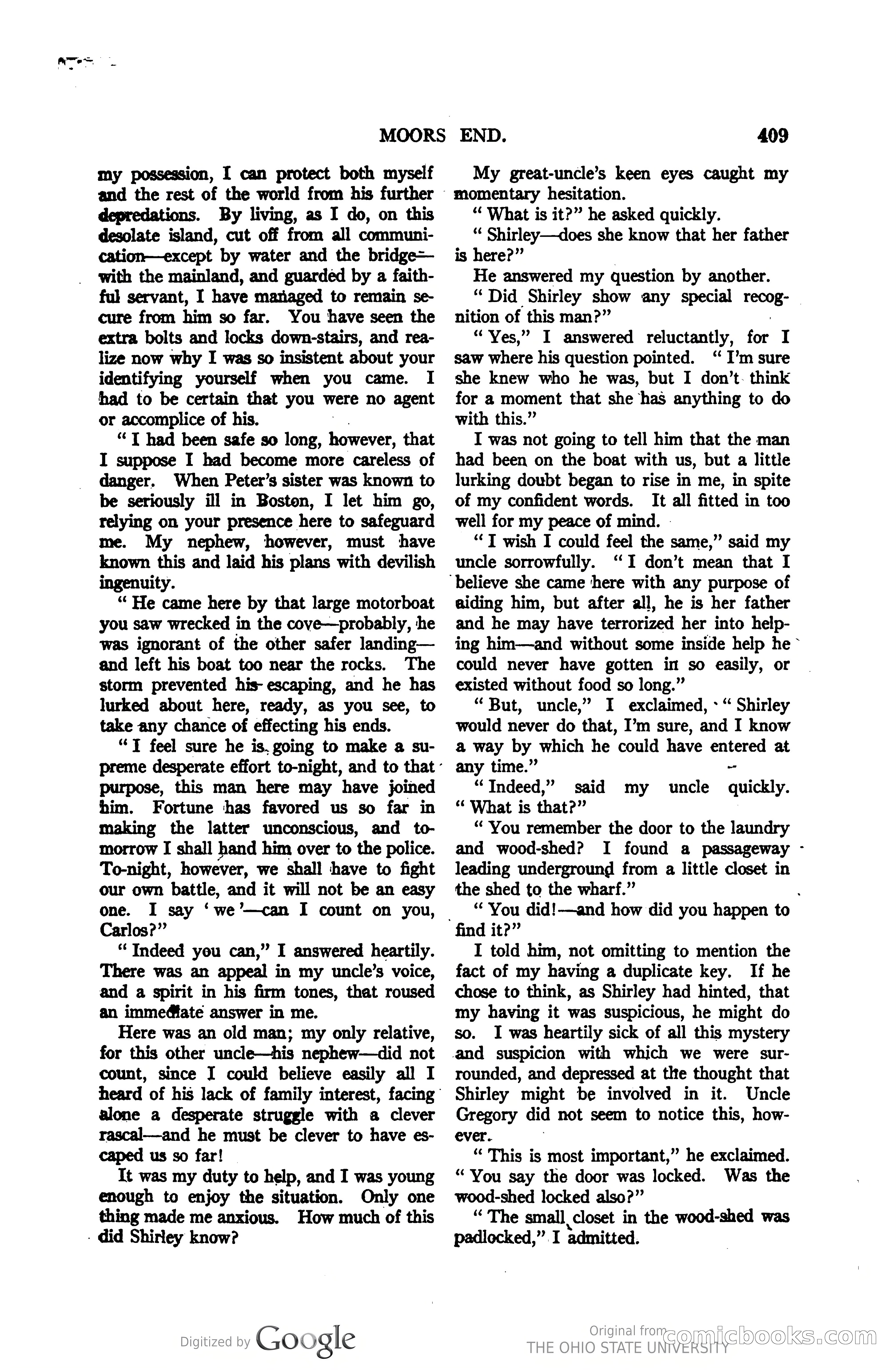
A restored page from Pulp Fiction, 1920. Page through the whole issue in the reader above.
📄 Transcribed text from this page (OCR, searchable)
Machine-transcribed from the original scan — historical spelling and the odd misread are preserved.
MOORS END. my possession, I can protect both myself and the rest of the world from his further © depredations. By living, as I do, on this desolate island, cut off from all communi- cation—except by water and the bridge— with the mainland, and guarded by a faith- ful servant, I have managed to remain se- cure from him so far. You have seen the extra bolts and locks down-stairs, and rea- lize now why I was so insistent about your identifying yourself when you came. I had to be certain that you were no agent or accomplice of his. ‘“‘T had been safe so long, however that I suppose I had become more careless of danger. When Peter’s sister was known to be seriously ill in Boston, I let him go, relying on your presence here to safeguard me. My nephew, however, must have known this and laid his plans with devilish ingenuity. ‘“‘ He came here by that large motorboat you saw wrecked in the cove—probably, ‘he was ignorant of the other safer landing— and left his boat too near the rocks. The storm prevented his- escaping, and he has lurked about here, ready, as you see, to take any chance of effecting his ends. “1 feel sure he is. going to make a su- preme desperate effort to-night, and to that - purpose, this man here may have joined him. Fortune thas favored us so far in making the latter unconscious, and to- morrow I shall hand him over to the police. To-night, however, we shall have to fight our own battle, and it will not be an easy one. I say ‘we’—can I count on you, Carlos?” “Indeed yeu can,” I answered heartily. There was an appeal in my uncle’s voice, and a spirit in his firm tones, that roused an imme@fate answer in me. Here was an old man; my only relative, for this other uncle—his nephew—did not count, since I could believe easily all I heard of his lack of family interest, facing alone a desperate struggle with a clever rascal—and he must be clever to have es- caped us so far! — It was my duty to help, and I was young enough to enjoy the situation. Only one thing made me anxious. How much of this - did Shirley know? 409 My great-uncle’s keen eyes caught my momentary hesitation. “‘ What is it?” he asked quickly. *¢ Shirley—does she know that her father is here?” | He answered my question by another. “ Did Shirley show any special recog: | nition of this man?” “Yes,” I answered reluctantly, for I saw where his question pointed. ‘I’m sure she knew who he was, but I don’t. think for 2 moment that she has anything to do with this.” I was not going to tell him that the man had been on the boat with us, but a little lurking doubt began to rise in me, in spite of my confident words. It all fitted in too well for my peace of mind. . ‘“‘T wish I could feel the same,” said my uncle sorrowfully. “‘I don’t mean that I ‘believe she came here with any purpose of aiding him, but after all, he is her father and he may have terrorized her into help- ing him—and without some inside help he - could never have gotten in so easily, or existed without food so long.” “ But, uncle,” I exclaimed, - “ Shirley would never do that, I’m sure, and I know a way by which he could have entered at any time.” - “‘Indeed,” said my _ uncle quickly. “ What is that?” “You remember the door to the laundry and wood-shed? I found a passageway - leading underground from a little closet in the shed to the wharf.” “You did!—and how did you happen to | find it?” I told him, not omitting to mention the fact of my having a duplicate key. If he chose to think, as Shirley had hinted, that my having it was suspicious, he might do so. I was heartily sick of all this mystery and suspicion with which we were sur- rounded, and depressed at thte thought that Shirley might be involved in it. Uncle Gregory did not seem to notice this, how- ever. “This is most important,” he exclaimed. “You say the door was locked. Was the wood-shed locked also?”’ “ The small closet in the wood-shed was padiocked,”’ I admitted. Original f ACO (C NOOO a) S CO THE OHIO STATE