
Pulp Fiction, 1928 · page 47 of 156
Argosy All-Story Weekly — "Sea Marauders" — page 47: what you’re looking at
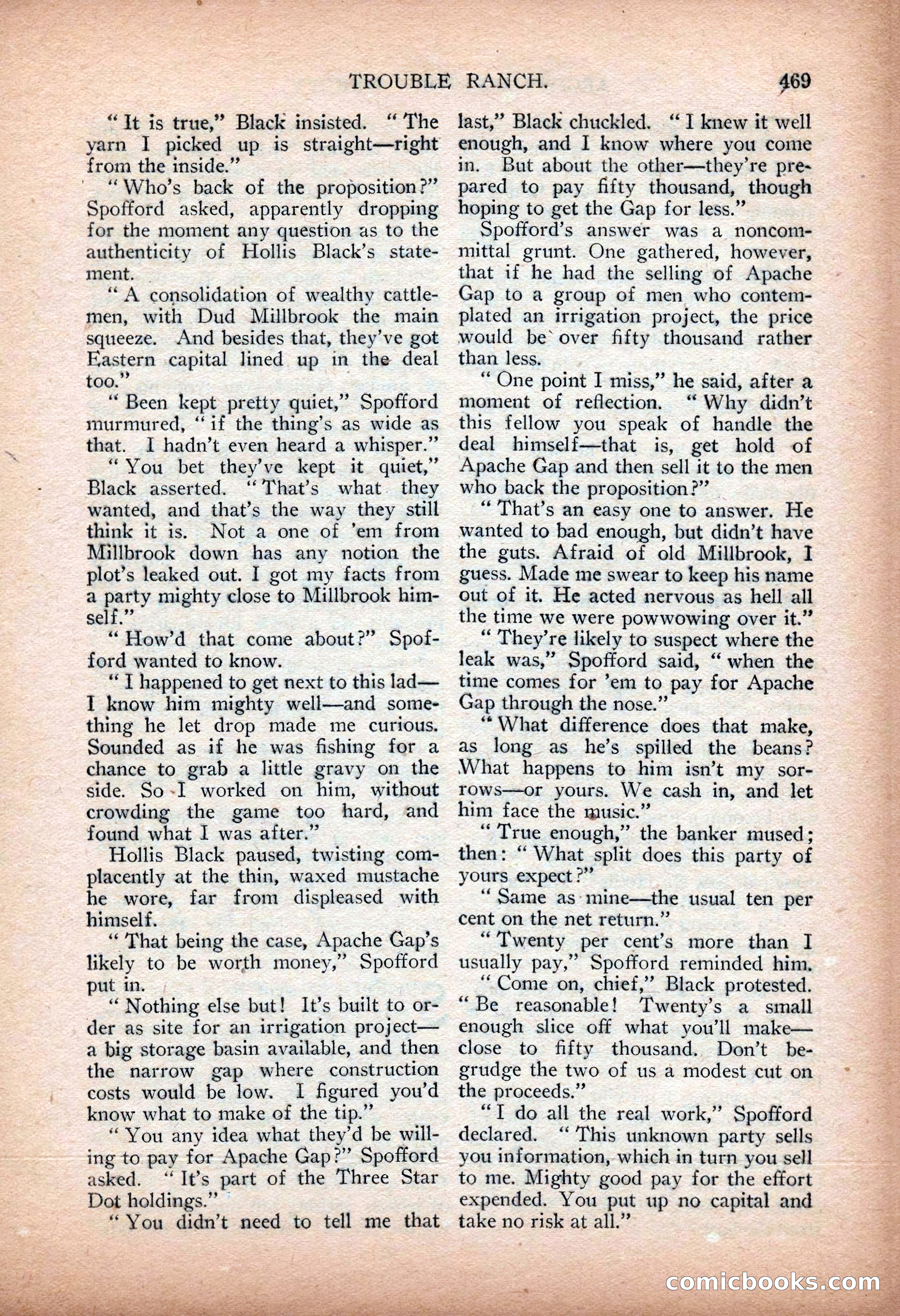
A restored page from Pulp Fiction, 1928. Page through the whole issue in the reader above.
📄 Transcribed text from this page (OCR, searchable)
Machine-transcribed from the original scan — historical spelling and the odd misread are preserved.
TROUBLE RANCH. “It is true,” Black insisted. “‘ The yarn I picked up is straight—right from the inside.” ‘“Who’s back of the proposition?” Spofford asked, apparently dropping for the moment any question as to the authenticity of Hollis Black’s state- ment. _ “A consolidation of wealthy cattle- men, with Dud Millbrook the main squeeze. And besides that, they’ve got Eastern capital lined up in the deal too.” | “Been kept pretty quiet,” Spofford murmured, “if the thing’s as wide as that. I hadn’t even heard a whisper.” “You bet they’ve kept it quiet,” Black asserted. ‘‘ That’s what. they wanted, and that’s the way they still think it is. Not a one of ‘em from Millbrook down has any notion the plot’s leaked out. I got my facts from a party mighty close to Millbrook him- self.” ““How’d that come about?” Spof- ford wanted to know. “ T happened to get next to this lad— 1 know him mighty well—and some- thing he let drop made me curious. Sounded as if he was fishing for a chance to grab a little gravy on the side. So-l worked on him, without crowding the game too hard, and found what I was after.” Hollis Black paused, twisting com- placently at the thin, waxed mustache he wore, far from displeased with himself. “That being the case, Apache Gap’s likely to be worth money,” Spofford put in. “Nothing else but! It’s butlt to or- der as site for an irrigation project— a big storage basin available, and then the narrow gap where construction costs would be low. I figured you'd know what to make of the tip.” “You any idea what they'd be will- ing to pay for Apache Gap?” Spofford asked. “It’s part of the Three Star Dot holdings.” “You didn’t need to tell me that 469 last,” Black chuckled. ‘I knew it well enough, and I know where you come in. But about the other—they’re pre- pared to pay fifty thousand, though hoping to get the Gap for less.” Spofford’s answer was a noncom- mittal grunt. One gathered, however, that if he had the selling of Apache Gap to a group of men who contem- plated an irrigation project, the price would be over fifty thousand rather than less. “One point I miss,” he said, after a moment of reflection. “Why didn’t this fellow you speak of handle the deal himself—that is, get hold of Apache Gap and then sell it to the men who back the proposition?” “ That’s an easy one to answer. He wanted to bad enough, but didn’t have the guts. Afraid of old Millbrook, I guess. Made me swear to keep his name out of it. He acted nervous as hell all the time we were powwowing over it.” “ They’re likely to suspect where the leak was,” Spofford said, “ when the time comes for ’em to pay for Apache Gap through the nose.” “What difference does that make, as long as he’s spilled the beans? What happens to him isn’t my sor- rows—or yours. We cash in, and let him face the music.” “True enough,” the banker mused; then: “ What split does this party of yours expect?” “Same as: mine—the usual ten per cent on the net return.” “Twenty per cent’s more than I usually pay,” Spofford reminded him. “Come on, chief,’ Black protested. “Be reasonable! Twenty’s a_ small enough slice off what you'll make— close to fifty thousand. Don’t be- grudge the two of us a modest cut on the proceeds.” “TI do all the real work,” Spofford declared. “‘ This unknown party sells you information, which in turn you sell to me. Mighty good pay for the effort expended. You put up no capital and take no risk at all.” PA uw, a! , - avs, ti . 9 ae, he 4 wes hy Ait on “nt RS, WA Aad Ses Oy Ati wp? LTE Ty : <y a a TE EP AT iis: te ae Te 7 i, a oo EComich ee. OOKS. Corr se ee So Tae - 4 a =