
Pulp Fiction, 1928 · page 98 of 150
Argosy All-Story Weekly, July 7, 1928 — page 98: what you’re looking at
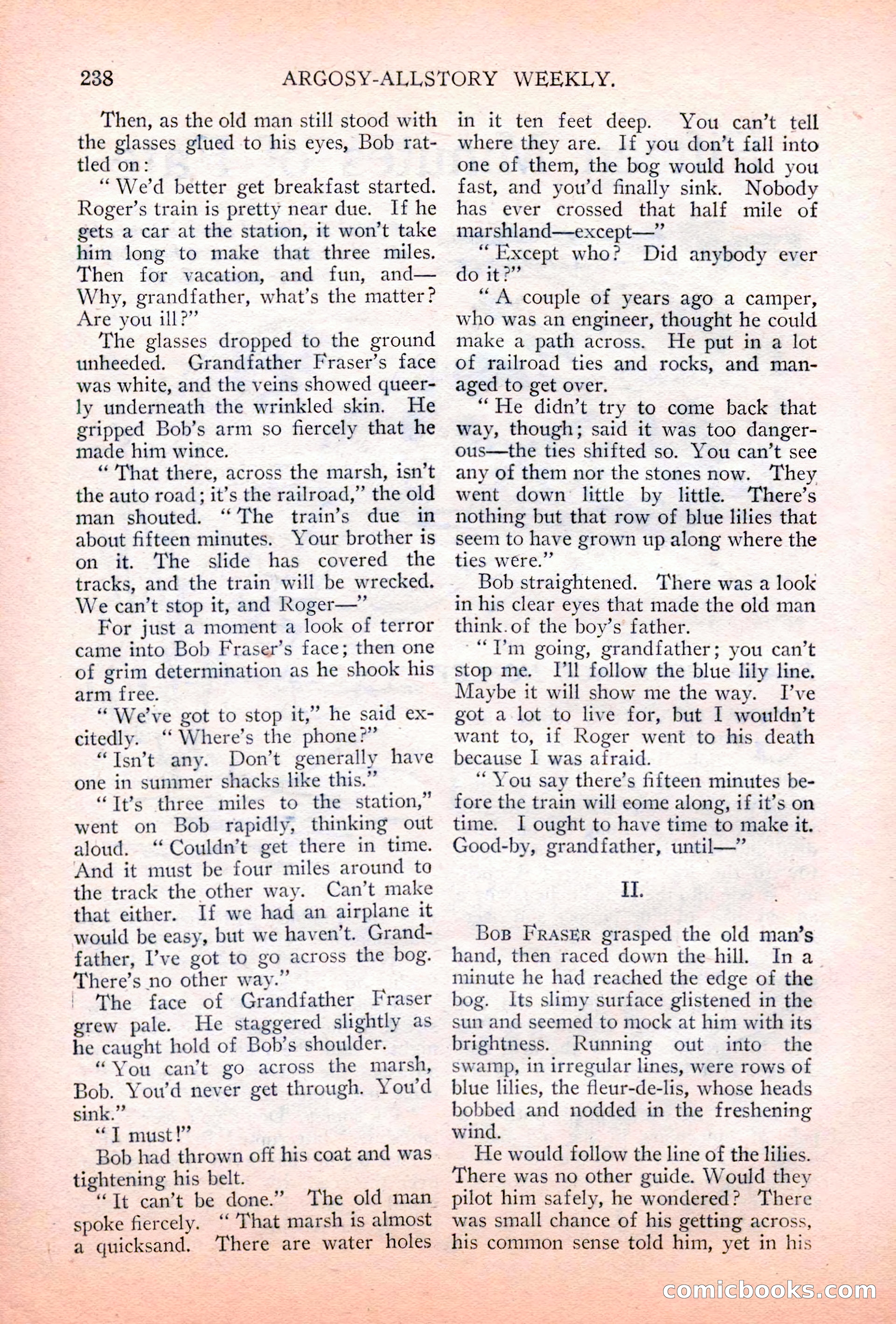
A restored page from Pulp Fiction, 1928. Page through the whole issue in the reader above.
📄 Transcribed text from this page (OCR, searchable)
Machine-transcribed from the original scan — historical spelling and the odd misread are preserved.
238 Then, as the old man still stood with the glasses glued to his eyes, Bob rat- tled on: “We'd better get breakfast started. Roger’s train is pretty near due. If he gets a car at the station, it won’t take him long to make that three miles. Then for vacation, and fun, and— Why, grandfather, what’s the matter? Are you ill?” The glasses dropped to the ground unheeded. Grandfather Fraser’s face was white, and the veins showed queer- ly underneath the wrinkled skin. He gripped Bob’s arm so fiercely that he made him wince. “That there, across the marsh, isn’t the auto road; it’s the railroad,” the old man shouted. “‘The train’s due in about fifteen minutes. Your brother is on it. The slide has covered the tracks, and the train will be wrecked. We can’t stop it, and Roger—” For just a moment a look of terror came into Bob Fraser’s face; then one of grim determination as he shook his arm free. “We've got to stop it,’ he said ex- citedly. “ Where’s the phone?” “Tsn’t any. Don’t generally have one in summer shacks like this.” “Tt’s three miles to the station,” went on Bob rapidly, thinking out aloud. ‘“ Couldn’t get there in time. And it must be four miles around to the track the other way. Can’t make that either. If we had an airplane it would be easy, but we haven’t. Grand- father, I’ve got to go across the bog. There’s no other way.” The face of Grandfather Fraser grew pale. He staggered slightly as he caught hold of Bob’s shoulder. “You can’t go across the marsh, Bob. You’d never get through. You'd sink.”’ “T must!” Bob had thrown off his coat and was tightening his belt. “Tt can’t be done.” spoke fiercely. ‘‘ That marsh is almost a quicksand. There are water holes The old man ARGOSY-ALLSTORY WEEKLY. in it ten feet deep. where they are. If you don’t fall into one of them, the bog would hold you fast, and you'd finally sink. Nobody has ever crossed that half mile of marshland—except—” “Except who? Did anybody ever do it?” “A couple of years ago a camper, who was an engineer, thought he could make a path across. He put in a lot of railroad ties and rocks, and man- aged to get over. “He didn’t try to come back that way, though; said it was too danger- ous—the ties shifted so. You can’t see any of them nor the stones now. They went down little by little. There’s nothing but that row of blue lilies that seem to have grown up along where the ties were.” Bob straightened. There was a look in his clear eyes that made the old man think.of the boy’s father. “Tm going, grandfather; you can’t stop me. I'll follow the blue lily line. Maybe it will show me the way. I’ve got a lot to live for, but I wouldn’t want to, if Roger went to his death because I was afraid. ‘You say there’s fifteen minutes be- fore the train will eome along, if it’s on time. I ought to have time to make it. Good-by, grandfather, until—” II. Bos Fraser grasped the old man’s hand, then raced down the hill. Ina minute he had reached the edge of the bog. Its slimy surface glistened in the sun and seemed to mock at him with its brightness. Running out into the swainp, in irregular lines, were rows of blue lilies, the fleur-de-lis, whose heads bobbed and nodded in the freshening wind. He would follow the line of the lilies. There was no other guide. Would they pilot him safely, he wondered? There was small chance of his getting across, his common sense told him, yet in his You can’t tell (EOWA COMNIEIOOKS