
Pulp Fiction, 1928 · page 96 of 150
Argosy All-Story Weekly, July 7, 1928 — page 96: what you’re looking at
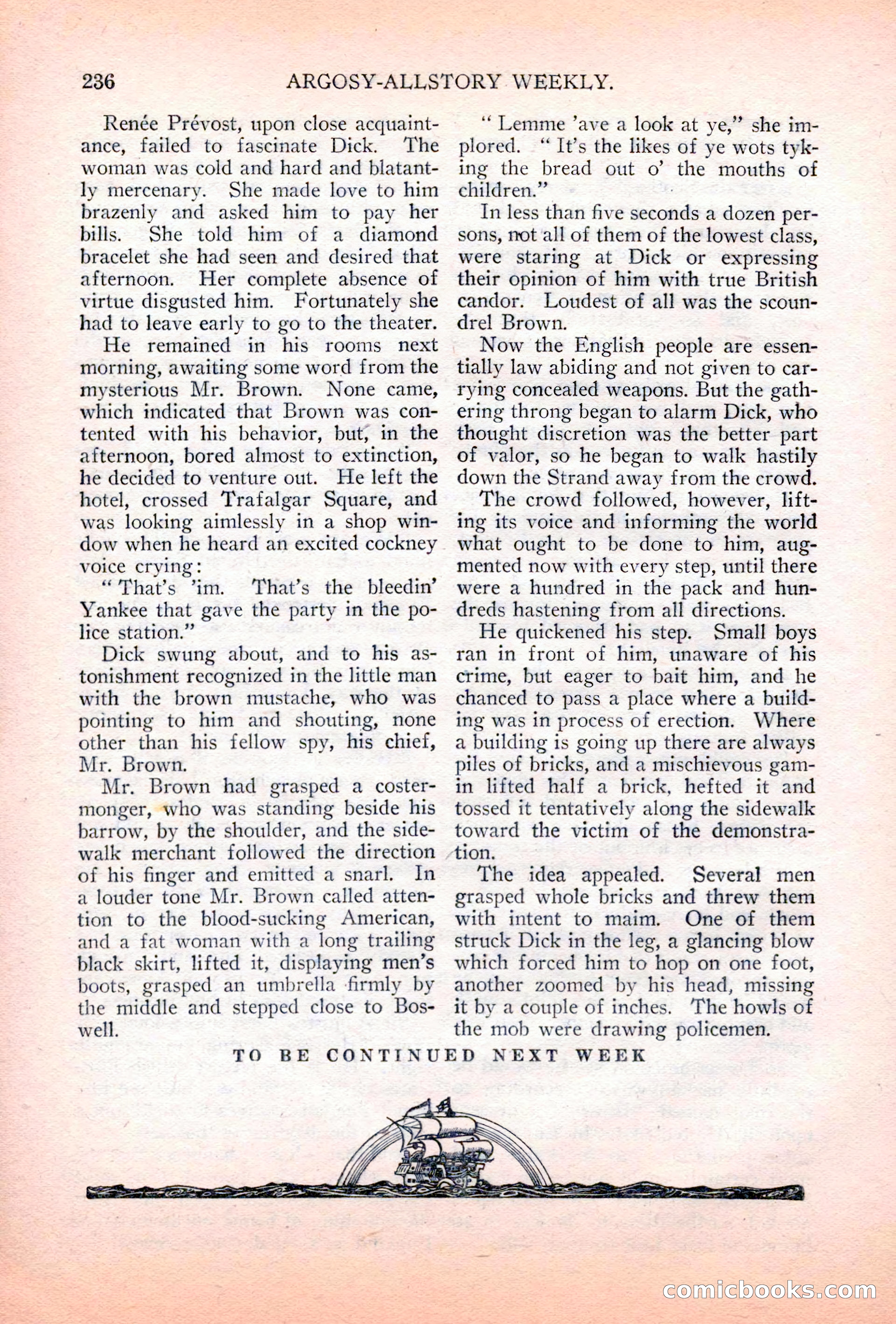
A restored page from Pulp Fiction, 1928. Page through the whole issue in the reader above.
📄 Transcribed text from this page (OCR, searchable)
Machine-transcribed from the original scan — historical spelling and the odd misread are preserved.
236 Renée Prévost, upon close acquaint- ance, failed to fascinate Dick. The woman was cold and hard and blatant- ly mercenary. She made love to him brazenly and asked him to pay her bills. She told him of a diamond bracelet she had seen and desired that afternoon. Her complete absence of virtue disgusted him. Fortunately she had to leave early to go to the theater. He remained in his rooms next morning, awaiting some word from the mysterious Mr. Brown. None came, which indicated that Brown was con- tented with his behavior, but, in the afternoon, bored almost to extinction, he decided to venture out. He left the hotel, crossed Trafalgar Square, and was looking aimlessly in a shop win- dow when he heard an excited cockney voice crying: “That’s ’im. That’s the bleedin’ Yankee that gave the party in the po- lice station.” Dick swung about, and to his as- tonishment recognized in the little man with the brown mustache, who was pointing to him and shouting, none other than his fellow spy, his chief, Mr. Brown. Mr. Brown had grasped a coster- monger, who was standing beside his barrow, by the shoulder, and the side- walk merchant followed the direction of his finger and emitted a snarl. In a louder tone Mr. Brown called atten- tion to the blood-sucking American, and a fat woman with a long trailing black skirt, lifted it, displaying men’s boots, grasped an umbrella firmly by the middle and stepped close to Bos- well. ARGOSY-ALLSTORY WEEKLY. “Lemme ’ave a look at ye,” she im- plored. “It’s the likes of ye wots tyk- ing the bread out o’ the mouths of children.” 7 In less than five seconds a dozen per- sons, mot all of them of the lowest class, were staring at Dick or expressing their opinion of him with true British candor. Loudest of all was the scoun- drel Brown. Now the English people are essen- tially law abiding and not given to car- rying concealed weapons. But the gath- ering throng began to alarm Dick, who thought discretion was the better part of valor, so he began to walk hastily down the Strand away from the crowd. The crowd followed, however, lift- ing its voice and informing the world what ought to be done to him, aug- mented now with every step, until there were a hundred in the pack and hun- dreds hastening from all directions. He quickened his step. Small boys ran in front of him, unaware of his crime, but eager to bait him, and he chanced to pass a place where a build- ing was in process of erection. Where a building is going up there are always piles of bricks, and a mischievous gam- in lifted half a brick, hefted it and tossed it tentatively along the sidewalk toward the victim of the demonstra- tion. The idea appealed. Several men grasped whole bricks and threw them with intent to maim. One of them struck Dick in the leg, a glancing blow which forced him to hop on one foot, another zoomed by his head, missing it by a couple of inches. ‘The howls of the mob were drawing policemen. TO BE CONTINUED NEXT WEEK (COPMICOOOKS (E@)