
Pulp Fiction, 1928 · page 61 of 150
Argosy All-Story Weekly, July 7, 1928 — page 61: what you’re looking at
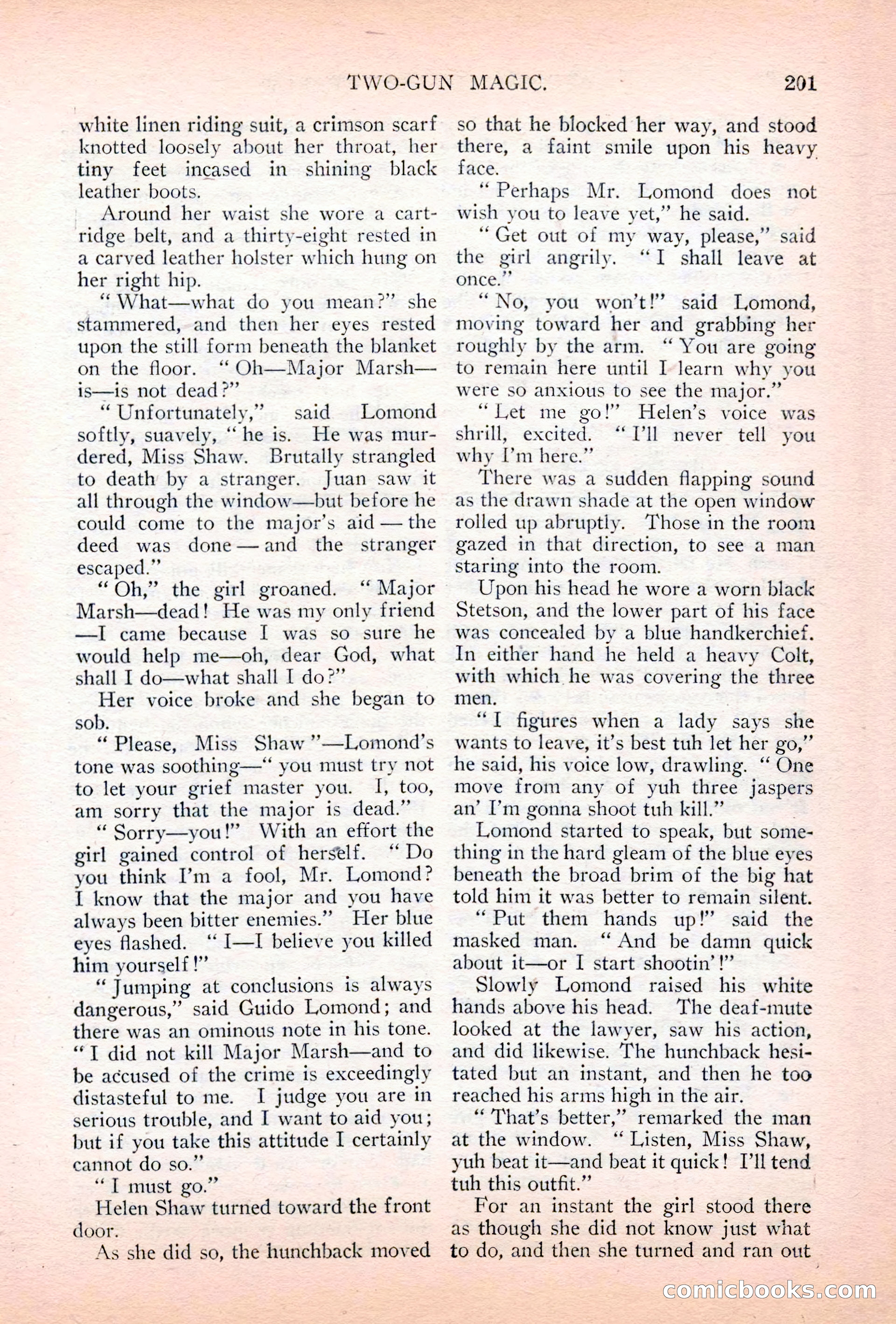
A restored page from Pulp Fiction, 1928. Page through the whole issue in the reader above.
📄 Transcribed text from this page (OCR, searchable)
Machine-transcribed from the original scan — historical spelling and the odd misread are preserved.
TWO-GUN MAGIC. white linen riding suit, a crimson scarf knotted loosely about her throat, her tiny feet incased in shining black leather boots. Around her waist she wore a cart- ridge belt, and a thirty-eight rested in a carved leather holster which hung on her right hip. “ What—what do you mean?” she stammered, and then her eyes rested upon the still form beneath the blanket on the floor. ‘ Oh—Major Marsh— is—is not dead?” “Unfortunately,” said Lomond softly, suavely, “he is. He was mur- dered, Miss Shaw. Brutally strangled to death by a stranger. Juan saw it all through the window—but before he could come to the major’s aid — the deed was done—and the stranger escaped.” “Oh,” the girl groaned. “ Major Marsh—dead! He was my only friend —I came because I was so sure he would help me—oh, dear God, what shall I do—what shall [I do?” Her voice broke and she began to sob. “ Please, Miss Shaw ”—Lomond’s tone was soothing—*‘ you must try not to let your grief master you. I, too, am sorry that the major is dead.” “ Sorry—you!” With an effort the girl gained control of herself. “ Do you think I’m a fool, Mr. Lomond? I know that the major and you have always been bitter enemies.” Her blue eyes flashed. ‘“ I—I believe you killed him yourself!” “Jumping at conclusions is always dangerous,” said Guido Lomond; and there was an ominous note in his tone. “T did not kill Major Marsh—and to be accused of the crime is exceedingly distasteful to me. I judge you are in serious trouble, and I want to aid you; but if you take this attitude I certainly cannot do so.” ‘“T must go.” Helen Shaw turned toward the front door. As she did so, the hunchback moved 201 so that he blocked her way, and stood there, a faint smile upon his heavy face. “Perhaps Mr. Lomond does not wish you to leave yet,” he said. ‘Get out of my way, please,” said the girl angrily. “I shall leave at once.” “No, you won't!” said Lomond, moving toward her and grabbing her roughly by the arm. ‘“ You are going to remain here until I learn why you were so anxious to see the major.” “Tet me go!” Helen’s voice was shrill, excited. “Tl never tell you why I[’m here.” There was a sudden flapping sound as the drawn shade at the open window rolled up abruptly. Those in the room gazed in that direction, to see a man staring into the room. Upon his head he wore a worn black Stetson, and the lower part of his face was concealed by a blue handkerchief. In either hand he held a heavy Colt, with which he was covering the three men. 2 “TI figures when a lady says she wants to leave, it’s best tuh let her go,” he said, his voice low, drawling. “ One move from any of yuh three jaspers an’ [’m gonna shoot tuh kill.” : Lomond started to speak, but some- thing in the hard gleam of the blue eyes beneath the broad brim of the big hat told him it was better to remain silent. “Put them hands up!” said the masked man. “ And be damn quick about it—or I start shootin’!” Slowly Lomond raised his white hands above his head. ‘The deaf-mute looked at the lawyer, saw his action, and did likewise. The hunchback hesi- tated but an instant, and then he too reached his arms high in the air. *’That’s better,” remarked the man at the window. ‘“ Listen, Miss Shaw, yuh beat it—and beat it quick! [ll tend tuh this outfit.” | For an instant the girl stood there as though she did not know just what to do, and then she turned and ran out COPNICLOOOKS (E@)