
Pulp Fiction, 1928 · page 59 of 150
Argosy All-Story Weekly, July 7, 1928 — page 59: what you’re looking at
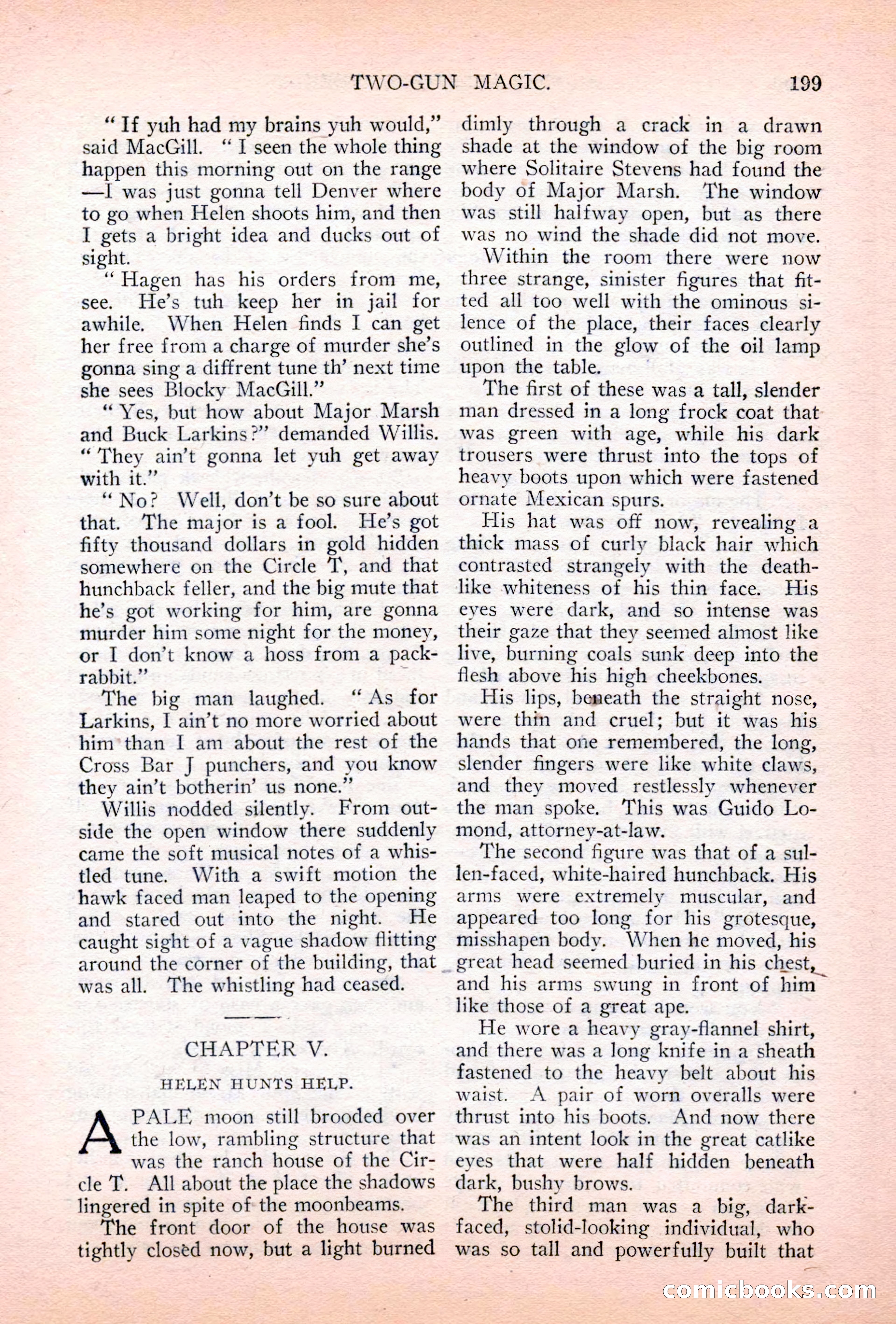
A restored page from Pulp Fiction, 1928. Page through the whole issue in the reader above.
📄 Transcribed text from this page (OCR, searchable)
Machine-transcribed from the original scan — historical spelling and the odd misread are preserved.
TWO-GUN MAGIC. “Tf yuh had my brains yuh would,” said MacGill. “I seen the whole thing happen this morning out on the range —I was just gonna tell Denver where to go when Helen shoots him, and then I gets a bright idea and ducks out of sight. “Hagen has his orders from me, see. He’s tuh keep her in jail for awhile. When Helen finds I can get her free from a charge of murder she’s gonna sing a diffrent tune th’ next time she sees Blocky MacGill.” “Yes, but how about Major Marsh and Buck Larkins?’ demanded Willis. “They ain’t gonna let yuh get away with it.” “No? Well, don’t be so sure about that. The major is a fool. He’s got fifty thousand dollars in gold hidden somewhere on the Circle TI, and that hunchback feller, and the big mute that he’s got working for him, are gonna murder him some night for the money, or I don’t know a hoss from a pack- rabbit.” The big man laughed. “ As for Larkins, I ain’t no more worried about him’ than I am about the rest of the Cross Bar J punchers, and you know they ain’t botherin’ us none.” Willis nodded silently. From out- side the open window there suddenly came the soft musical notes of a whis- tled tune. With a swift motion the hawk faced man leaped to the opening and stared out into the night. He caught sight of a vague shadow flitting around the corner of the building, that. was all. The whistling had ceased. CHAPTER V. HELEN HUNTS HELP. PALE moon still brooded over the low, rambling structure that was the ranch house of the Cir- cle T. All about the place the shadows lingered in spite of the moonbeams. The front door of the house was tightly closed now, but a light burned 199 dimly through a crack in a drawn shade at the window of the big room where Solitaire Stevens had found the body of Major Marsh. ‘The window was still halfway open, but as there was no wind the shade did not move. Within the room there were now three strange, sinister figures that fit- ted all too well with the ominous si- lence of the place, their faces clearly outlined in the glow of the oil lamp upon the table. 3 The first of these was a tall, slender man dressed in a long frock coat that was green with age, while his dark trousers were thrust into the tops of heavy boots upon which were fastened ornate Mexican spurs. His hat was off now, revealing a thick mass of curly black hair which contrasted strangely with the death- like whiteness of his thin face. His eyes were dark, and so intense was their gaze that they seemed almost like live, burning coals sunk deep into the flesh above his high cheekbones. His lips, bemeath the straight nose, were thin and cruel; but it was his hands that one remembered, the long, slender fingers were like white claws, and they moved restlessly whenever the man spoke. This was Guido Lo- mond, attorney-at-law. The second figure was that of a sul- len-faced, white-haired hunchback. His arms were extremely muscular, and appeared too long for his grotesque, misshapen body. When he moved, his great head seemed buried in his chest and his arms swung in front of him like those of a great ape. He wore a heavy gray-flannel shirt, and there was a long knife in a sheath fastened to the heavy belt about his waist. A pair of worn overalls were thrust into his boots. And now there was an intent look in the great catlike eyes that were half hidden beneath dark, bushy brows. The third man was a big, dark- faced, stolid-looking individual, who was so tall and powerfully built that COPMIGEG OOO KS (F@)