
Pulp Fiction, 1928 · page 35 of 150
Argosy All-Story Weekly, July 7, 1928 — page 35: what you’re looking at
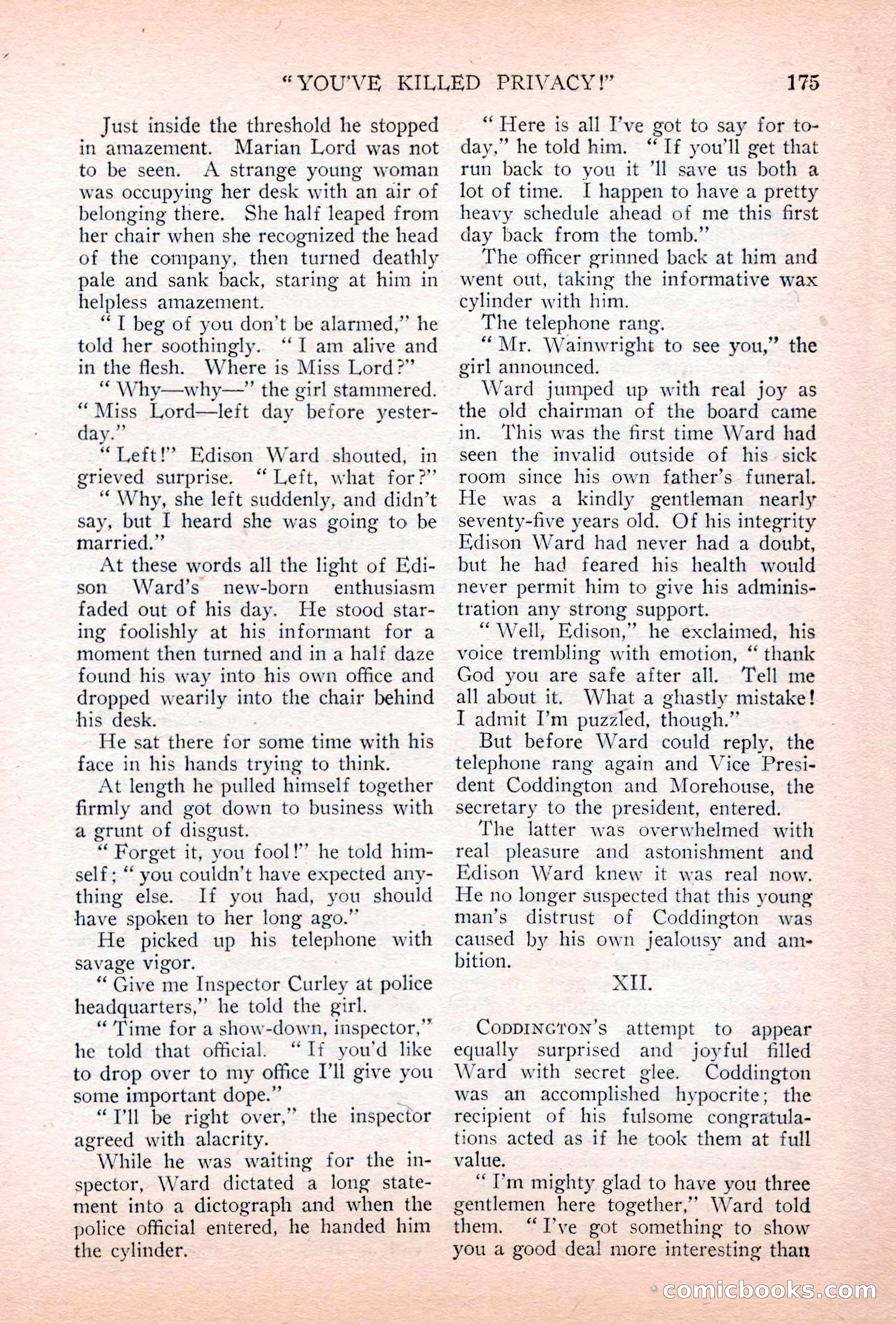
A restored page from Pulp Fiction, 1928. Page through the whole issue in the reader above.
📄 Transcribed text from this page (OCR, searchable)
Machine-transcribed from the original scan — historical spelling and the odd misread are preserved.
“YOU'VE KILLED -PRIVACY!” Just inside the threshold he stopped in amazement. Marian Lord was not to be seen. A strange young woman was occupying her desk with an air of belonging there. She half leaped from her chair when she recognized the head of the company, then turned deathly pale and sank back, staring at him in helpless amazement. “T beg of you don’t be alarmed,” he told her soothingly. “‘[ am alive and in the flesh. Where is Miss Lord?” “ Why—why—’” the girl stammered. “Miss Lord—left day before yester- day.” “Left!” Edison Ward shouted, in grieved surprise. “ Left, what for?” “Why, she left suddenly, and didn’t say, but [ heard she was going to be married.” At these words all the light of Edi- son Ward's new-born’ enthusiasm faded out of his day. He stood star- ing foolishly at his informant for a moment then turned and in a half daze found his way into his own office and dropped wearily into the chair behind his desk. 7 He sat there for some time with his face in his hands trying to think. At length he pulled himself together firmly and got down to business with a grunt of disgust. “ Forget it, you fool!’’ he told him- self; “ you couldn’t have expected any- thing else. If you had, you should have spoken to her long ago.” He picked up his telephone with savage vigor. “‘ Give me Inspector Curley at police headquarters,” he told the girl. “Time for a show-down, inspector,” he told that official. “If you'd like to drop over to my office [ll give you some important dope.” “T’ll be right over,” the inspector agreed with alacrity. While he was waiting for the in- spector, Ward dictated a long state- ment into a dictograph and when the police official entered, he handed him the cylinder. 175 “Here is all I’ve got to say for to- day,” he told him. “If you'll get that run back to you it ‘Il save us both a lot of time. I happen to have a pretty heavy schedule ahead of me this first day back from the tomb.” The officer grinned back at him and went out, taking the informative wax cylinder with him. The telephone rang. “Mr. Wainwright to see you,” the girl announced. Ward jumped up with real joy as the old chairman of the board came in. ‘This was the first time Ward had seen the invalid outside of his sick room since his own father’s funeral. He was a kindly gentleman nearly seventy-five years old. Of his integrity Edison Ward had never had a doubt, but he had feared his health would never permit him to give his adminis- tration any strong support. “Well, Edison,” he exclaimed, his voice trembling with emotion, “ thank God you are safe after all. Tell me all about it. What a ghastly mistake! IT admit I’m puzzled, though.” But before Ward could reply, the telephone rang again and Vice Presi- dent Coddington and Morehouse, the secretary to the president, entered. The latter was overwhelmed with real pleasure and astonishment and Edison Ward knew it was real now. He no longer suspected that this young man’s distrust of Coddington was caused by his own jealousy and am- bition. XIT. CoODDINGTON’s attempt to appear equally surprised and joyful filled Ward with secret glee. Coddington was an accomplished hypocrite; the recipient of his fulsome congratula- tions acted as if he took them at full value. “[’m mighty glad to have you three gentlemen here together,’ Ward told them. “Tve got something to show you a good deal more interesting than CONNIE LOOKS (C@)