
Pulp Fiction, 1928 · page 18 of 150
Argosy All-Story Weekly, July 7, 1928 — page 18: what you’re looking at
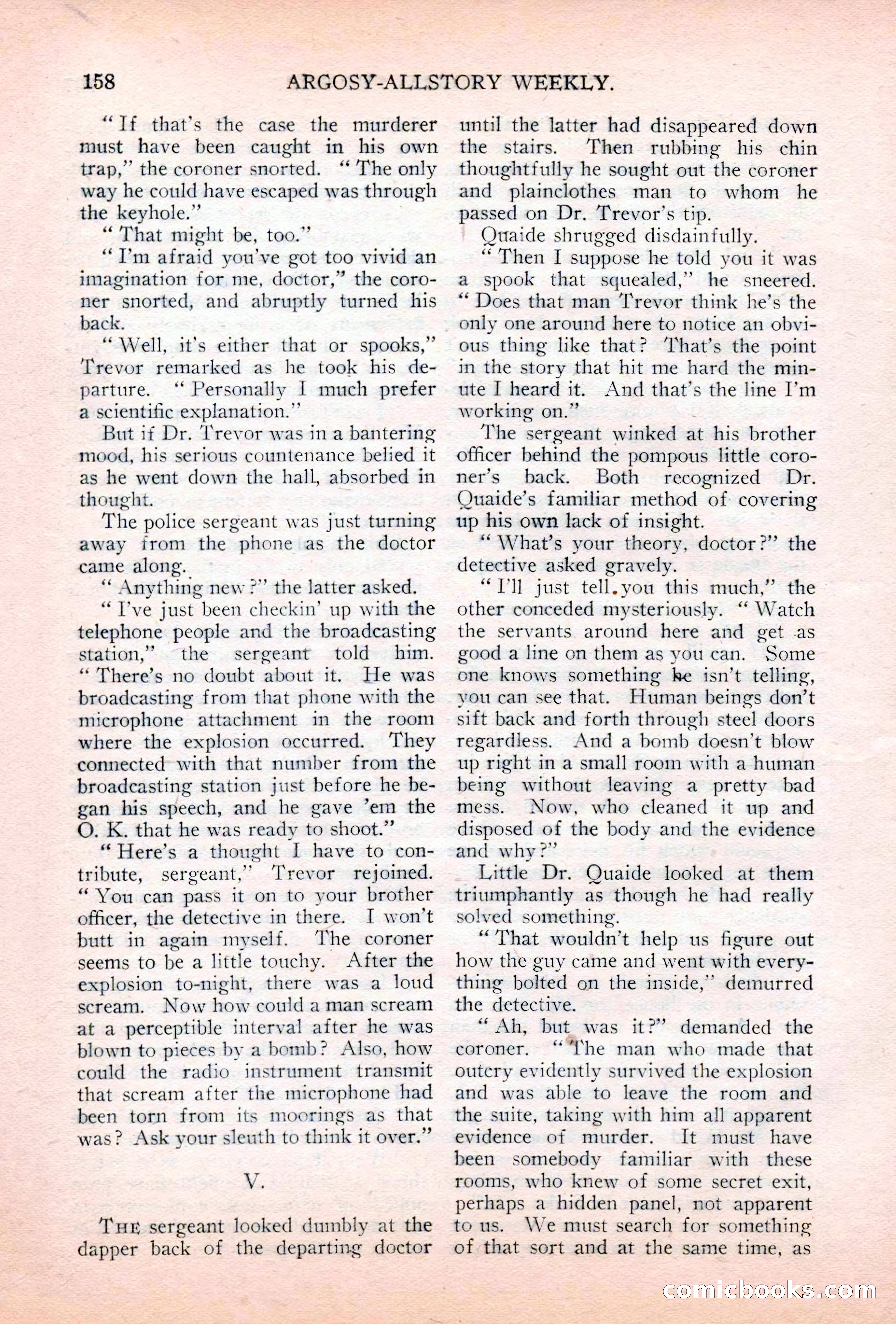
A restored page from Pulp Fiction, 1928. Page through the whole issue in the reader above.
📄 Transcribed text from this page (OCR, searchable)
Machine-transcribed from the original scan — historical spelling and the odd misread are preserved.
158 “Tf that’s the case the murderer must have been caught in his own trap,” the coroner snorted. ‘“‘ The only way he could have escaped was through the keyhole.” “That might be, too.” “I’m afraid you’ve got too vivid an imagination for me, doctor,” the coro- ner snorted, and abruptly turned his back. ‘Well, it’s either that or spooks,” Trevor remarked as he took his de- parture. ‘* Personally I much prefer a scientific explanation.” But if Dr. Trevor was in a bantering mood, his serious countenance belied it as he went down the hall, absorbed in thought. The police sergeant was just turning away from the phone as the doctor came along. ‘“« Anything new ?” the latter asked. “T’ve just been checkin’ up with the telephone people and the broadcasting station,” the sergeant told him. “ There’s no doubt about it. He was broadcasting from that phone with the microphone attachment in the room where the explosion occurred. They connected with that number from the broadcasting station just before he be- gan his speech, and he gave ’em the ©. K. that he was ready to shoot.” “ Here’s a thought I have to con- tribute, sergeant,’ Trevor rejoined. “ You can pass it on to your brother officer, the detective in there. I won't butt in again myself. The coroner seems to be a little touchy. After the explosion to-night, there was a loud scream. Now how could a man scream at a perceptible interval after he was blown to pieces by a bomb? Also, how could the radio instrument transmit that scream after the microphone had been torn from its moorings as that was? Ask your sleuth to think it over.” V. THE sergeant looked dumbly at the dapper back of the departing doctor ARGOSY-ALLSTORY WEEKLY. until the latter had disappeared down the stairs. Then rubbing his chin thoughtfully he sought out the coroner and plainclothes man to whom he passed on Dr. Trevor’s tip. Ortaide shrugged disdainfully. “Then I suppose he told you it was a spook that squealed,” he sneered. ** Does that man Trevor think he’s the only one around here to notice an obvi- ous thing like that? That’s the point in the story that hit me hard the min- ute I heard it. And that’s the line I’m working on.” The sergeant winked at his brother officer behind the pompous little coro- ner’s back. Both recognized Dr. Quaide’s familiar method of. covering up his own lack of insight. “What’s your theory, doctor?” the detective asked gravely. “Tl just tell.you this much,” the other conceded mysteriously. ‘‘ Watch the servants around here and get .as good a line on them as you can. Some one knows something ke isn’t telling, you can see that. Human beings don’t sift back and forth through steel doors regardless. And a bomb doesn’t blow up right in a small room with a human being without leaving a pretty bad mess. Now, who cleaned it up and disposed of the body and the evidence and why?” Little Dr. Quaide looked at them triumphantly as though he had really solved something. “That wouldn't help us figure out how the guy came and went with every- thing bolted on the inside,” demurred the detective. “Ah, but was it?” demanded the coroner. “ The man who made that outcry evidently survived the explosion and was able to leave the room and the suite, taking with him all apparent evidence of murder. It must have been somebody familiar with these rooms, who knew of some secret exit, perhaps a hidden panel, not apparent to us. We must search for something of that sort and at the same time, as COPMICGLOOOKS (E©)