
Pulp Fiction, 1928 · page 15 of 150
Argosy All-Story Weekly, July 7, 1928 — page 15: what you’re looking at
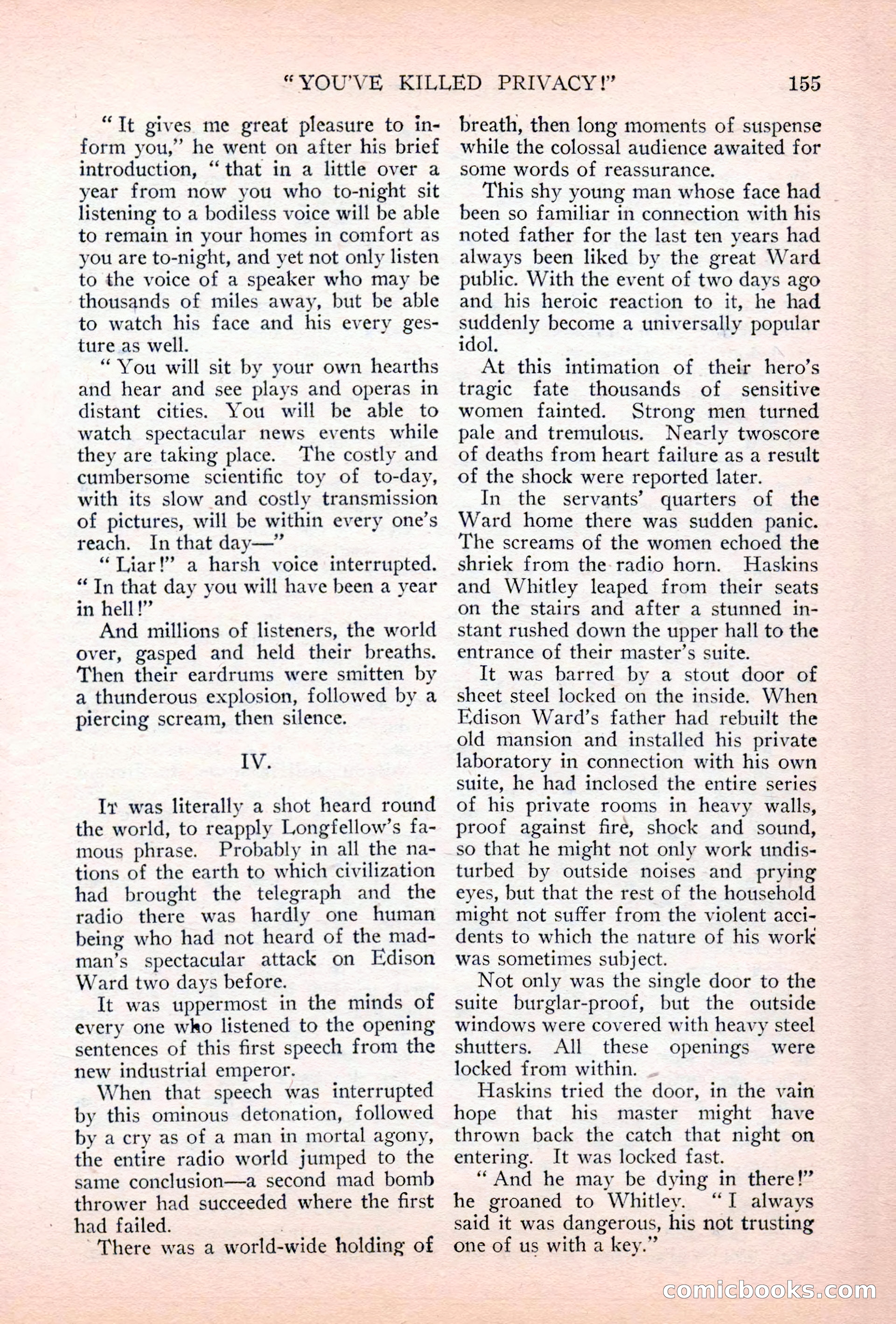
A restored page from Pulp Fiction, 1928. Page through the whole issue in the reader above.
📄 Transcribed text from this page (OCR, searchable)
Machine-transcribed from the original scan — historical spelling and the odd misread are preserved.
“YOU'VE KILLED PRIVACY!” “Tt gives me great pleasure to in- form you,” he went on after his brief introduction, “ that in a little over a year from now you who to-night sit listening to a bodiless voice will be able to remain in your homes in comfort as you are to-night, and yet not only listen to the voice of a speaker who may be thousands of miles away, but be able to watch his face and his every ges- ture as well. “You will sit by your own hearths and hear and see plays and operas in distant cities. You will be able to watch spectacular news events while they are taking place. The costly and cumbersome scientific toy of to-day, with its slow and costly transmission of pictures, will be within every one’s reach. In that day—” “Liar!” a harsh voice interrupted. “Tn that day you will have been a year in hell!” And millions of listeners, the world over, gasped and held their breaths. Then their eardrums were smitten by a thunderous explosion, followed by a piercing scream, then silence. IV. Ir was literally a shot heard round the world, to reapply Longfellow’s fa- mous phrase. Probably in all the na- tions of the earth to which civilization had brought the telegraph and the radio there was hardly one human being who had not heard of the mad- man’s spectacular attack on Edison Ward two days before. It was uppermost in the minds of every one wko listened to the opening sentences of this first speech from the new industrial emperor. When that speech was interrupted by this ominous detonation, followed by a cry as of a man in mortal agony, the entire radio world jumped to the same conclusion—a second mad bomb thrower had succeeded where the first had failed. : There was a world-wide holding of 155 breath, then long moments of stispense while the colossal audience awaited for some words of reassurance. This shy young man whose face had been so familiar in connection with his noted father for the last ten years had always been liked by the great Ward public. With the event of two days ago and his heroic reaction to it, he had suddenly become a universally popular idol. At this intimation of their hero’s tragic fate thousands of sensitive women fainted. Strong men turned pale and tremulous. Nearly twoscore of deaths from heart failure as a result of the shock were reported later. In the servants’ quarters of the Ward home there was sudden panic. The screams of the women echoed the shriek from the radio horn. Haskins and Whitley leaped from their seats on the stairs and after a stunned in- stant rushed down the upper hall to the entrance of their master’s suite. It was barred by a stout door of sheet steel locked on the inside. When Edison Ward’s father had rebuilt the old mansion and installed his private laboratory in connection with his own suite, he had inclosed the entire series of his private rooms in heavy walls, proof against fire, shock and sound, so that he might not only work undis- turbed by outside noises and prying eyes, but that the rest of the household might not suffer from the violent acci- dents to which the nature of his work was sometimes subject. Not only was the single door to the suite burglar-proof, but the outside windows were covered with heavy steel shutters. All these openings were locked from within. Haskins tried the door, in the vain hope that his master might have thrown back the catch that night on entering. It was locked fast. “And he may be dying in there!” he groaned to Whitley. “I always said it was dangerous, his not trusting one of us with a key.” Gomichbooks (E@)