
Pulp Fiction, 1928 · page 122 of 150
Argosy All-Story Weekly, July 7, 1928 — page 122: what you’re looking at
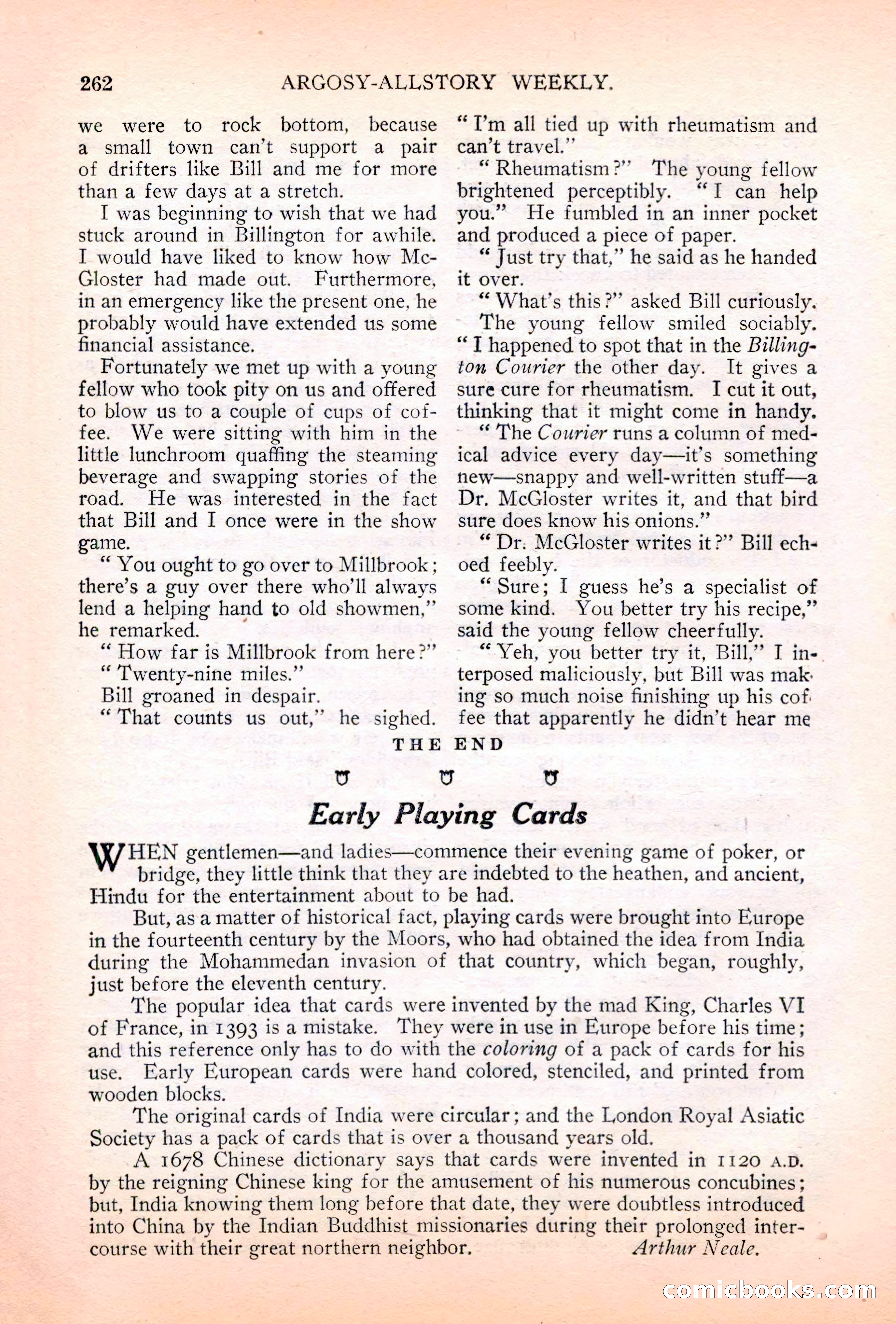
A restored page from Pulp Fiction, 1928. Page through the whole issue in the reader above.
📄 Transcribed text from this page (OCR, searchable)
Machine-transcribed from the original scan — historical spelling and the odd misread are preserved.
262 we were to rock bottom, because a small town can’t support a pair of drifters like Bill and me for more than a few days at a stretch. I was beginning to wish that we had stuck around in Billington for awhile. I would have liked to know how Mc- Gloster had made out. Furthermore, in an emergency like the present one, he probably would have extended us some financial assistance. Fortunately we met up with a young fellow who took pity on us and offered to blow us to a couple of cups of cof- fee. We were sitting with him in the little lunchroom quaffing the steaming beverage and swapping stories of the road. He was interested in the fact that Bill and I once were in the show game. “You ought to go over to Millbrook; there’s a guy over there who'll always lend a helping hand to old showmen,” he remarked. “ How far is Millbrook from here?” “Twenty-nine miles.” Bill groaned in despair. “That counts us out,” he sighed. ARGOSY-ALLSTORY WEEKLY. “Tm all tied up with rheumatism and can’t travel.” “ Rheumatism?’ The young fellow brightened perceptibly. “I can help you.” He fumbled in an inner pocket and produced a piece of paper. “ Just try that,” he said as he handed it over. “What's this?” asked Bill curiously. The young fellow smiled sociably. “T happened to spot that in the Billing- ton Courier the other day. It gives a sure cure for rheumatism. I cut it out, thinking that it might come in handy. “ The Courier runs a column of med- ical advice every day—it’s something hew—snappy and well-written stuff—a Dr. McGloster writes it, and that bird sure does know his onions.”’ * Dr: McGloster writes it ?”’ Bill ech- oed feebly. “Sure; I guess he’s a specialist of some kind. You better try his recipe,” said the young fellow cheerfully. “Yeh, you better try it, Bill,” I in-. terposed maliciously, but Bill was mak: ing so much noise finishing up his cof: fee that apparently he didn’t hear me THE END Lv} u Early Playing Cards W HEN gentlemen—and ladies—commence their evening game of poker, or bridge, they little think that they are indebted to the heathen, and ancient, Hindu for the entertainment about to be had. But, asa matter of historical fact, playing cards were brought into Europe in the fourteenth century by the Moors, who had obtained the idea from India during the Mohammedan invasion of that country, which began, roughly, just before the eleventh century. The popular idea that cards were invented by the mad King, Charles VI of France, in 1393 is a mistake. They were in use in Europe before his time; and this reference only has to do with the coloring of a pack of cards for his use. wooden blocks. Early European cards were hand colored, stenciled, and printed from The original cards of India were circular; and the London Royal Asiatic Society has a pack of cards that is over a thousand years old. A 1678 Chinese dictionary says that cards were invented in 1120 A.D. by the reigning Chinese king for the amusement of his numerous concubines; but, India knowing them long before that date, they were doubtless introduced into China by the Indian Buddhist missionaries during their prolonged inter- course with their great northern neighbor, Arthur Neale. (e(0) NOOLKS AMUNG Con