
Pulp Fiction, 1928 · page 99 of 156
Argosy All-Story Weekly, May 5, 1928 — page 99: what you’re looking at
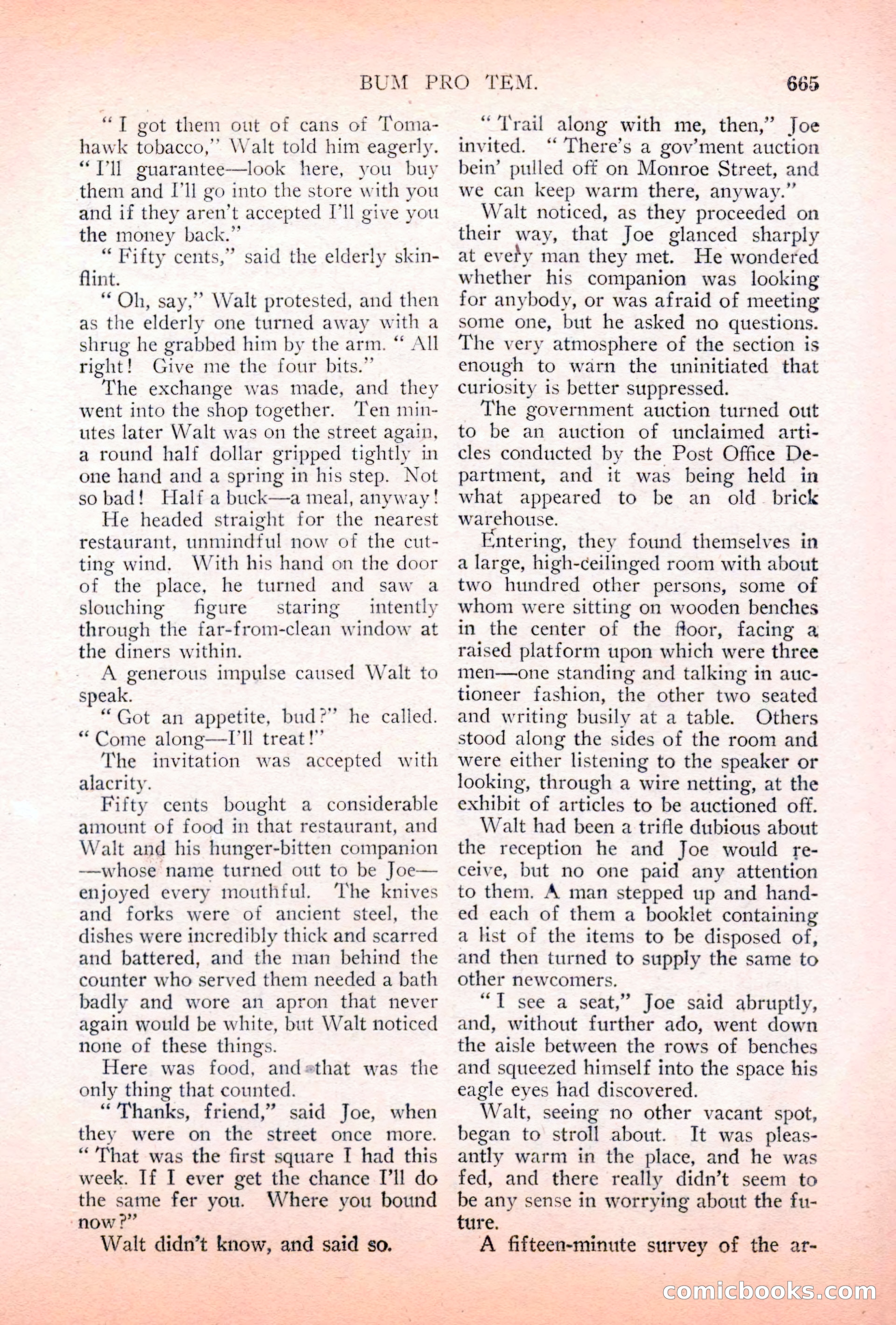
A restored page from Pulp Fiction, 1928. Page through the whole issue in the reader above.
📄 Transcribed text from this page (OCR, searchable)
Machine-transcribed from the original scan — historical spelling and the odd misread are preserved.
BUM PRO TEM. “T got them out of cans of Toma- hawk tobacco,” Walt told him eagerly. “Tl guarantee—look here, you buy them and I’ll go into the store with you and if they aren't accepted I'll give you the money back.” “Tifty cents,” said the elderly skin- flint. “Oh, say,” Walt protested, and then as the elderly one turned away with a shrug he grabbed him by the arm. “ All right! Give me the four bits.” The exchange was made, and they went into the shop together. Ten min- utes later Walt was on the street again, a round half dollar gripped tightly in one hand and a spring in his step. Not so bad! Half a buck—a meal, anyway! He headed straight for the nearest restaurant, unmindful now of the cut- ting wind. With his hand on the door of the place, he turned and saw a slouching figure staring intently through the far-from-clean window at the diners within. A generous impulse caused Walt to speak. “Got an appetite, bud?” he called. “Come along—l’ll treat!’ The invitation was accepted with alacrity. Fifty cents bought a considerable amount of food in that restaurant, and Walt and his hunger-bitten companion ——whose name turned out to be Joe— enjoyed every mouthful. The knives and forks were of ancient steel, the dishes were incredibly thick and scarred and battered, and the man behind the counter who served them needed a bath badly and wore an apron that never again would be white, but Walt noticed none of these things. Here was food, andethat was the only thing that counted. “Thanks, friend,” said Joe, when they were on the street once more. “That was the first square I had this week. If I ever get the chance [ll do the same fer you. Where you bound ‘now P” Walt didn’t know, and said so. 665 “Trail along with me, then,’ Joe invited. ‘“ There’s a gov’ment auction bein’ pulled off on Monroe Street, and we can keep warm there, anyway.” Walt noticed, as they proceeded on their way, that Joe glanced sharply at evely man they met. He wondered whether his companion was looking for anybody, or was afraid of meeting some one, but he asked no questions. The very atmosphere of the section is enough to warn the uninitiated that curiosity is better suppressed. The government auction turned out to be an auction of unclaimed arti- cles conducted by the Post Office De- partment, and it was being held in what appeared to be an old_ brick warehouse. Entering, they found themselves in a large, high-ceilinged room with about two hundred other persons, some of whom were sitting on wooden benches in the center of the floor, facing a raised platform upon which were three men—one standing and talking in auc- tioneer fashion, the other two seated and writing busily at a table. Others stood along the sides of the room and were either listening to the speaker or looking, through a wire netting, at the exhibit of articles to be auctioned off. Walt had been a trifle dubious about the reception he and Joe would re- ceive, but no one paid any attention to them. A man stepped up and hand- ed each of them a booklet containing a list of the items to be disposed of, and then turned to supply the same to other newcomers. “T see a seat,” Joe said abruptly, and, without further ado, went down the aisle between the rows of benches and squeezed himself into the space his eagle eves had discovered. Walt, seeing no other vacant spot, began to stroll about. It was pleas- antly warm in the place, and he was fed, and there really didn’t seem to be any sense in worrying about the fu- ture. A fifteen-minute survey of the ar- (E00) DOOKS MAI (C@)