
Pulp Fiction, 1928 · page 61 of 156
Argosy All-Story Weekly, May 5, 1928 — page 61: what you’re looking at
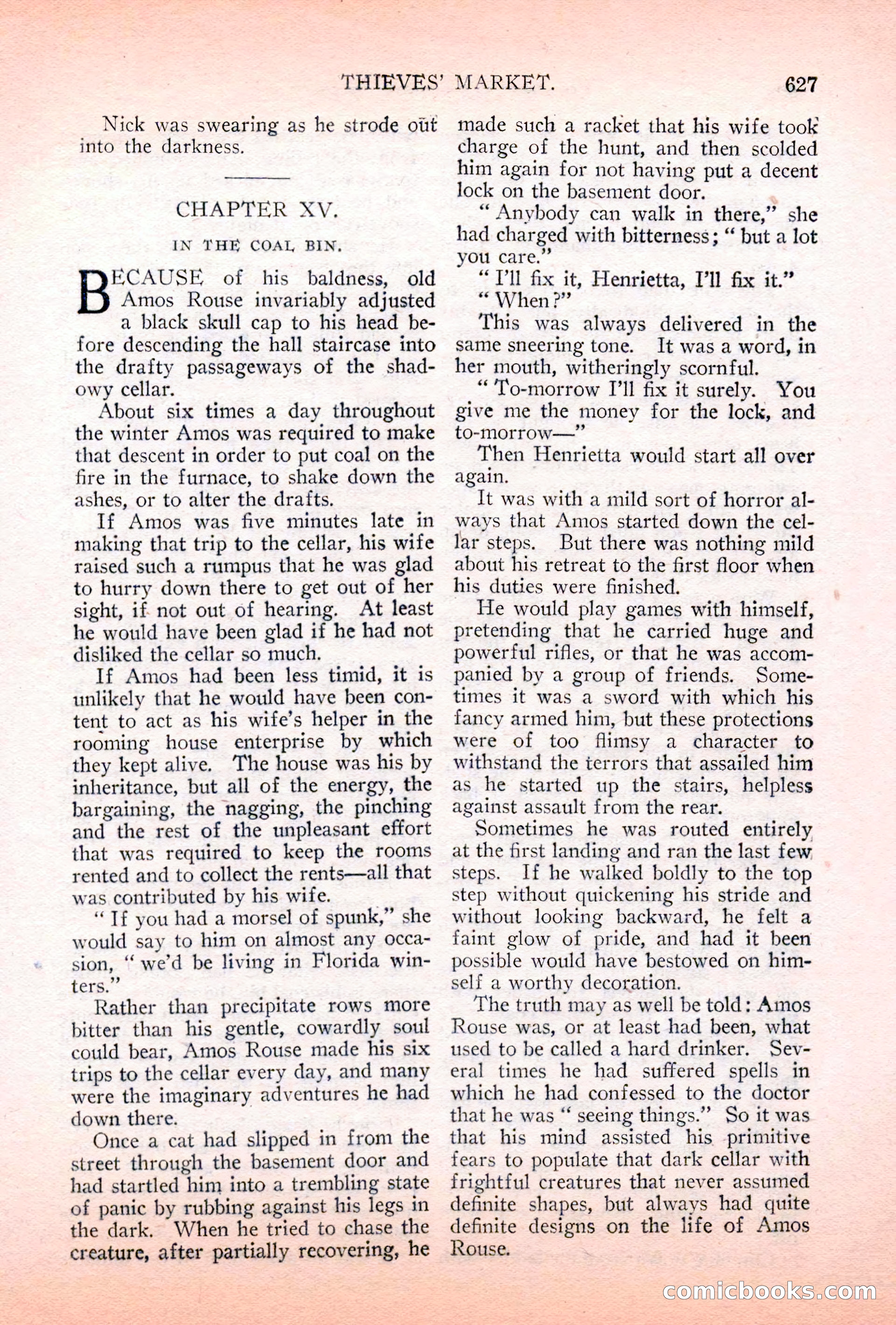
A restored page from Pulp Fiction, 1928. Page through the whole issue in the reader above.
📄 Transcribed text from this page (OCR, searchable)
Machine-transcribed from the original scan — historical spelling and the odd misread are preserved.
THIEVES’ MARKET. Nick was swearing as he strode otit into the darkness. CHAPTER XV, IN THE COAL BIN, ECAUSE of his baldness, old Amos Rouse invariably adjusted a black skull cap to his head be- fore descending the hall staircase into the drafty passageways of the shad- owy cellar. About six times a day throughout the winter Amos was required to make that descent in order to put coal on the fire in the furnace, to shake down the ashes, or to alter the drafts. If Amos was five minutes late in making that trip to the cellar, his wife raised such a rumpus that he was glad to hurry down there to get out of her sight, if not out of hearing. At least he would have been glad if he had not disliked the cellar so much. If Amos had been less timid, it is unlikely that he would have been con- tent to act as his wife’s helper in the rooming house enterprise by which they kept alive. The house was his by inheritance, but all of the energy, the bargaining, the nagging, the pinching and the rest of the unpleasant effort that was required to keep the rooms rented and to collect the rents—all that was contributed by his wife. 7 “Tf you had a morsel of spunk,” she would say to him on almost any occa- sion, ‘‘ we'd be living in Florida win- ters.” Rather than precipitate rows more bitter than his gentle, cowardly soul could bear, Amos Rouse made his six trips to the cellar every day, and many were the imaginary adventures he had down there. Once a cat had slipped in from the street through the basement door and had startled him into a trembling state of panic by rubbing against his legs in the dark. When he tried to chase the creature, after partially recovering, he 627 made such a racket that his wife took charge of the hunt, and then scolded him again for not having put a decent lock on the basement door. “Anybody can walk in there,” she had charged with bitterness; “ but a lot you care.” “Tl fix it, Henrietta, I’) fix it.” ** When ?” This was always delivered in the same sneering tone. It was a word, in her mouth, witheringly scornful. “To-morrow I’ll fix it surely. You give me the money for the lock, and to-morrow—” Then Henrietta would start all over again. It was with a mild sort of horror al- ways that Amos started down the cel- lar steps. But there was nothing mild about his retreat to the first floor when his duties were finished. He would play games with himself, pretending that he carried huge and powerful rifles, or that he was accom- panied by a group of friends. Some- times it was a sword with which his fancy armed him, but these protections were of too flimsy a character to withstand the terrors that assailed him as he started up the stairs, helpless against assault from the rear. Sometimes he was routed entirely at the first landing and ran the last few steps. If he walked boldly to the top step without quickening his stride and without looking backward, he felt a faint glow of pride, and had it been possible would have bestowed on him- self a worthy decoration. The truth may as well be told: Amos Rouse was, or at least had been, what used to be called a hard drinker. Sev- eral times he had suffered spells in which he had confessed to the doctor that he was “ seeing things.” So it was that his mind assisted his primitive fears to populate that dark cellar with frightful creatures that never assumed definite shapes, but always had quite definite designs on the life of Amos Rouse. (EOLA MCE DOOKS (EF)