
Pulp Fiction, 1928 · page 52 of 156
Argosy All-Story Weekly, May 5, 1928 — page 52: what you’re looking at
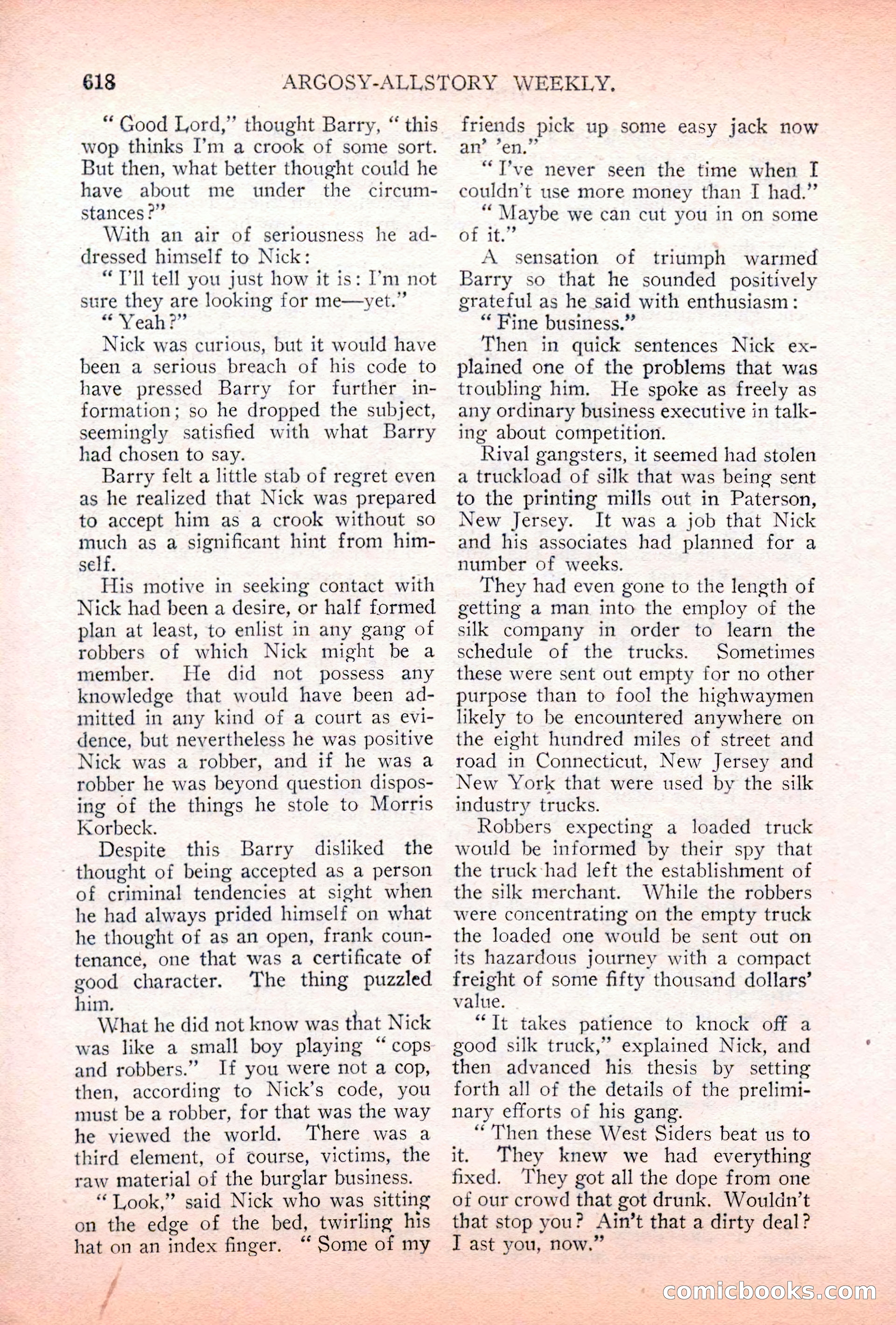
A restored page from Pulp Fiction, 1928. Page through the whole issue in the reader above.
📄 Transcribed text from this page (OCR, searchable)
Machine-transcribed from the original scan — historical spelling and the odd misread are preserved.
618 “ Good Lord,” thought Barry, “ this wop thinks I’m a crook of some sort. But then, what better thought could he have about me under the circum- stances?” With an air of seriousness he ad- dressed himself to Nick: “Tl tell you just how it is: I’m not sure they are looking for me—yet.” oY Cat Nick was curious, but it would have been a serious breach of his code to have pressed Barry for further in- formation; so he dropped the subject, seemingly satished with what Barry had chosen to say. Barry felt a little stab of regret even as he realized that Nick was prepared to accept him as a crook without so much as a significant hint from him- self. His motive in seeking contact with Nick had been a desire, or half formed plan at least, to enlist in any gang of robbers of which Nick might be a member. He did not possess any knowledge that would have been ad- mitted in any kind of a court as evi- dence, but nevertheless he was positive Nick was a robber, and if he was a robber he was beyond question dispos- ing of the things he stole to Morris Korbeck. Despite this Barry disliked the thought of being accepted as a person of criminal tendencies at sight when he had always prided himself on what he thought of as an open, frank coun- tenance, one that was a certificate of good character. ‘The thing puzzled him. What he did not know was that Nick was like a small boy playing “cops and robbers.” If you were not a cop, then, according to Nick’s code, you must be a robber, for that was the way he viewed the world. There was a third element, of course, victims, the raw material of the burglar business. “Look,” said Nick who was sitting on the edge of the bed, twirling his hat on an index finger. “ Some of my ARGOSY-ALLSTORY WEEKLY, friends pick up some easy jack now an’ ’en.” “T’ve never seen the time when I couldn’t use more money than I had.” “Maybe we can cut you in on some Of it. A sensation of triumph warmed Barry so that he sounded positively erateful as he said with enthusiasm: “Fine business.” Then in quick sentences Nick ex- plained one of the problems that was troubling him. He spoke as freely as any ordinary business executive in talk- ing about competition. Rival gangsters, it seemed had stolen a truckload of silk that was being sent to the printing mills out in Paterson, New Jersey. It was a job that Nick and his associates had planned for a number of weeks. They had even gone to the length of getting a man into the employ of the silk company in order to learn the schedule of the trucks. Sometimes these were sent out empty for no other purpose than to fool the highwaymen likely to be encountered anywhere on the eight hundred miles of street and road in Connecticut, New Jersey and New York that were used by the silk industry trucks. Robbers expecting a loaded truck would be informed by their spy that the truck had left the establishment of the silk merchant. While the robbers were concentrating on the empty truck the loaded one would be sent out on its hazardous journey with a compact freight of some fifty thousand dollars’ value. “It takes patience to knock off a good silk truck,” explained Nick, and then advanced his thesis by setting forth all of the details of the prelimi- nary efforts of his gang. “Then these West Siders beat us to it. They knew we had everything fixed. They got all the dope from one of our crowd that got drunk. Wouldn’t that stop you? Ain’t that a dirty deal? I ast you, now.” EOPMIG MOOKS (E@)