
Pulp Fiction, 1928 · page 44 of 156
Argosy All-Story Weekly, May 5, 1928 — page 44: what you’re looking at
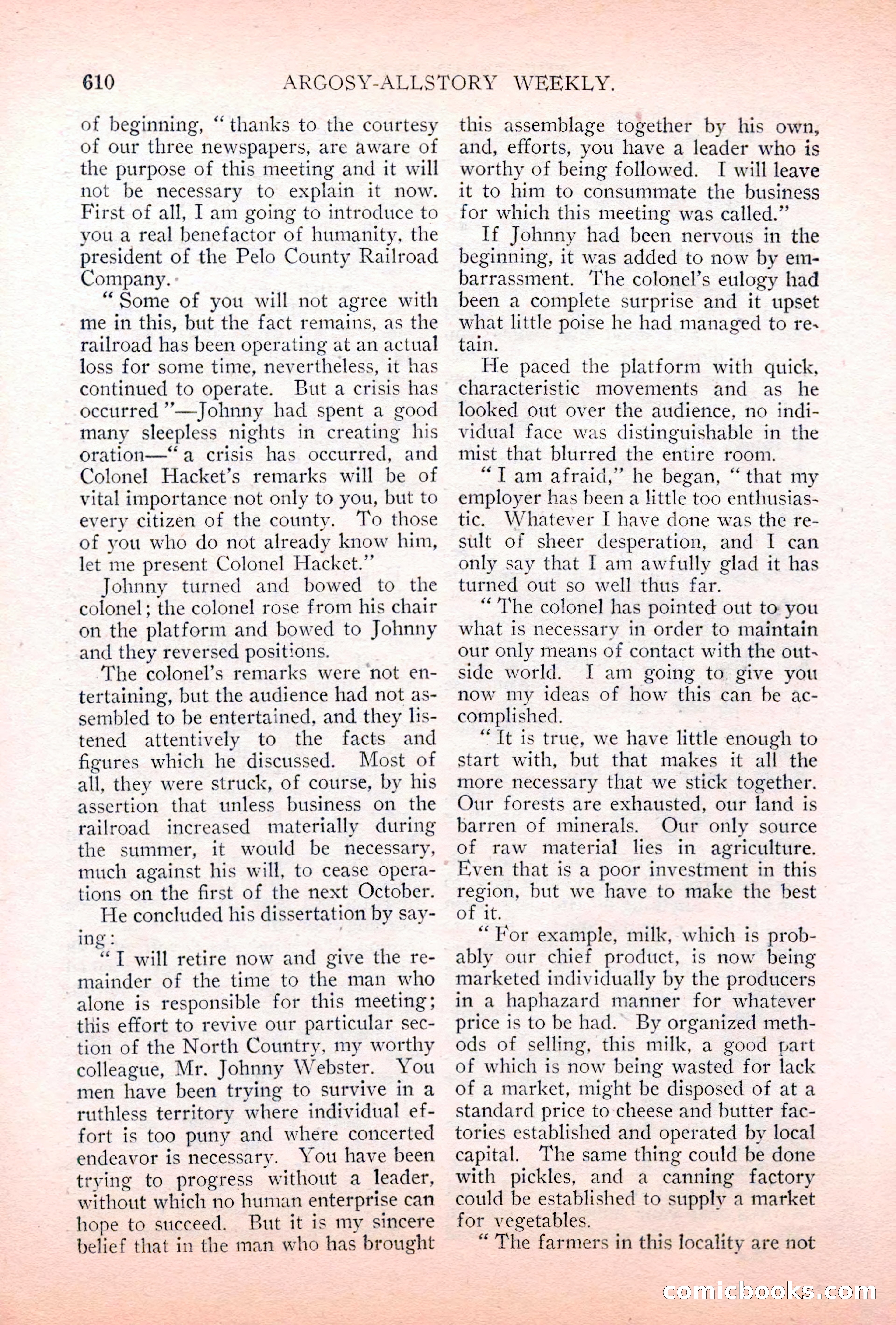
A restored page from Pulp Fiction, 1928. Page through the whole issue in the reader above.
📄 Transcribed text from this page (OCR, searchable)
Machine-transcribed from the original scan — historical spelling and the odd misread are preserved.
610 of beginning, “thanks to the courtesy of our three newspapers, are aware of the purpose of this meeting and it will not be necessary to explain it now. First of all, I am going to introduce to you a real benefactor of humanity, the president of the Pelo County Railroad Company. “Some of you will not agree with me in this, but the fact remains, as the railroad has been operating at an actual loss for some time, nevertheless, it has continued to operate. But a crisis has occurred ’’—Johnny had spent a good many sleepless nights in creating his oration—“a crisis has occurred, and Colonel Hacket’s remarks will be of vital importance not only to you, but to every citizen of the county. To those of you who do not already know him, let me present Colonel Hacket.”’ Johnny turned and bowed to the colonel; the colonel rose from his chair on the platform and bowed to Johnny and they reversed positions. The colonel’s remarks were not en- tertaining, but the audience had not as- sembled to be entertained, and they lis- tened attentively to the facts and figures which he discussed. Most of all, they were struck, of course, by his assertion that unless business on the railroad increased materially during the summer, it would be necessary, much against his will, to cease opera- tions on the first of the next October. He concluded his dissertation by say- ing: . “T will retire now and give the re- mainder of the time to the man who alone is responsible for this meeting; this effort to revive our particular sec- tion of the North Country, my worthy colleague, Mr. Johnny Webster. You men have been trying to survive in a ruthless territory where individual ef- fort is too puny and where concerted endeavor is necessary. You have been trying to progress without a leader, without which no human enterprise can hope to succeed. But it is my sincere belief that in the man who has brought ARGOSY-ALLSTORY WEEKLY. this assemblage together by his own, and, efforts, you have a leader who is worthy of being followed. I will leave it to him to consummate the business for which this meeting was called.” If Johnny had been nervous in the beginning, it was added to now by em- barrassment. The colonel’s eulogy had been a complete surprise and it upset what little poise he had managed to re. tain. He paced the platform with quick, characteristic movements and as he looked out over the audience, no indi- vidual face was distinguishable in the mist that blurred the entire room. “T am afraid,” he began, “ that my employer has been a little too enthusias- tic. Whatever I have done was the re- sult of sheer desperation, and I can only say that [ am awfully glad it has turned out so well thus far. “The colonel has pointed out to you what is necessarv in order to maintain our only means of contact with the out- side world. I am going to give you now my ideas of how this can be ac- complished. “Tt is true, we have little enough to start with, but that makes it all the more necessary that we stick together. Our forests are exhausted, our land is barren of minerals. Our only source of raw material lies in agriculture. Even that is a poor investment in this region, but we have to make the best of it. “For example, milk, which is prob- ably our chief product, is now being marketed individually by the producers in a haphazard manner for whatever price is to be had. By organized meth- ods of selling, this milk, a good part of which is now being wasted for lack of a market, might be disposed of at a standard price to cheese and butter fac- tories established and operated by local capital. The same thing could be done with pickles, and a canning factory could be established to supply a market for vegetables. “The farmers in this locality are not EOPMIELOOO KS (C@)