
Pulp Fiction, 1928 · page 35 of 156
Argosy All-Story Weekly, May 5, 1928 — page 35: what you’re looking at
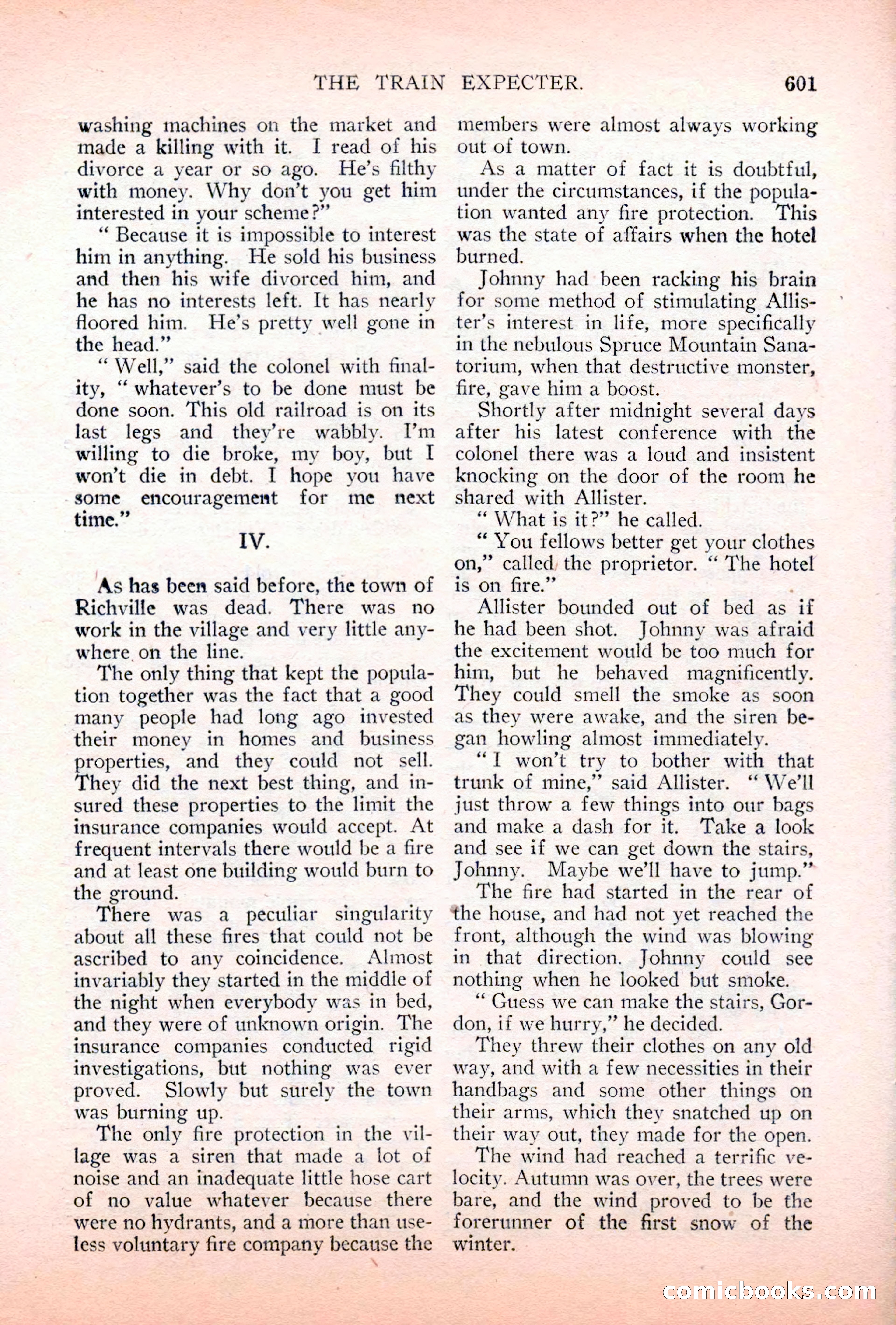
A restored page from Pulp Fiction, 1928. Page through the whole issue in the reader above.
📄 Transcribed text from this page (OCR, searchable)
Machine-transcribed from the original scan — historical spelling and the odd misread are preserved.
THE TRAIN washing machines on the market and made a killing with it. I read of his divorce a year or so ago. He’s filthy with money. Why don’t you get him interested in your scheme?” ‘“ Because it is impossible to interest him in anything. He sold his business and then his wife divorced him, and he has no interests left. [It has nearly floored him. He’s pretty well gone in the head.” “Well,” said the colonel with final- ity, “ whatever’s to be done must be done soon. This old railroad is on its last legs and they’re wabbly. [’m willing to die broke, my boy, but I won't die in debt. I hope you have some encouragement for me next time.” IV. As has been said before, the town of Richville was dead. There was no work in the village and very little any- where on the line. The only thing that kept the popula- tion together was the fact that a good many people had long ago invested their money in homes and _ business properties, and they could not sell. They did the next best thing, and in- sured these properties to the limit the insurance companies would accept. At frequent intervals there would be a fire and at least one building would burn to the ground. There was a peculiar singularity about all these fires that could not be ascribed to any coincidence. Almost invariably they started in the middle of the night when everybody was in bed, and they were of unknown origin. The insurance companies conducted rigid investigations, but nothing was ever proved. Slowly but surely the town was burning up. The only fire protection in the vil- lage was a siren that made a lot of noise and an inadequate little hose cart of no value whatever because there were no hydrants, and a more than use- less voluntary fire company because the \ EXPECTER. 601 members were almost always working out of town. As a matter of fact it is doubtful, under the circumstances, if the popula- tion wanted any fire protection. This was the state of affairs when the hotel burned. Johnny had been racking his brain for some method of stimulating Allis- ter’s interest in life, more specifically in the nebulous Spruce Mountain Sana- torium, when that destructive monster, fire, gave him a boost. Shortly after midnight several days after his latest conference with the colonel there was a loud and insistent knocking on the door of the room he shared with Allister. “ What is it?” he called. “ You fellows better get your clothes on,” called the proprietor. “ The hotel is on fire.” Allister bounded out of bed as if he had been shot. Johnny was afraid the excitement would be too much for him, but he behaved magnificently. They could smell the smoke as soon as they were awake, and the siren be- gan howling almost immediately. “T won’t try to bother with that trunk of mine,” said Allister. ‘“‘ We'll just throw a few things into our bags and make a dash for it. Take a look and see if we can get down the stairs, Johnny. Maybe we'll have to jump.” The fire had started in the rear of the house, and had not yet reached the front, although the wind was blowing in that direction. Johnny could see nothing when he looked but smoke. “Guess we can make the stairs, Gor- don, if we hurry,” he decided. They threw their clothes on any old way, and with a few necessities in their handbags and some other things on their arms, which they snatched up on their way out, they made for the open. The wind had reached a terrific ve- locity. Autumn was over, the trees were bare, and the wind proved to be the forerunner of the first snow of the winter. (E(0) .OO (E@)