
Pulp Fiction, 1928 · page 30 of 156
Argosy All-Story Weekly, May 5, 1928 — page 30: what you’re looking at
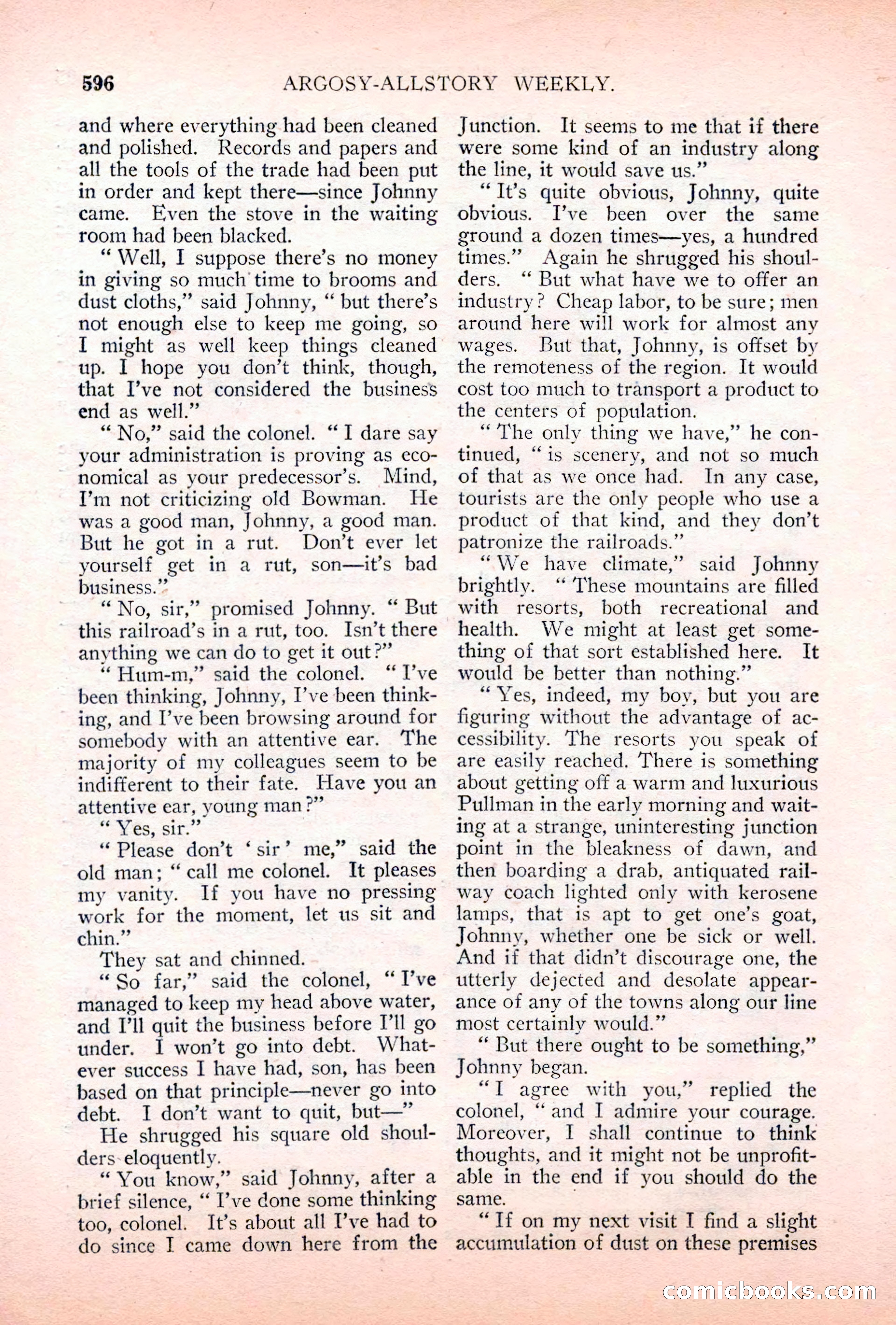
A restored page from Pulp Fiction, 1928. Page through the whole issue in the reader above.
📄 Transcribed text from this page (OCR, searchable)
Machine-transcribed from the original scan — historical spelling and the odd misread are preserved.
596 and where everything had been cleaned and polished. Records and papers and all the tools of the trade had been put in order and kept there—since Johnny came. Even the stove in the waiting room had been blacked. “Well, I suppose there’s no money in giving so much time to brooms and dust cloths,” said Johnny, “ but there’s not enough else to keep me going, so { might as well keep things cleaned up. I hope you don’t think, though, that I’ve not considered the business end as well.” “No,” said the colonel. “I dare say your administration is proving as eco- nomical as your predecessor’s. Mind, I’m not criticizing old Bowman. He was a good man, Johnny, a good man. But he got in a rut. Don’t ever let yourself get in a rut, son—it’s bad business.” “No, sir,” promised Johnny. “ But this railroad’s in a rut, too. Isn’t there anything we can do to get it out?” ‘‘Hum-m,” said the colonel. “I’ve been thinking, Johnny, I’ve been think- ing, and I’ve been browsing around for somebody with an attentive ear. The majority of my colleagues seem to be indifferent to their fate. Have you an attentive ear, young man?” eS. Str ‘Please don’t ‘sir’ me,” said the old man; “ call me colonel. It pleases my vanity. If you have no pressing work for the moment, let us sit and chin.” They sat and chinned. “So far,” said the colonel, “I’ve managed to keep my head above water, and I’ll quit the business before I’ll go under. JI won’t go into debt. What- ever success I have had, son, has been based on that principle—never go into debt. I don’t want to quit, but—” He shrugged his square old shoul- ders: eloquently. “You know,” said Johnny, after a brief silence, “ I’ve done some thinking too, colonel. It’s about all P’ve had to do since I came down here from the ARGOSY-ALLSTORY WEEKLY. Junction. It seems to me that if there were some kind of an industry along the line, it would save us.” “It’s quite obvious, Johnny, quite obvious. I’ve been over the same ground a dozen times—yes, a hundred times.” Again he shrugged his shoul- ders. “‘ But what have we to offer an industry? Cheap labor, to be sure; men around here will work for almost any wages. But that, Johnny, is offset by the remoteness of the region. It would cost too much to transport a product to the centers of population. “The only thing we have,” he con- tinued, “is scenery, and not so much of that as we once had. In any case, tourists are the only people who use a product of that kind, and they don’t patronize the railroads.” “We have climate,” said Johnny brightly. “‘ These mountains are filled with resorts, both recreational and health. We might at least get some- thing of that sort established here. It would be better than nothing.” “Yes, indeed, my boy, but you are figuring without the advantage of ac- cessibility. The resorts you speak of are easily reached. There is something about getting off a warm and luxurious Pullman in the early morning and wait- ing at a strange, uninteresting junction point in the bleakness of dawn, and then boarding a drab, antiquated rail- way coach lighted only with kerosene lamps, that is apt to get one’s goat, Johnny, whether one be sick or well. And if that didn’t discourage one, the utterly dejected and desolate appear- ance of any of the towns along our line most certainly would.” “ But there ought to be something,” Johnny began. “T agree with you,” replied the colonel, “and I admire your courage. Moreover, I shall continue to think thoughts, and it might not be unprofit- able in the end if you should do the same, | “Tf on my next visit I find a slight accumulation of dust on these premises (E00) DOO AAG <S) (F@)