
Pulp Fiction, 1928 · page 23 of 156
Argosy All-Story Weekly, May 5, 1928 — page 23: what you’re looking at
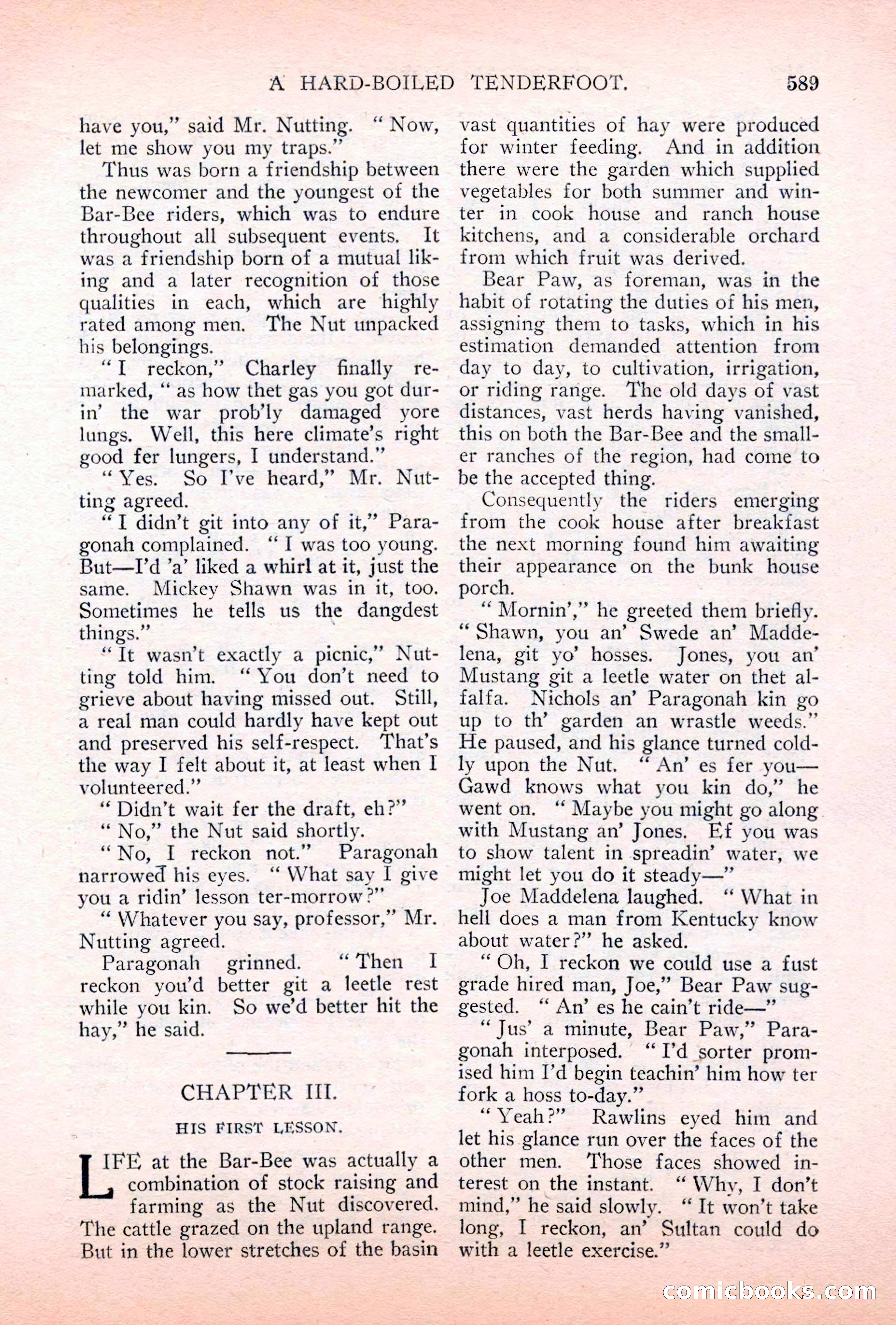
A restored page from Pulp Fiction, 1928. Page through the whole issue in the reader above.
📄 Transcribed text from this page (OCR, searchable)
Machine-transcribed from the original scan — historical spelling and the odd misread are preserved.
A HARD-BOILED have you,” said Mr. Nutting. “ Now, let me show you my traps.” Thus was born a friendship between the newcomer and the youngest of the Bar-Bee riders, which was to endure throughout all subsequent events. It was a friendship born of a mutual lik- ing and a later recognition of those qualities in each, which are highly rated among men. The Nut unpacked his belongings. “| reckon,” “Charley” finally re- marked, “ as how thet gas you got dur- in’ the war prob’ly damaged yore lungs. Well, this here climate’s right good fer lungers, I understand.” “Yes. So I’ve heard,” Mr. Nut- ting agreed. “T didn’t git into any of it,” Para- gonah complained. “I was too young. But—I’d ’a’ liked a whirl at it, just the same. Mickey Shawn was in it, too. Sometimes he tells us the dangdest things.” 3 “Tt wasn’t exactly a picnic,” Nut- ting told him. “ You don’t need to grieve about having missed out. Still, a real man could hardly have kept out and preserved his self-respect. That’s the way I felt about it, at least when | volunteered.” ‘“‘Didn’t wait fer the draft, eh?” “No,” the Nut said shortly. “No, I reckon not.” Paragonah narrowed his eyes. “‘ What say I give you a ridin’ lesson ter-morrow ?”’ “ Whatever you say, professor,” Mr. Nutting agreed. Paragonah grinned. “Then I reckon you'd better git a leetle rest while you kin. So we’d better hit the hay,” he said. CHAPTER III. HIS FIRST LESSON. IFE at the Bar-Bee was actually a combination of stock raising and farming as the Nut discovered. The cattle grazed on the upland range. But in the lower stretches of the basin TENDERFOOT. 589 vast quantities of hay were produced for winter feeding. And in addition there were the garden which supplied vegetables for both summer and win- ter in cook house and ranch house kitchens, and a considerable orchard from which fruit was derived. Bear Paw, as foreman, was in the habit of rotating the duties of his men, assigning them to tasks, which in his estimation demanded attention from day to day, to cultivation, irrigation, or riding range. The old days of vast distances, vast herds having vanished, this on both the Bar-Bee and the small- er ranches of the region, had come to be the accepted thing. Consequently the riders emerging from the cook house after breakfast the next morning found him awaiting their appearance on the bunk house porch. ‘“ Mornin’,” he greeted them briefly. “Shawn, you an’ Swede an’ Madde- lena, git yo’ hosses. Jones, you an’ Mustang git a leetle water on thet al- falfa. Nichols an’ Paragonah kin go up to th’ garden an wrastle weeds.” He paused, and his glance turned cold- ly upon the Nut. “ An’ es fer you— Gawd knows what you kin do,” he went on. “ Maybe you might go along with Mustang an’ Jones. Ef you was to show talent in spreadin’ water, we might let you do it steady—” Joe Maddelena laughed. ‘‘ What in hell does a man from Kentucky know about water?” he asked. “Oh, I reckon we could use a fust grade hired man, Joe,” Bear Paw sug- gested. “ An’ es he cain’t ride—” Jus’ a minute, Bear Paw,” Para- gonah interposed. “I'd sorter prom- ised him I’d begin teachin’ him how ter fork a hoss to-day.” “ Yeah?” Rawlins eyed him and let his glance run over the faces of the other men. ‘Those faces showed in- terest on the instant. ‘‘ Why, I don’t mind,” he said slowly. “ It won’t take long, I reckon, an’ Sultan could do with a leetle exercise.” (e(0) DOOKS mie (E@)