
Pulp Fiction, 1928 · page 9 of 148
Argosy All-Story Weekly, April 28, 1928 — page 9: what you’re looking at
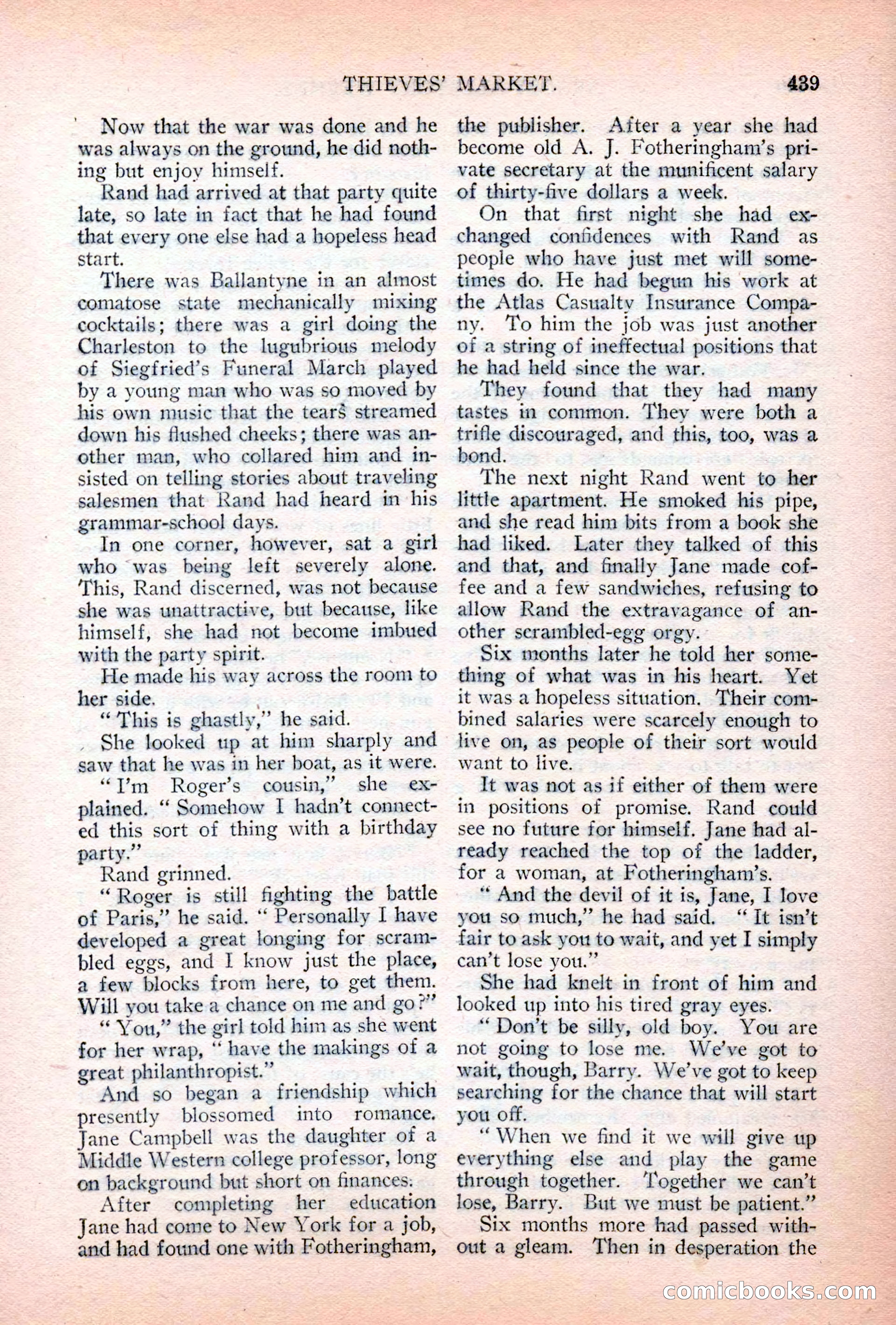
A restored page from Pulp Fiction, 1928. Page through the whole issue in the reader above.
📄 Transcribed text from this page (OCR, searchable)
Machine-transcribed from the original scan — historical spelling and the odd misread are preserved.
THIEVES’ Now that the war was done and he was always on the ground, he did noth- ing but enjoy himself. Rand had arrived at that party quite late, so late in fact that he had found that every one else had a hopeless head start. There was Ballantyne in an almost comatose state mechanically mixing cocktails; there was a girl doing the Charleston to the lugubrious melody of Siegfried’s Funeral March played by a young man who was so moved by his own music that the tears streamed down his flushed cheeks; there was an- other man, who collared him and in- sisted on telling stories about traveling salesmen that Rand had heard in his grammar-school days. In one corner, however, sat a girl who was being left severely alone. This, Rand discerned, was not because she was unattractive, but because, like himself, she had not become imbued with the party spirit. He made his way across the room to her side. “This is ghastly,” he said. _ She looked up at him sharply and saw that he was in her boat, as it were. “I’m Roger’s cousin,” she ex- plained. ‘“‘ Somehow I hadn’t connect- ed this sort of thing with a birthday party.” Rand grinned. “Roger is still fighting the battle of Paris,” he said. ‘‘ Personally I have developed a great longing for scram- bled eggs, and I know just the place, a few blocks from here, to get them. Will you take a chance on me and go?” “Vou,” the girl told him as she went for her wrap, “ have the makings of a great philanthropist.” . And so began a friendship which presently blossomed into romance, Jane Campbell was the daughter of a Middle Western college professor, long on background but short on finances. After completing her education Jane had come to New York for a job, and had found one with Fotheringham, MARKET. 439 the publisher. After a year she had become old A. J. Fotheringham’s pri- vate secretary at the munificent salary of thirty-five dollars a week. On that first night she had ex- changed confidences with Rand as people who have just met will some- times do. He had begun his work at the Atlas Casualtv Insurance Compa- ny. To him the job was just another of a string of ineffectual positions that he had held since the war. They found that they had many tastes in common. They were both a trifle discouraged, and this, too, was a bond. The next night Rand went to her little apartment. He smoked his pipe, and she read him bits from a book she had liked. Later they talked of this and that, and finally Jane made cof- fee and a few sandwiches, refusing to allow Rand the extravagance of an- other serambled-egg orgy. Six months later he told her some- thing of what was in his heart. Yet it was a hopeless situation. Their com- bined salaries were scarcely enough to live on, as people of their sort would want to live. It was not as if either of them were in positions of promise. Rand could see no future for himself. Jane had al- ready reached the top of the ladder, for a woman, at Fotheringham’s. “ And the devil of it is, Jane, I love you so much,” he had said. “It isn’t fair to ask you to wait, and yet I simply can’t lose you.” She had knelt in front of him and looked up into his tired gray eyes. “Don’t be silly, old boy. You are not going to lose me. We’ve got to wait, though, Barry. We've got to keep searching for the chance that will start you off. ‘When we find it we will give up everything else and play the game through together. ‘Together we can’t lose, Barry. But we must be patient.” Six months more had passed with- out a gleam. Then in desperation the EOPMICLOO© (C cS (E@)