
Pulp Fiction, 1928 · page 89 of 148
Argosy All-Story Weekly, April 28, 1928 — page 89: what you’re looking at
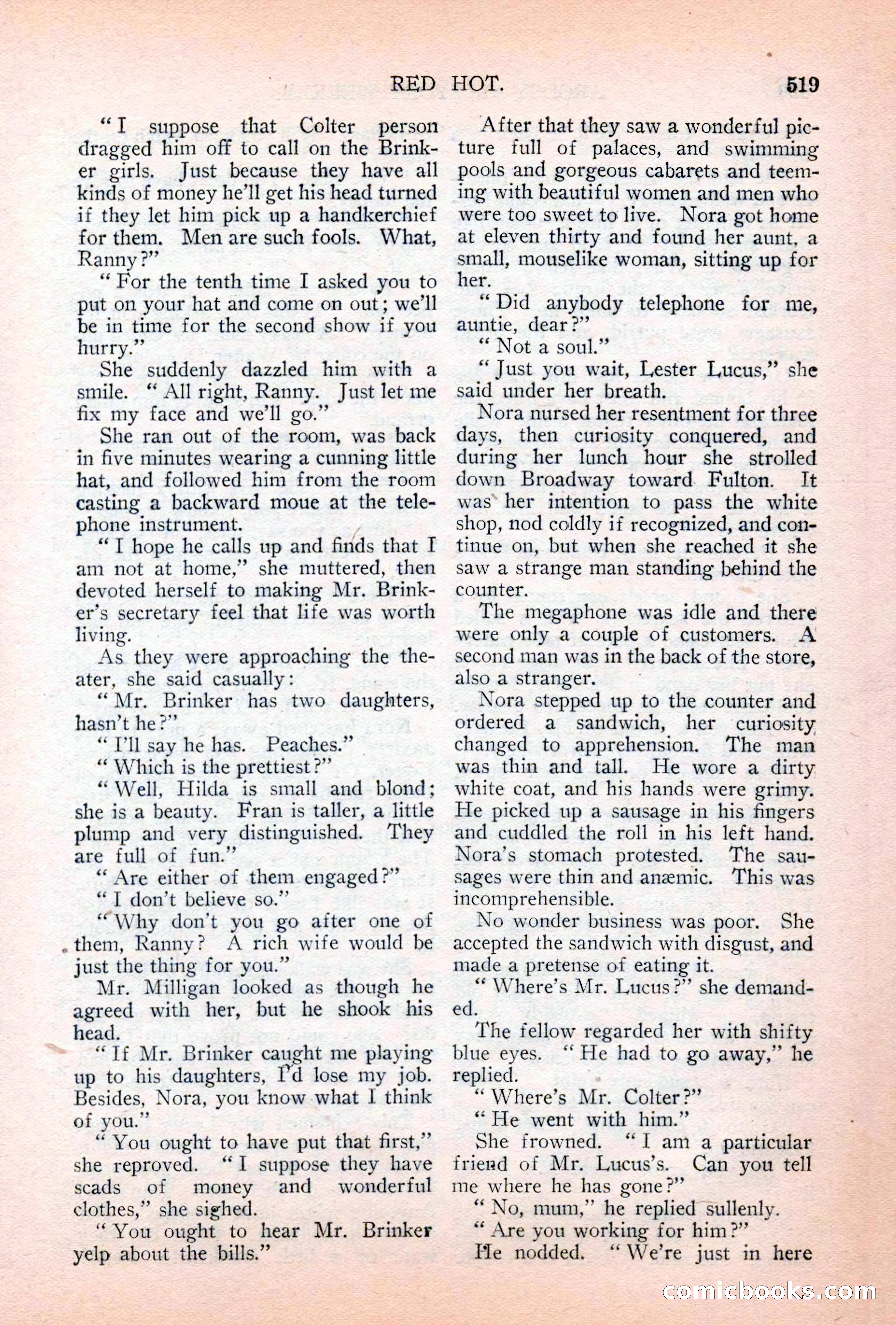
A restored page from Pulp Fiction, 1928. Page through the whole issue in the reader above.
📄 Transcribed text from this page (OCR, searchable)
Machine-transcribed from the original scan — historical spelling and the odd misread are preserved.
RED “T suppose that Colter person dragged him off to call on the Brink- er girls. Just because they have all kinds of money he’ll get his head turned if they let him pick up a handkerchief for them. Men are such fools. What, Ranny ?” “For the tenth time I asked you to put on your hat and come on out; we'll be in time for the second show if you hurry.” She suddenly dazzled him with a smile. “ All right, Ranny. Just let me fix my face and we'll go.” She ran out of the room, was back in five minutes wearing a cunning little hat, and followed him from the room casting a backward moue at the tele- phone instrument. “‘T hope he calls up and finds that I am not at home,” she muttered, then devoted herself to making Mr. Brink- er’s secretary feel that life was worth living. As they were approaching the the- ater, she said casually: “Mr. Brinker has two daughters, hasn’t he?” “ T’ll say he has. Peaches.” “ Which is the prettiest ?”’ “Well, Hilda is small and blond; she is a beauty. Fran is taller, a little plump and very distinguished. They are full of fun.” “ Are either of them engaged?” “| don’t believe so.” “Why don’t you go aiter one of them, Ranny? A rich wife would be just the thing for you.” Mr. Milligan looked as though he agreed with her, but he shook his head. “Tf Mr. Brinker caught me playing up to his daughters, I'd lose my job. Besides, Nora, you know what I think of you.” 7 “You ought to have put that first,” she reproved. “1 suppose they have scads of money and _ wonderful clothes,” she sighed. “You ought to hear Mr. Brinker yelp about the bills.” HOT. 519 After that they saw a wonderful pic- ture full of palaces, and swimming pools and gorgeous cabarets and teem- ing with beautiful women and men who were too sweet to live. Nora got home at eleven thirty and found her aunt, a iat mouselike woman, sitting up for er. “Did anybody telephone for me, auntie, dear?” * Not a soul.” “Just you wait, Lester Lucus,” she said under her breath. Nora nursed her resentment for three days, then curiosity conquered, and during her lunch hour she strolled down Broadway toward Fulton. It was’ her intention to pass the white shop, nod coldly if recognized, and con- tinue on, but when she reached it she saw a strange man standing behind the counter. The megaphone was idle and there were only a couple of customers. A second man was in the back of the store, also a stranger. Nora stepped up to the counter and ordered a sandwich, her curiosity changed to apprehension. The man was thin and tall. He wore a dirty white coat, and his hands were grimy. He picked up a sausage in his fingers and cuddled the roll in his left hand. Nora’s stomach protested. The sau- sages were thin and anemic. This was incomprehensible. No wonder business was poor. She accepted the sandwich with disgust, and made a pretense of eating it. “ Where’s Mr. Lucus?” she demand- ed. The fellow regarded her with shifty blue eyes. “‘ He had to go away,” he replied. “Where’s Mr. Colter?” “He went with him.” She frowned. “I am a particular friead of Mr. Lucus’s. Can you tell ime where he has gone?” “No, mum,” he replied sullenly. “ Are you working for him?” Fie nodded. “‘ We're just in here COPMICLOOOKS (E@)