
Pulp Fiction, 1928 · page 55 of 148
Argosy All-Story Weekly, April 28, 1928 — page 55: what you’re looking at
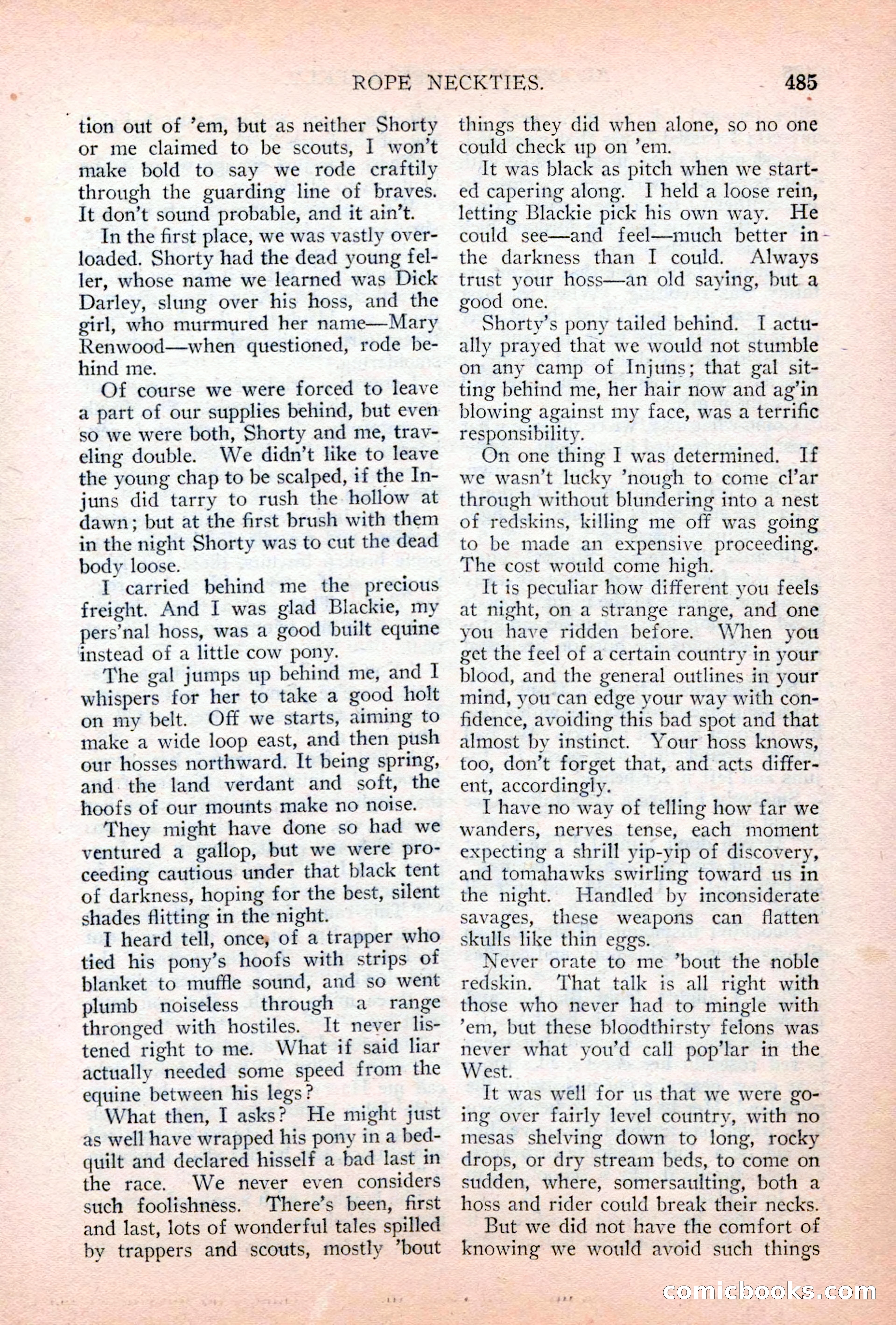
A restored page from Pulp Fiction, 1928. Page through the whole issue in the reader above.
📄 Transcribed text from this page (OCR, searchable)
Machine-transcribed from the original scan — historical spelling and the odd misread are preserved.
ROPE NECKTIES. tion out of ’em, but as neither Shorty or me claimed to be scouts, ] won't make bold to say we rode craftily through the guarding line of braves. It don’t sound probable, and it ain’t. In the first place, we was vastly over- loaded. Shorty had the dead young fel- ler, whose name we learned was Dick Darley, slung over his hoss, and the girl, who murmured her name—Mary Renwood—when questioned, rode be- hind me. Of course we were forced to leave a part of our supplies behind, but even so we were both, Shorty and me, trav- eling double. We didn’t like to leave the young chap to be scalped, if the In- juns did tarry to rush the hollow at dawn; but at the first brush with them in the night Shorty was to cut the dead body loose. I carried behind me the precious freight. And I was glad Blackie, my pers’nal hoss, was a good built equine instead of a little cow pony. The gal jumps up behind me, and I whispers for her to take a good holt on my belt. Off we starts, aiming to make a wide loop east, and then push our hosses northward. It being spring, and. the land verdant and soft, the hoofs of our mounts make no noise. They might have done so had we ventured a gallop, but we were pro- ceeding cautious under that black tent of darkness, hoping for the best, silent shades flitting in the night. I heard tell, once; of a trapper who tied his pony’s hoofs with strips of blanket to muffle sound, and so went plumb noiseless through a _ range thronged with hostiles. It never lis- tened right to me. What if said liar actually needed some speed from the equine between his legs? What then, I asks? He might just as well have wrapped his pony in a bed- quilt and declared hisself a bad last in the race. We never even considers such foolishness. There’s been, first and last, lots of wonderful tales spilled by trappers and scouts, mostly “bout 485 things they did when alone, so no one could check up on ’em. It was black as pitch when we start- ed capering along. I held a loose rein, letting Blackie pick his own way. He could see—and feel—much better in- the darkness than I could. Always trust your hoss—an old saying, but a good one. Shorty’s pony tailed behind. I actu- ally prayed that we would not stumble on any camp of Injuns; that gal sit- ting behind me, her hair now and ag’in blowing against my face, was a terrific responsibility. On one thing I was determined. If we wasn’t lucky *nough to come cl’ar through without blundering into a nest of redskins, killing me off was going to be made an expensive proceeding. The cost would come high. It is peculiar how different you feels at night, on a strange range, and one you have ridden before. When you get the feel of a certain country in your blood, and the general outlines in your mind, you can edge your way with con- fidence, avoiding this bad spot and that almost by instinct. Your hoss knows, too, don’t forget that, and acts differ- ent, accordingly. [ have no way of telling how far we wanders, nerves tense, each moment expecting a shrill yip-yip of discovery, and tomahawks swirling toward us in the night. Handled by inconsiderate savages, these weapons can flatten skulls like thin eggs. Never orate to me *bout the noble redskin. That talk is all right with those who never had to mingle with "em, but these bloodthirsty felons was never what you'd call pop’lar in the West. It was well for us that we were go- ing over fairly level country, with no mesas shelving down to long, rocky drops, or dry stream beds, to come on sudden, where, somersaulting, both a hoss and rider could break their necks. But we did not have the comfort of knowing we would avoid such things Eo JOO AMG S) (F@)