
Pulp Fiction, 1928 · page 146 of 148
Argosy All-Story Weekly, April 28, 1928 — page 146: what you’re looking at
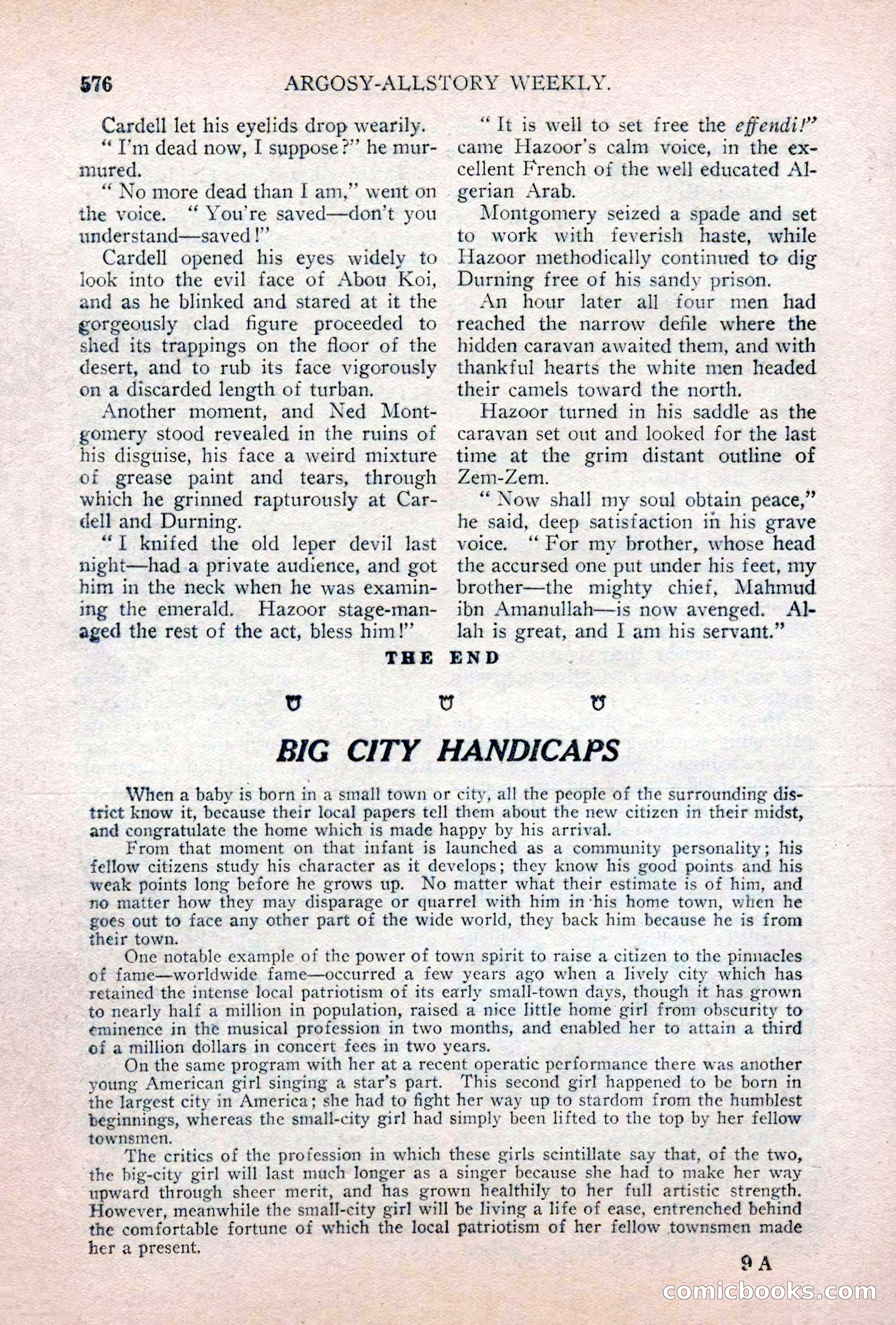
A restored page from Pulp Fiction, 1928. Page through the whole issue in the reader above.
📄 Transcribed text from this page (OCR, searchable)
Machine-transcribed from the original scan — historical spelling and the odd misread are preserved.
876 Cardell let his eyelids drop wearily. “I’m dead now, I suppose?” he mur- mured. ‘““ No more dead than I am,” went on the voice. “‘ You're saved—don’t you understand—saved !”’ Cardell opened his eyes widely to look into the evil face of Abou Koi, and as he blinked and stared at it the gorgeously clad figure proceeded to shed its trappings on the floor of the desert, and to rub its face vigorously on a discarded length of turban. Another moment, and Ned Mont- gomery stood revealed in the ruins of his disguise, his face a weird mixture of grease paint and tears, through which he grinned rapturously at Car- dell and Durning. “I knifed the old leper devil last night—had_a private audience, and got him in the neck when he was examin- ing the emerald. Hazoor stage-man- aged the rest of the act, bless him!” ARGOSY-ALLSTORY WEEKLY. “It is well to set free the effendi!”’ carne Hazoor’s calm voice, in the ex- cellent French of the well educated Al- gerian Arab. : Montgomery seized a spade and set to work with feverish haste, while Hazoor methodically continued to dig Durning free of his sandy prison. An hour later all four men had reached the narrow defile where the hidden caravan awaited them, and with thankful hearts the white men headed their camels toward the north. Hazoor turned in his saddle as the caravan set out and looked for the last time at the grim distant outline of Zem-Zem. ““ Now shall my soul obtain peace,” he said, deep satisfaction in his grave voice. ‘‘ For my brother, whose head the accursed one put under his feet, my brother—the mighty chief, Mahmud ibn Amanullah—is now avenged. Al- lah is great, and I am his servant.” THE END U U U BIG CITY HANDICAPS When a baby is born in a small town or city, all the people of the surrounding dis- trict know it, because their local papers tell them about the new citizen in their midst, and congratulate the home which is made happy by his arrival. From that moment on that infant is launched as a community personality; his fellow citizens study his character as it develops; they know his good points and his weak points long before he grows up. No matter what their estimate is of him, and no matter how they may disparage or quarrel with him in‘his home town, when he goes out to face any other part of the wide world, they back him because he is from their town. One notable example of the power of town spirit to raise a citizen to the pinnacles of fame—worldwide fame—occurred a few years ago when a lively city which has retained the intense local patriotism of its early small-town days, though it has grown to nearly half a million in population, raised a nice little home girl from obscurity to eminence in the musical profession in two months, and enabled her to attain a third of a million dollars in concert fees in two years. On the same program with her at a recent operatic performance there was another young American girl singing a star’s part. This second girl happened to be born in the largest city in America; she had to fight her way up to stardom from the humblest beginnings, whereas the small-city girl had simply been lifted to the top by her fellow townsmen. The critics of the profession in which these girls scintillate say that, of the two, the big-city girl will last much longer as a singer because she had to make her way upward through sheer merit, and has grown healthily to her full artistic strength. However, meanwhile the small-city girl will be living a life of ease, entrenched behind the comfortable fortune of which the local patriotism of her fellow townsmen made her a present. GA .OOK (COLAA (F@)