
Pulp Fiction, 1928 · page 133 of 148
Argosy All-Story Weekly, April 28, 1928 — page 133: what you’re looking at
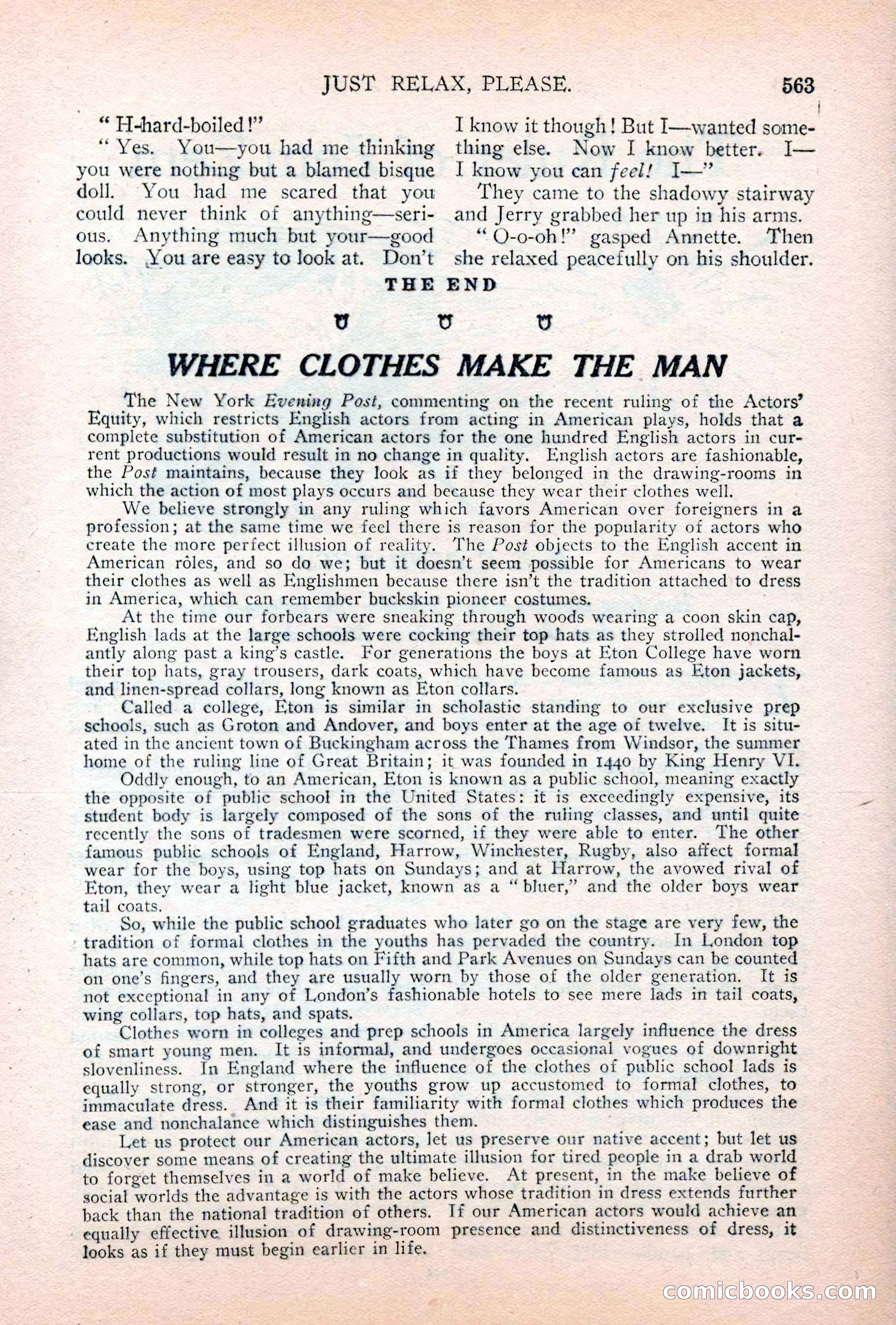
A restored page from Pulp Fiction, 1928. Page through the whole issue in the reader above.
📄 Transcribed text from this page (OCR, searchable)
Machine-transcribed from the original scan — historical spelling and the odd misread are preserved.
JUST RELAX, PLEASE. “ H-hard-boiled !” “Yes. You—you had me thinking you were nothing but a blamed bisque doll. You had me scared that you could never think of anything—-seri- ous. Anything much but your—good looks. You are easy to look at. Don’t 563 I know it though! But I—wanted some- thing else. Now I know better. I— I know you can feel! IJ—” They came to the shadowy stairway and Jerry grabbed her up in his arms. ““O-o-oh!” gasped Annette. Then she relaxed peacefully on his shoulder. THE END Uv Lo} Lv} WHERE CLOTHES MAKE THE MAN The New York Evening Post, commenting on the recent ruling of the Actors’ Equity, which restricts English actors from acting in American plays, holds that a complete substitution of American actors for the one hundred English actors in cur- rent productions would result in no change in quality. English actors are fashionable, the Post maintains, because they look as if they belonged in the drawing-rooms in which the action of most plays occurs and because they wear their clothes well. We believe strongly in any ruling which favors American over foreigners in a profession; at the same time we feel there is reason for the popularity of actors who create the more perfect illusion of reality. The Post objects to the English accent in American roles, and so do we; but it doesn’t seem possible for Americans to wear their clothes as well as Englishmen because there isn’t the tradition attached to dress in America, which can remember buckskin pioneer costumes. . At the time our forbears were sneaking through woods wearing a coon skin cap, English lads at the large schools were cocking their top hats as they strolled nonchal- antly along past a king’s castle. For generations the boys at Eton College have worn their top hats, gray trousers, dark coats, which have become famous as Eton jackets, and linen-spread collars, long known as Eton collars. Called a college, Eton is similar in scholastic standing to our exclusive prep schools, such as Groton and Andover, and boys enter at the age of twelve. It is situ- ated in the ancient town of Buckingham across the Thames from Windsor, the summer home of the ruling line of Great Britain; it was founded in 1440 by King Henry VI. Oddly enough, to an American, Eton is known as a public school, meaning exactly the opposite of public school in the United States: it is exceedingly expensive, its student body is largely composed of the sons of the ruling classes, and until quite recently the sons of tradesmen were scorned, if they were able to enter. The other famous public schools of England, Harrow, Winchester, Rugby, also affect formal wear for the boys, using top hats on Sundays; and at Harrow, the avowed rival of Eton, they wear a light blue jacket, known as a “bluer,” and the older boys wear tail coats. So, while the public school graduates who later go on the stage are very few, the tradition of formal clothes in the youths has pervaded the country. In London top hats are common, while top hats on Fifth and Park Avenues on Sundays can be counted on one’s fingers, and they are usually worn by those of the older generation. It is not exceptional in any of London’s fashionable hotels to see mere lads in tail coats, wing collars, top hats, and spats. Clothes worn in colleges and prep schools in America largely influence the dress of smart young men. slovenliness. It is informal, and undergoes occasional vogues of downright In England where the influence of the clothes of public school lads is equally strong, or stronger, the youths grow up accustomed to formal clothes, to immaculate dress. And it is their familiarity with formal clothes which produces the ease and nonchalance which distinguishes them. a Let us protect our American actors, let us preserve our native accent; but let us discover some means of creating the ultimate illusion for tired people in a drab world to forget themselves in a world of make believe. At present, in the make believe of social worlds the advantage is with the actors whose tradition in dress extends further back than the national tradition of others. If our American actors would achieve an - equally effective illusion of drawing-room presence and distinctiveness of dress, it looks as if they must begin earlier in life. EOPNICLOOOKS (E@)