
Pulp Fiction, 1928 · page 11 of 148
Argosy All-Story Weekly, April 28, 1928 — page 11: what you’re looking at
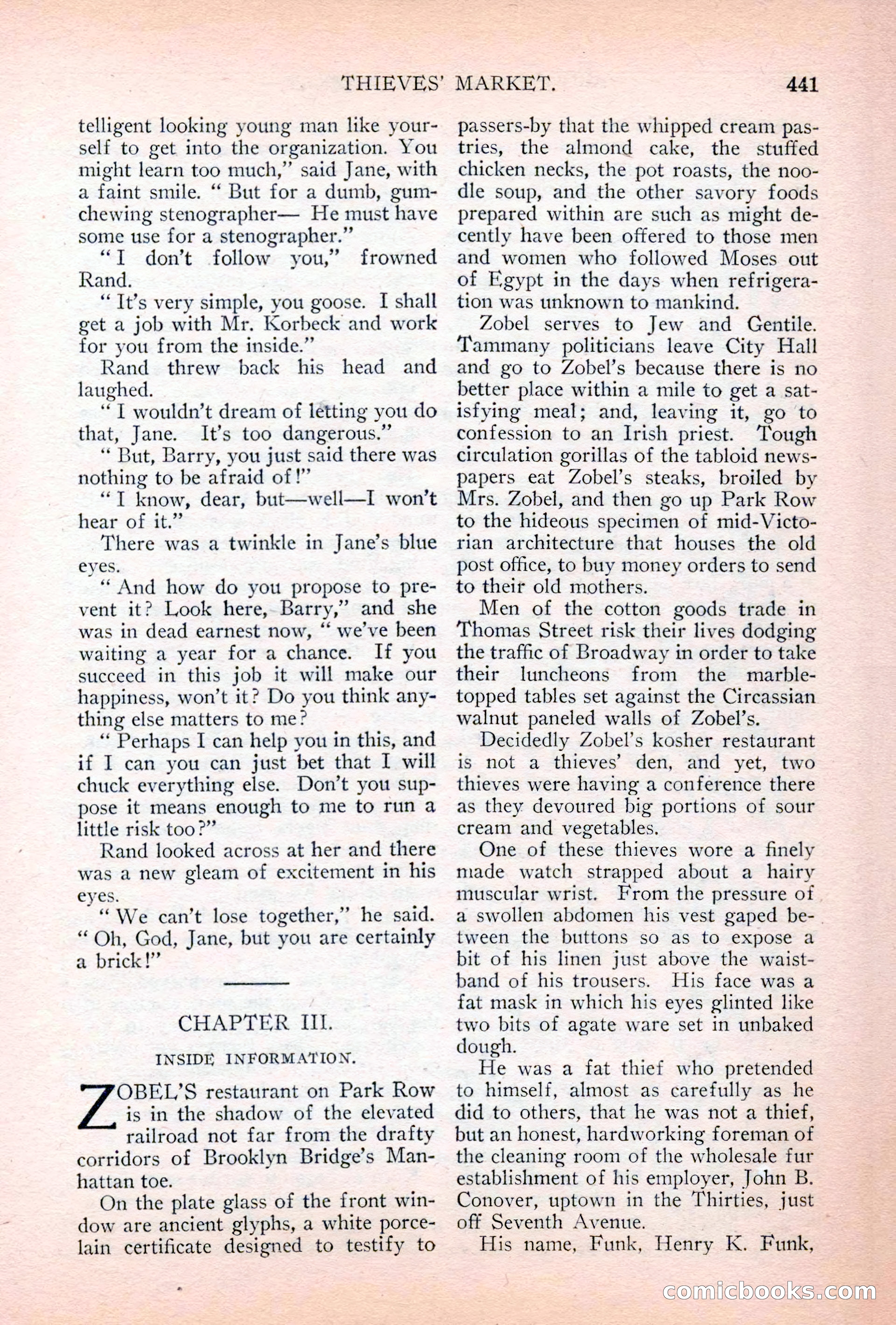
A restored page from Pulp Fiction, 1928. Page through the whole issue in the reader above.
📄 Transcribed text from this page (OCR, searchable)
Machine-transcribed from the original scan — historical spelling and the odd misread are preserved.
THIEVES’ telligent looking young man like your- self to get into the organization. You might learn too much,” said Jane, with a faint smile. “ But for a dumb, gum- chewing stenographer— He must have some use for a stenographer.” “T don’t follow you,” Rand. “It’s very simple, you goose. I shall get a job with Mr. Korbeck and work for you from the inside.” Rand threw back his head and laughed. ‘“T wouldn’t dream of letting you do that, Jane. It’s too dangerous,” ‘ But, Barry, you just said there was nothing to be afraid of!” “T know, dear, but—well—I won’t hear of it.” There was a twinkle in Jane’s blue eyes. ‘And how do you propose to pre- vent it? Look here, Barry,” and she was in dead earnest now, “ we’ve been waiting a year for a chance. If you succeed in this job it will make our happiness, won’t it? Do you think any- thing else matters to me? ‘‘ Perhaps I can help you in this, and if I can you can just bet that I will chuck everything else. Don’t you sup- pose it means enough to me to run a little risk too?” Rand looked across at her and there was a new gleam of excitement in his eyes. ‘We can’t lose together,” he said. “Oh, God, Jane, but you are certainly a brick!” frowned CHAPTER III. INSIDE INFORMATION. OBEL’S restaurant on Park Row is in the shadow of the elevated railroad not far from the drafty corridors of Brooklyn Bridge’s Man- hattan toe. On the plate glass of the front win- dow are ancient glyphs, a white porce- lain certificate designed to testify to MARKET, 441 passers-by that the whipped cream pas- tries, the almond cake, the stuffed chicken necks, the pot roasts, the noo- dle soup, and the other savory foods prepared within are such as might de- cently have been offered to those men and women who followed Moses out of Egypt in the days when refrigera- tion was unknown to mankind. Zobel serves to Jew and Gentile. Tammany politicians leave City Hall and go to Zobel’s because there is no better place within a mile to get a sat- isfying meal; and, leaving it, go to confession to an Irish priest. Tough circulation gorillas of the tabloid news- papers eat Zobel’s steaks, broiled by Mrs. Zobel, and then go up Park Row to the hideous specimen of mid-Victo- rian architecture that houses the old post office, to buy money orders to send to their old mothers. Men of the cotton goods trade in Thomas Street risk their lives dodging the traffic of Broadway in order to take their luncheons from the marble- topped tables set against the Circassian walnut paneled walls of Zobel’s. Decidedly Zobel’s kosher restaurant is not a thieves’ den, and yet, two thieves were having a conference there as they devoured big portions of sour cream and vegetables. One of these thieves wore a finely made watch strapped about a hairy muscular wrist. From the pressure of a swollen abdomen his vest gaped be-. tween the buttons so as to expose a bit of his linen just above the waist- band of his trousers. His face was a fat mask in which his eyes glinted like two bits of agate ware set in unbaked dough. 3 He was a fat thief who pretended to himself, almost as carefully as he did to others, that he was not a thief, but an honest, hardworking foreman of the cleaning room of the wholesale fur establishment of his employer, John B. Conover, uptown in the Thirties, just off Seventh Avenue. | His name, Funk, Henry K. Funk, COPMICLOOOKS (F@)