
Pulp Fiction, 1928 · page 109 of 148
Argosy All-Story Weekly, April 28, 1928 — page 109: what you’re looking at
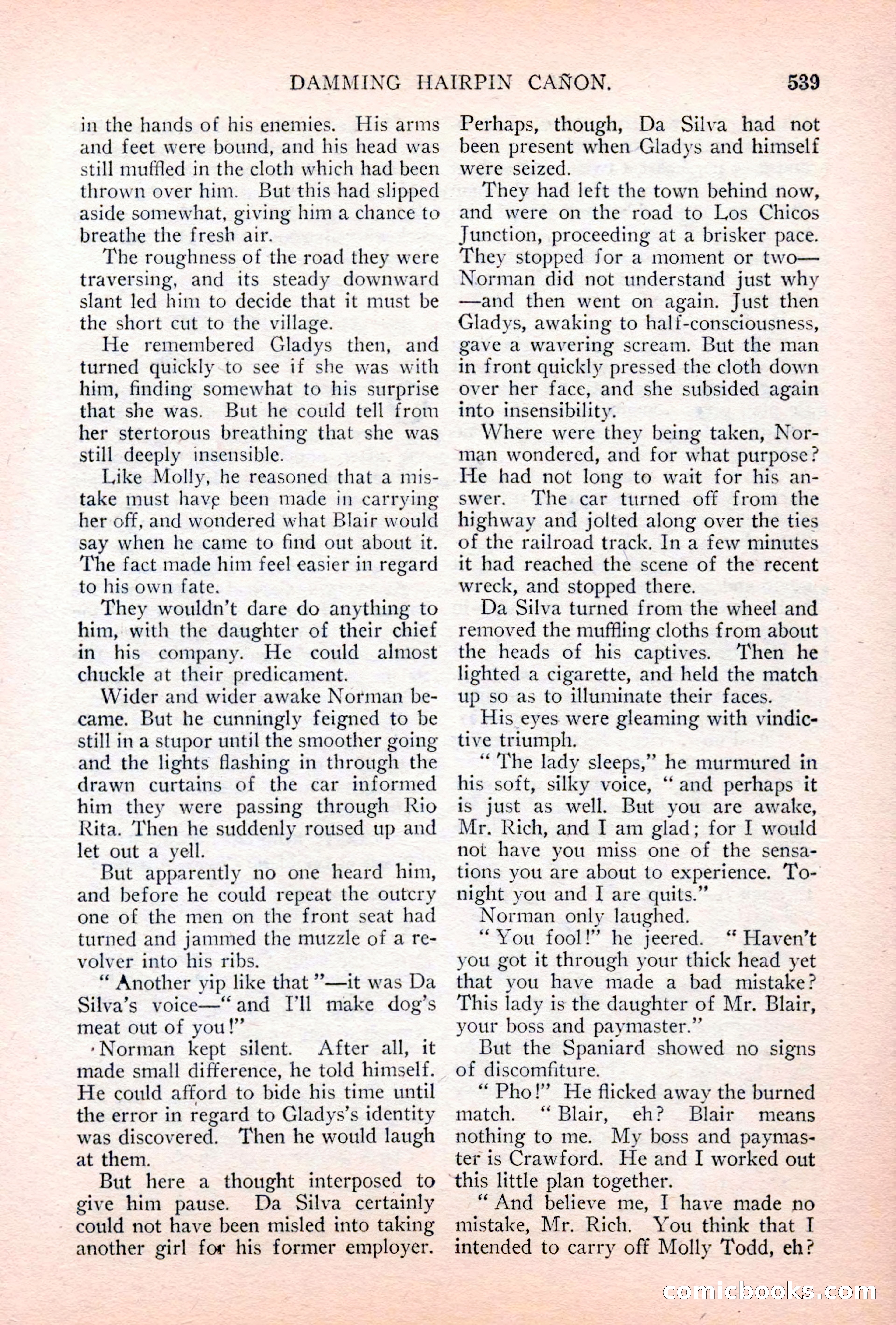
A restored page from Pulp Fiction, 1928. Page through the whole issue in the reader above.
📄 Transcribed text from this page (OCR, searchable)
Machine-transcribed from the original scan — historical spelling and the odd misread are preserved.
DAMMING HAIRPIN CANON, in the hands of his enemies. His arms and feet were bound, and his head was still muffled in the cloth which had been thrown over him. But this had slipped aside somewhat, giving him a chance to breathe the fresh air. The roughness of the road they were traversing, and its steady downward slant led him to decide that it must be the short cut to the village. He remembered Gladys then, and turned quickly to see if she was with him, finding somewhat to his surprise that she was. But he could tell from her stertorous breathing that she was still deeply insensible. Like Molly, he reasoned that a mis- take must have been made in carrying her off, and wondered what Blair would say when he came to find out about it. The fact made him feel easier in regard to his own fate. They wouldn’t dare do anything to him, with the daughter of their chief in his company. He could almost chuckle at their predicament. Wider and wider awake Norman be- came. But he cunningly feigned to be still in a stupor until the smoother going and the lights flashing in through the drawn curtains of the car informed him they were passing through Rio Rita. Then he suddenly roused up and let out a yell. But apparently no one heard him, and before he could repeat the outcry one of the men on the front seat had turned and jammed the muzzle of a re- volver into his ribs. “ Another yip like that ”—it was Da Silva’s voice—“and I’ll make dog’s meat out of you!’ ‘Norman kept silent. After all, it made small difference, he told himself. He could afford to bide his time until the error in regard to Gladys’s identity was discovered. Then he would laugh at them. But here a thought interposed to give him pause. Da Silva certainly could not have been misled into taking another girl for his former employer. 539 Perhaps, though, Da Silva had not been present when Gladys and himself were seized. They had left the town behind now, and were on the road to Los Chicos Junction, proceeding at a brisker pace. They stopped for a moment or two— Norman did not understand just why —and then went on again. Just then Gladys, awaking to half-consciousness, gave a wavering scream. But the man in front quickly pressed the cloth down over her face, and she subsided again into insensibility. Where were they being taken, Nor- man wondered, and for what purpose? He had not long to wait for his an- swer. The car turned off from the highway and jolted along over the ties of the railroad track. In a few minutes it had reached the scene of the recent wreck, and stopped there. Da Silva turned from the wheel and removed the muffling cloths from about the heads of his captives. Then he lighted a cigarette, and held the match up so as to illuminate their faces. His eyes were gleaming with vindic- tive triumph. “The lady sleeps,” he murmured in his soft, silky voice, ‘ and perhaps it is just as well. But you are awake, Mr. Rich, and I am glad; for I would not have you miss one of the sensa- tions you are about to experience. To- night you and I are quits.” Norman only laughed. “You fool!” he jeered. “ Haven’t you got it through your thick head yet that you have made a bad mistake? This lady is the daughter of Mr. Blair, your boss and paymaster.”’ But the Spaniard showed no signs of discomfiture. “Pho!” He flicked away the burned match. “Blair, eh? — Blair means nothing to me. My boss and paymas- ter is Crawford. He and I worked out ‘this little plan together. “And believe me, I have made no mistake, Mr. Rich. You think that I intended to carry off Molly Todd, eh? NOOLKS COMMUC (C@