
Pulp Fiction, 1928 · page 72 of 152
Argosy All-Story Weekly, April 14, 1928 — page 72: what you’re looking at
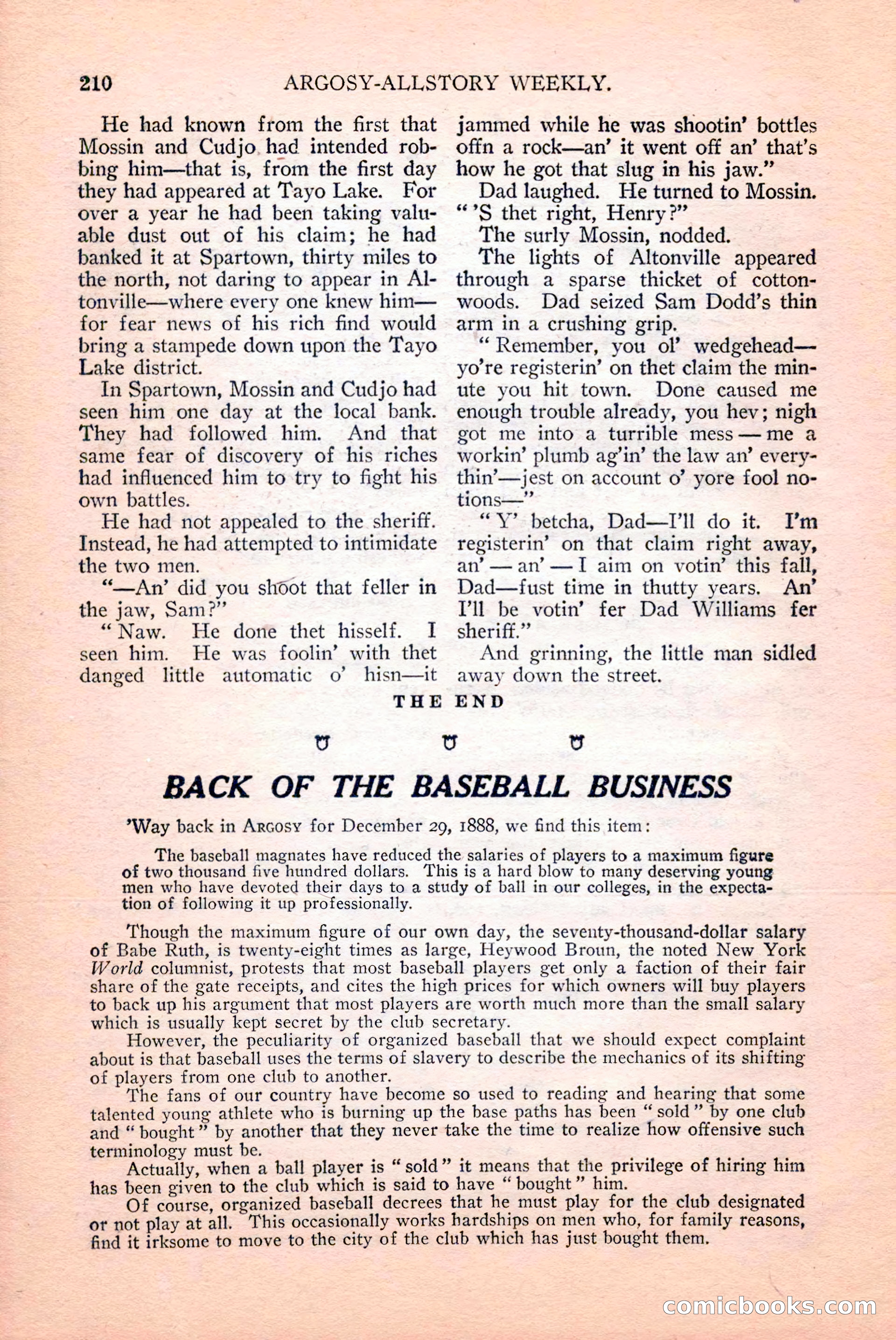
A restored page from Pulp Fiction, 1928. Page through the whole issue in the reader above.
📄 Transcribed text from this page (OCR, searchable)
Machine-transcribed from the original scan — historical spelling and the odd misread are preserved.
210 He had known from the first that Mossin and Cudjo. had intended rob- bing him—that is, from the first day they had appeared at Tayo Lake. For over a year he had been taking valu- able dust out of his claim; he had banked it at Spartown, thirty miles to the north, not daring to appear in Al- tonville—where every one knew him— for fear news of his rich find would bring a stampede down upon the Tayo Lake district. In Spartown, Mossin and Cudjo had seen him one day at the local bank. They had followed him. And _ that same fear of discovery of his riches had influenced him to try to fight his own battles. He had not appealed to the sheriff. Instead, he had attempted to intimidate the two men. “__An’ did you shoot that feller in the jaw, Sam?” “Naw. He done thet hisself. I seen him. He was foolin’ with thet danged little automatic o’ hisn—it THE U U ARGOSY-ALLSTORY WEEKLY. jammed while he was shootin’ bottles offn a rock—an’ it went off an’ that’s how he got that slug in his jaw.” Dad laughed. He turned to Mossin. °S thet right, Henry?” The surly Mossin, nodded. The lights of Altonville appeared through a sparse thicket of cotton- woods. Dad seized Sam Dodd’s thin arm in a crushing grip. “Remember, you ol’ wedgehead— yore registerin’ on thet claim the min- ute you hit town. Done caused me enough trouble already, you hev; nigh got me into a turrible mess—me a workin’ plumb ag’in’ the law an’ every- thin’—jest on account o’ yore fool no- tions—” ““Y": betcha, ‘Dad—TI’'ll do it I’m registerin’ on that claim right away, an’ — an’ — TI aim on votin’ this tau, Dad—fust time in thutty years. An’ Pll be votin’ fer Dad Williams fer sheriff.” And grinning, the little man sidled away down the street. END Ls} BACK OF THE BASEBALL BUSINESS *Way back in Arcosy for December 29, 1888, we find this item: The baseball magnates have reduced the salaries of players to a maximum figure of two thousand five hundred dollars. This is a hard blow to many deserving young men who have devoted their days to a study of ball in our colleges, in the expecta- tion of following it up professionally. Though the maximum figure of our own day, the seventy-thousand-dollar salary of Babe Ruth, is twenty-eight times as large, Heywood Broun, the noted New York World columnist, protests that most baseball players get only a faction of their fair share of the gate receipts, and cites the high prices for which owners will buy players to back up his argument that most players are worth much more than the small salary which is usually kept secret by the club secretary. However, the peculiarity of organized baseball that we should expect complaint about is that baseball uses the terms of slavery to describe the mechanics of its shifting of players from one club to another. The fans of our country have become so used to reading and hearing that some talented young athlete who is burning up the base paths has been “sold” by one club and “ bought” by another that they never take the time to realize how offensive such terminology must be. Actually, when a ball player is “sold” it means that the privilege of hiring him has been given to the club which is said to have “ bought” him. Of course, organized baseball decrees that he must play for the club designated ot not play at all. This occasionally works hardships on men who, for family reasons, find it irksome to move to the city of the club which has just bought them. Gomichbook (E@)