
Pulp Fiction, 1928 · page 63 of 152
Argosy All-Story Weekly, April 14, 1928 — page 63: what you’re looking at
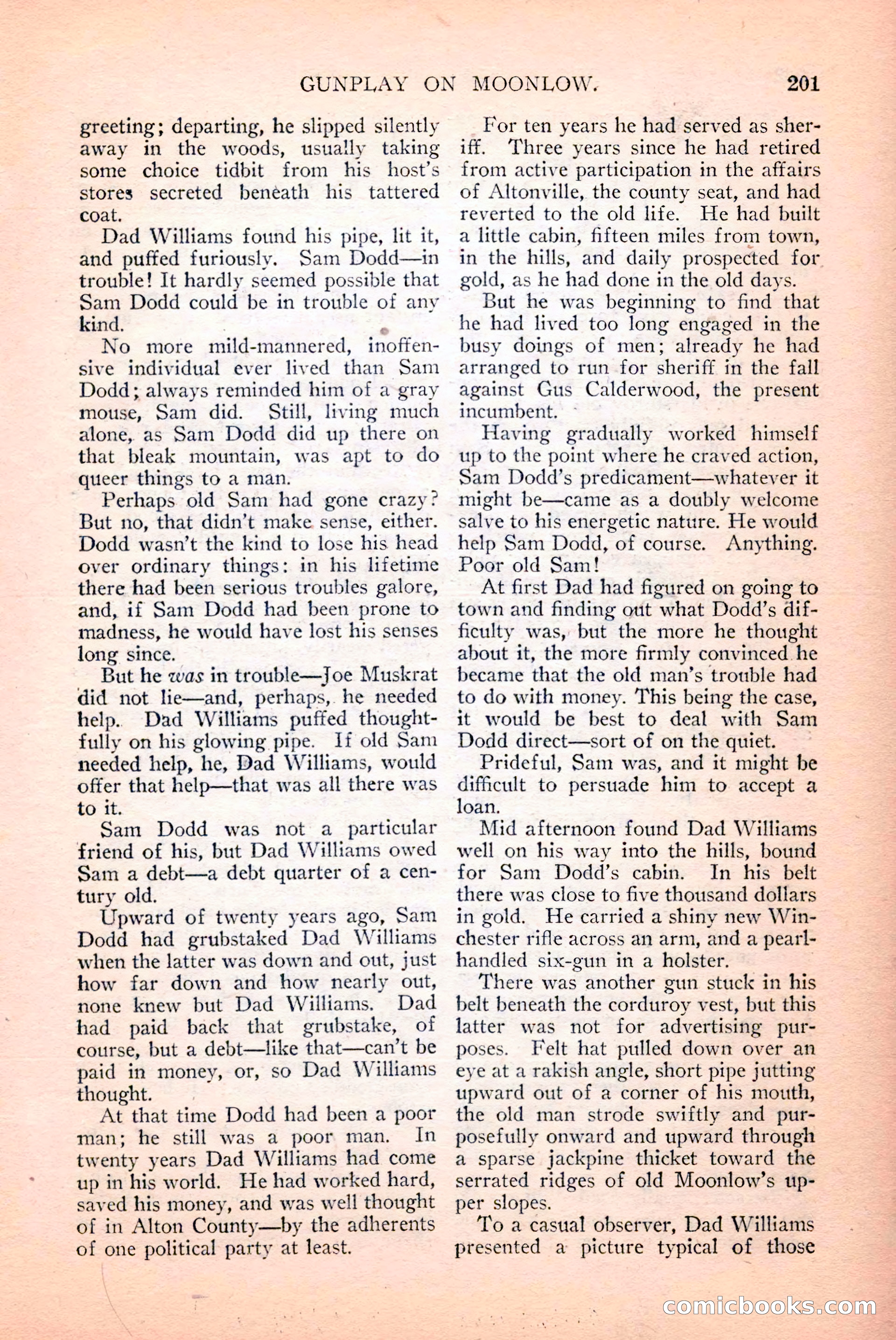
A restored page from Pulp Fiction, 1928. Page through the whole issue in the reader above.
📄 Transcribed text from this page (OCR, searchable)
Machine-transcribed from the original scan — historical spelling and the odd misread are preserved.
GUNPLAY ON greeting; departing, he slipped silently away in the woods, usually taking some choice tidbit from his host’s stores secreted benéath his tattered coat. Dad Williams found his pipe, lit it, and puffed furiously. Sam Dodd—in trouble! It hardly seemed possible that Sam Dodd could be in trouble of any kind. ; No more mild-mannered, inoffen- sive individual ever lived than Sam Dodd; always reminded him of a gray mouse, Sam did. Still, living much alone, as Sam Dodd did up there on that bleak mountain, was apt to do queer things to a man. Perhaps old Sam had gone crazy? But no, that didn’t make sense, either. Dodd wasn’t the kind to lose his head over ordinary things: in his lifetime there had been serious troubles galore, and, if Sam Dodd had been prone to madness, he would have lost his senses long since. But he was in trouble—Joe Muskrat did not lie—and, perhaps, he needed help. Dad Williams puffed thought- fully on his glowing pipe. If old Sam needed help, he, Dad Williams, would offer that help—that was all there was to it. Sam Dodd was not a particular friend of his, but Dad Williams owed Sam a debt—a debt quarter of a cen- tury old. Upward of twenty years ago, Sam Dodd had grubstaked Dad Williams when the latter was down and out, just how far down and how nearly out, none knew but Dad Williams. Dad had paid back that grubstake, of course, but a debt—like that—can’t be paid in money, or, so Dad Williams thought. At that time Dodd had been a poor man; he still was a poor man. In twenty years Dad Williams had come up in his world. He had worked hard, saved his money, and was well thought of in Alton County—by the adherents of one political party at least. MOONLOW. 201 For ten years he had served as sher- iff. Three years since he had retired from active participation in the affairs of Altonville, the county seat, and had reverted to the old life. He had built a little cabin, fifteen miles from town, in the hills, and daily prospected for gold, as he had done in the old days. But he was beginning to find that he had lived too long engaged in the busy doings of men; already he had arranged to run for sheriff in the fall against Gus Calderwood, the present incumbent. Having gradually worked himself up to the point where he craved action, Sam Dodd’s predicament—whatever it might be—came as a doubly welcome salve to his energetic nature. He would help Sam Dodd, of course. Anything. Poor old Sam! At first Dad had figured on going to town and finding out what Dodd’s dif- ficulty was, but the more he thought about it, the more firmly convinced he became that the old man’s trouble had to do with money. This being the case, it would be best to deal with Sam Dodd direct—sort of on the quiet. Prideful, Sam was, and it might be dificult to persuade him to accept a loan. Mid afternoon found Dad Williams well on his way into the hills, bound for Sam Dodd’s cabin. In his belt there was close to five thousand dollars in gold. He carried a shiny new Win- chester rifle across an arm, and a pearl- handled six-gun in a holster. There was another gun stuck in his belt beneath the corduroy vest, but this latter was not for advertising pur- poses. Felt hat pulled down over an eye at a rakish angle, short pipe jutting upward out of a corner of his mouth, the old man strode swiftly and pur- posefully onward and upward through a sparse jackpine thicket toward the serrated ridges of old Moonlow’s up- per slopes. To a casual observer, Dad Williams presented a picture typical of those EOPMICGOOOKS (E©)