
Pulp Fiction, 1928 · page 61 of 152
Argosy All-Story Weekly, April 14, 1928 — page 61: what you’re looking at
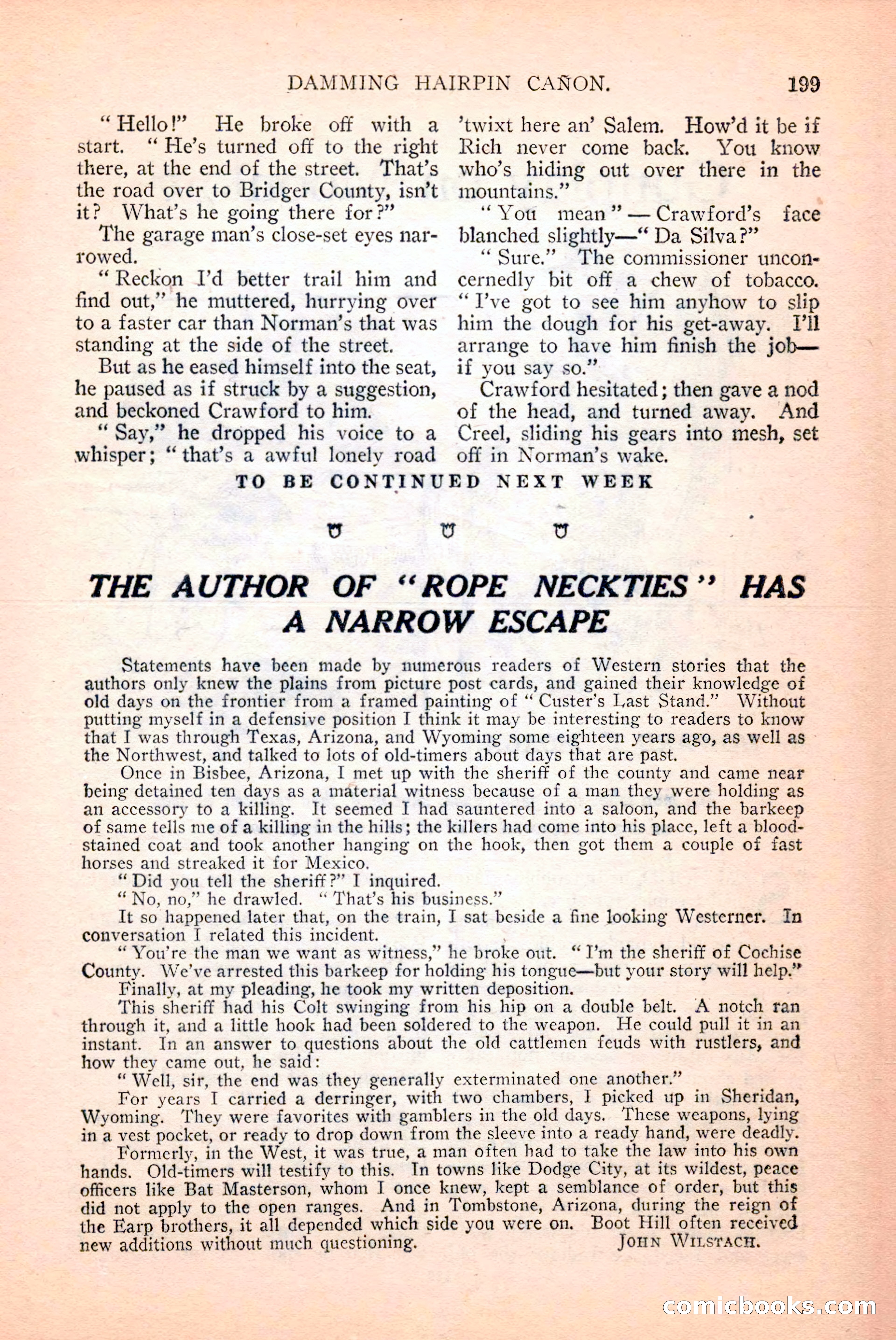
A restored page from Pulp Fiction, 1928. Page through the whole issue in the reader above.
📄 Transcribed text from this page (OCR, searchable)
Machine-transcribed from the original scan — historical spelling and the odd misread are preserved.
DAMMING HAIRPIN CANON. “Hello!” He broke off with a start. “‘ He’s turned off to the right there, at the end of the street. That’s the road over to Bridger County, isn’t it? What’s he going there for?” The garage man’s close-set eyes nar- rowed. “Reckon I’d better trail him and find out,” he muttered, hurrying over to a faster car than Norman’s that was standing at the side of the street. But as he eased himself into the seat, he paused as if struck by a suggestion, and beckoned Crawford to him. “Say,” he dropped his voice to a whisper; “that’s a awful lonely road 199 ‘twixt here an’ Salem. How’d it be if Rich never come back. You know who’s hiding out over there in the mountains.” “You mean” — Crawford’s blanched slightly—*“ Da Silva?” “Sure.” The commissioner uncon- cernedly bit off a chew of tobacco. “ve got to see him anyhow to slip him the dough for his get-away. Til arrange to have him finish the job— if you say so.” Crawford hesitated; then gave a nod of the head, and turned away. And Creel, sliding his gears into mesh, set off in Norman’s wake. face TO BE CONTINUED NEXT WEEK uw U U THE AUTHOR OF “ROPE NECKTIES’’ HAS A NARROW ESCAPE Statements have been made by numerous readers of Western stories that the authors only knew the plains from picture post cards, and gained their knowledge of old days on the frontier from a framed painting of ‘‘ Custer’s Last Stand.” Without putting myself in a defensive position I think it may be interesting to readers to know that I was through Texas, Arizona, and Wyoming some eighteen years ago, as well as the Northwest, and talked to lots of old-timers about days that are past. Once in Bisbee, Arizona, I met up with the sheriff of the county and came near being detained ten days as a material witness because of a man they were holding as an accessory to a killing. It seemed I had sauntered into a saloon, and the barkeep of same tells me of a killing in the hills; the killers had come into his place, left a blood- stained coat and took another hanging on the hook, then got them a couple of fast horses and streaked it for Mexico. “ Did you tell the sheriff?” I inquired. “No, no,” he drawled. ‘ That’s his business.” It so happened later that, on the train, I sat beside a fine looking Westerner. In conversation [ related this incident. ; * You're the man we want as witness,” he broke out. “ I’m the sheriff of Cochise County. We've arrested this barkeep for holding his tongue—but your story will help.” Finally, at my pleading, he took my written deposition. This sheriff had his Colt swinging from his hip on a double belt. A notch ran through it, and a little hook had been soldered to the weapon. He could pull it in an instant. In an answer to questions about the old cattlemen feuds with rustlers, and how they came out, he said: “ Well, sir, the end was they generally exterminated one another.” For years I carried a derringer, with two chambers, | picked up in Sheridan, Wyoming. They were favorites with gamblers in the old days. These weapons, lying in a vest pocket, or ready to drop down from the sleeve into a ready hand, were deadly. Formerly, in the West, it was true, a man often had to take the law into his own hands. Old-timers will testify to this. In towns like Dodge City, at its wildest, peace officers like Bat Masterson, whom I once knew, kept a semblance of order, but this did not apply to the open ranges. And in Tombstone, Arizona, during the reign of the Earp brothers, it all depended which side you were on. Boot Hill often received new additions without much questioning. Joun WILsTrach. ECORMICGLOOOL< (C@)