
Pulp Fiction, 1928 · page 51 of 152
Argosy All-Story Weekly, April 14, 1928 — page 51: what you’re looking at
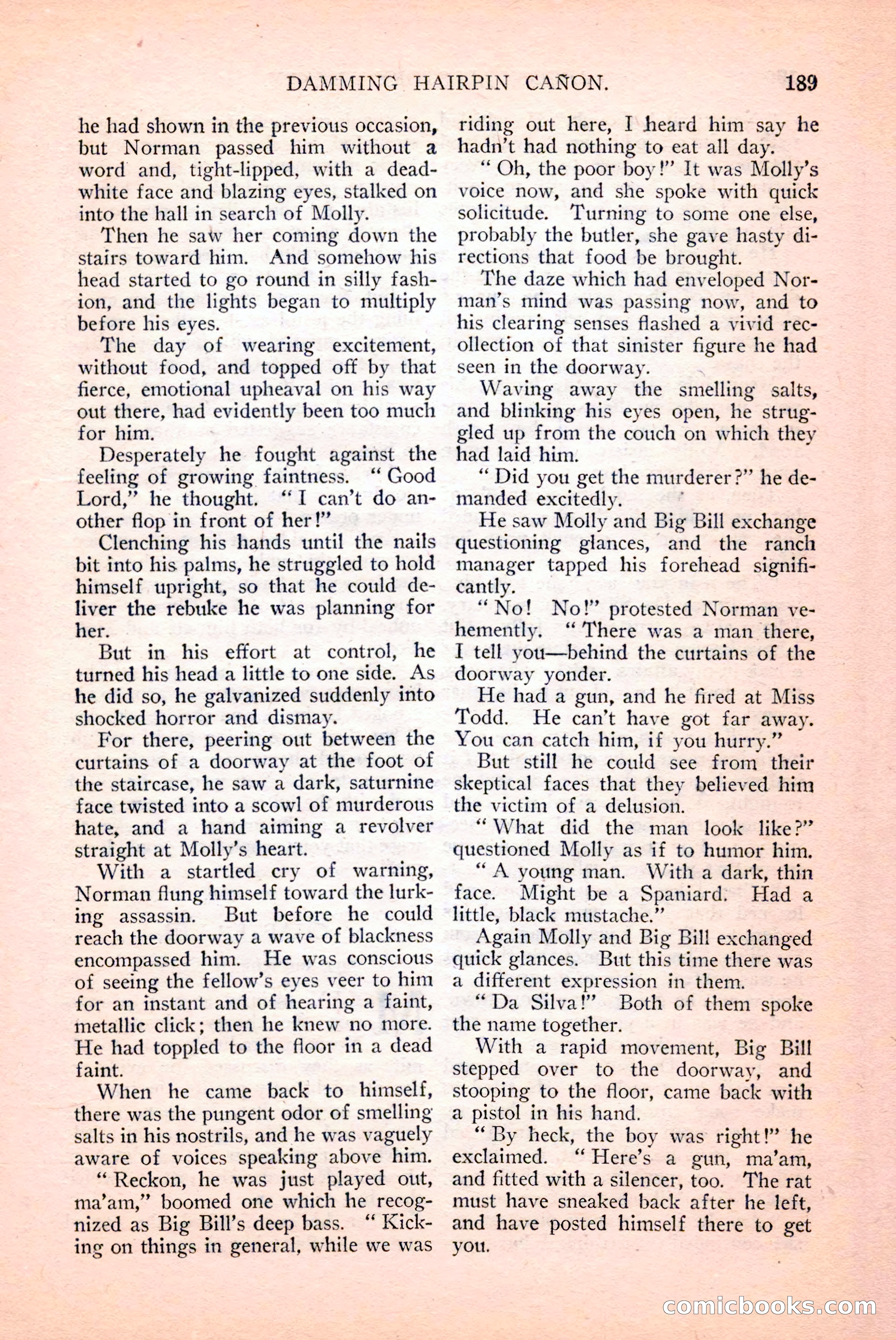
A restored page from Pulp Fiction, 1928. Page through the whole issue in the reader above.
📄 Transcribed text from this page (OCR, searchable)
Machine-transcribed from the original scan — historical spelling and the odd misread are preserved.
DAMMING HAIRPIN he had shown in the previous occasion, but Norman passed him without a word and, tight-lipped, with a dead- white face and blazing eyes, stalked on into the hall in search of Molly. Then he saw her coming down the stairs toward him. And somehow his head started to go round in silly fash- ion, and the lights began to multiply before his eyes. The day of wearing excitement, without food, and topped off by that fierce, emotional upheaval on his way out there, had evidently been too much for him. Desperately he fought against the feeling of growing faintness. “‘ Good Lord,” he thought. “I can’t do an- other flop in front of her!’ Clenching his hands until the nails bit into his palms, he struggled to hold himself upright, so that he could de- liver the rebuke he was planning for her. But in his effort at control, he turned his head a little to one side. As he did so, he galvanized suddenly into shocked horror and dismay. For there, peering out between the curtains of a doorway at the foot of the staircase, he saw a dark, saturnine face twisted into a scowl of murderous hate, and a hand aiming a revolver straight at Molly’s heart. With a startled cry of warning, Norman flung himself toward the lurk- ing assassin. But before he could reach the doorway a wave of blackness encompassed him. He was conscious of seeing the fellow’s eyes veer to him for an instant and of hearing a faint, metallic click; then he knew no more. He had toppled to the floor in a dead faint. When he came back to himself, there was the pungent odor of smelling salts in his nostrils, and he was vaguely aware of voices speaking above him. “ Reckon, he was just played out, ma’am,” boomed one which he recog- nized as Big Bill’s deep bass. “ Kick- ing on things in general, while we was CANON, 189 riding out here, [ heard him say he hadn’t had nothing to eat all day. “Oh, the poor boy!” It was Molly’s voice now, and she spoke with quick solicitude. Turning to some one else, probably the butler, she gave hasty di- rections that food be brought. The daze which had enveloped Nor- man’s mind was passing now, and to his clearing senses flashed a vivid rec- ollection of that sinister figure he had seen in the doorway. Waving away the smelling salts, and blinking his eyes open, he strug- gled up from the couch on which they had laid him. “ Did you get the murderer?” he de- manded excitedly. He saw Molly and Big Bill exchange questioning glances, and the ranch manager tapped his forehead signifi- cantly. “No! No!’ protested Norman ve- hemently, ‘‘ There was a man there, I tell you—behind the curtains of the doorway yonder. He had a gun, and he fired at Miss Todd. He can’t have got far away. You can catch him, if you hurry.” But still he could see from their skeptical faces that they believed him the victim of a delusion. “What did the man look like?” questioned Molly as if to humor him. “A young man. With a dark, thin face. Might be a Spaniard: Had a little, black mustache.” Again Molly and Big Bill exchanged quick glances. But this time there was a different expression in them. “Da Silva!” Both of them spoke the name together. With a rapid movement, Big Bill stepped over to the doorway, and stooping to the floor, came back with a pistol in his hand. “By heck, the boy was right!” he exclaimed. “ Here’s a gtin, ma’am, and fitted with a silencer, too. The rat must have sneaked back after he left, and have posted himself there to get you. EORNICLOOLK< (E@)