
Pulp Fiction, 1928 · page 18 of 152
Argosy All-Story Weekly, April 14, 1928 — page 18: what you’re looking at
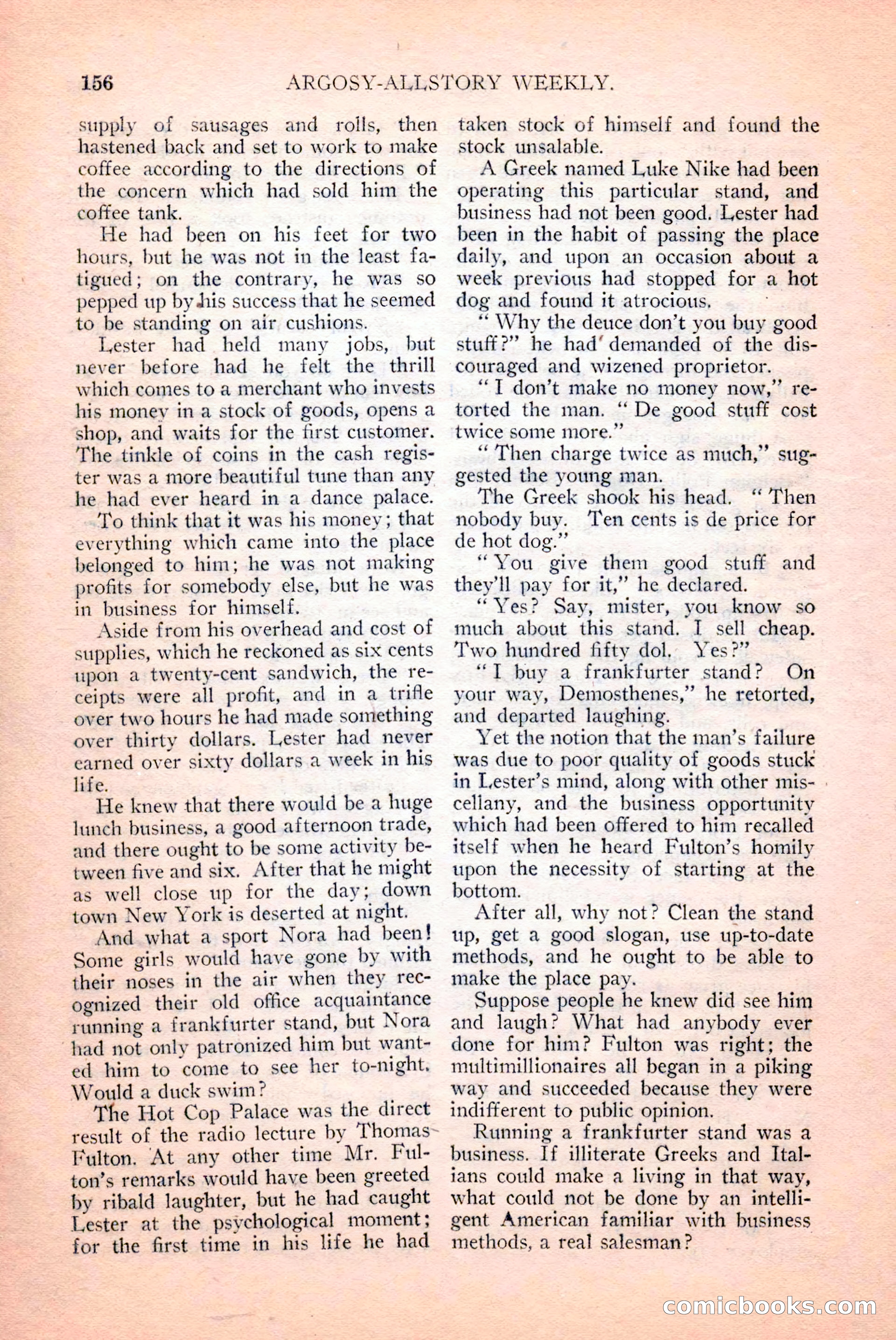
A restored page from Pulp Fiction, 1928. Page through the whole issue in the reader above.
📄 Transcribed text from this page (OCR, searchable)
Machine-transcribed from the original scan — historical spelling and the odd misread are preserved.
156 supply of sausages and rolls, then hastened back and set to work to make coffee according to the directions of the concern which had sold him the coffee tank. He had been on his feet for two hours, but he was not in the least fa- tigued; on the contrary, he was so pepped up by his success that he seemed to be standing on air cushions. Lester had held many jobs, but never before had he felt the thrill which comes to a merchant who invests his money in a stock of goods, opens a shop, and waits for the first customer. The tinkle of coins in the cash regis- ter was a more beautiful tune than any he had ever heard in a dance palace. To think that it was his money; that everything which came into the place belonged to him; he was not making profits for somebody else, but he was in business for himself. Aside from his overhead and cost of supplies, which he reckoned as six cents upon a twenty-cent sandwich, the re- ceipts were all profit, and in a trifle over two hours he had made something over thirty dollars. Lester had never earned over sixty dollars a week in his life. He knew that there would be a huge lunch business, a good afternoon trade, and there ought to be some activity be- tween five and six. After that he might as well close up for the day; down town New York is deserted at night. And what a sport Nora had been! Some girls would have gone by with their noses in the air when they rec- ognized their old office acquaintance running a frankfurter stand, but Nora ‘had not only patronized him but want- ed him to come to see her to-night, Would a duck swim? The Hot Cop Palace was the direct result of the radio lecture by Thomas~ Fulton. At any other time Mr. Ful- ton’s remarks would have been greeted by ribald laughter, but he had caught Lester at the psychological moment; for the first time in his life he had ARGOSY-ALLSTORY WEEKLY. taken stock of himself and found the stock unsalable. A Greek named Luke Nike had been operating this particular stand, and business had not been good. Lester had been in the habit of passing the place daily, and upon an occasion about a week previous had stopped for a hot dog and found it atrocious, : “Why the deuce don’t you buy good stuff?”’ he had‘ demanded of the dis- couraged and wizened proprietor. “T don’t make no money now,” re- torted the man. “ De good stuff cost twice some more.” “Then charge twice as much,” sug- gested the young man. The Greek shook his head. ‘ Then nobody buy. ‘Ten cents is de price for de hot dog.”’ “You give them good stuff and they'll pay for it,” he declared. “Yes? Say, mister, you know so much about this stand. I sell cheap. Two hundred fifty dol, Yes?” “T buy a frankfurter stand? On your way, Demosthenes,” he retorted, and departed laughing. Yet the notion that the man’s failure was due to poor quality of goods stuck in Lester’s mind, along with other mis- | cellany, and the business opportunity which had been offered to him recalled itself when he heard Fulton’s homily upon the necessity of starting at the bottom. After all, why not? Clean the stand up, get a good slogan, use up-to-date methods, and he ought to be able to make the place pay. Suppose people he knew did see him and laugh? What had anybody ever done for him? Fulton was right; the multimillionaires all began in a piking way and succeeded because they were indifferent to public opinion. Running a frankfurter stand was a business. If illiterate Greeks and Ital- ians could make a living in that way, what could not be done by an intelli- gent American familiar with business methods, a real salesman? 3 (€(0) v.OOK (E@)