
Pulp Fiction, 1928 · page 16 of 152
Argosy All-Story Weekly, April 14, 1928 — page 16: what you’re looking at
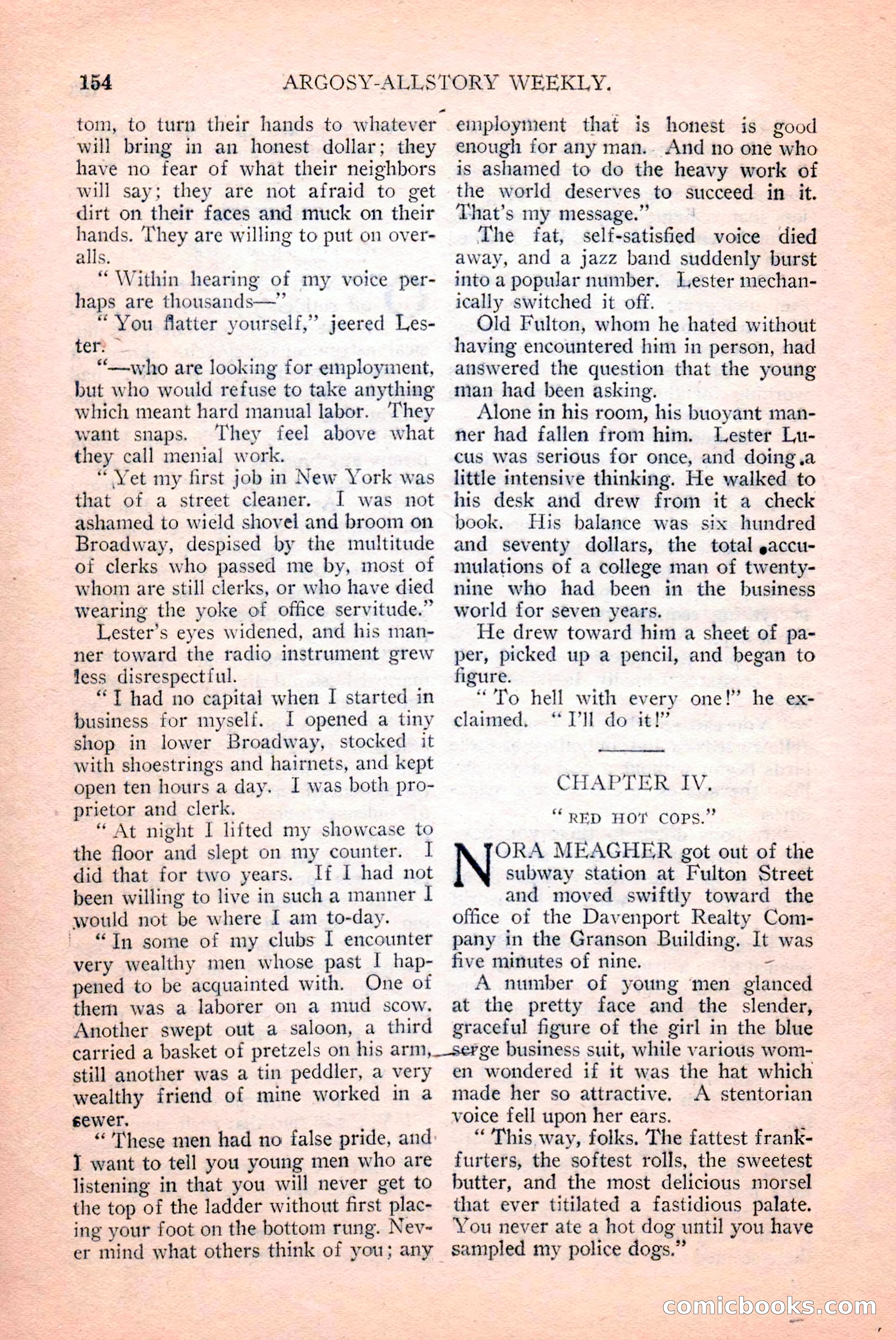
A restored page from Pulp Fiction, 1928. Page through the whole issue in the reader above.
📄 Transcribed text from this page (OCR, searchable)
Machine-transcribed from the original scan — historical spelling and the odd misread are preserved.
154 tom, to turn their hands to whatever will bring in an honest dollar; they have no fear of what their neighbors will say; they are not afraid to get dirt on their faces and muck on their hands. They are willing to put on over- alls. “Within hearing of my voice per- haps are thousands—” “You flatter yourself,’ jeered Les- rer “who are looking for employment, but who would refuse to take anything which meant hard manual labor. They want snaps. They feel above what they call menial work. “Yet my first job in New York was that of a street cleaner. I was not ashamed to wield shovel and broom on Broadway, despised by the multitude of clerks who passed me by, most of whom are still clerks, or who have died wearing the yoke of office servitude.” Lester’s eyes widened, and his man- ner toward the radio instrument grew less disrespectful. “T had no capital when I started in business for myself. I opened a tiny shop in lower Broadway, stocked it with shoestrings and hairnets, and kept open ten hours a day. I was both pro- prietor and clerk, “ At night I lifted my showcase to the floor and slept on my counter. I did that for two years. If 1 had not been willing to live in such a manner | would not be where I am to-day. ~ “Tn some of my clubs I encounter very wealthy men whose past | hap- pened to be acquainted with. One of them was a laborer on a mud scow. Another swept out a saloon, a third ARGOSY-ALLSTORY WEEKLY. employment that is honest is good enough for any man.. And no one who is ashamed to do the heavy work of the world deserves to succeed in it. That’s my message.” . The fat, self-satisfied voice died away, and a jazz band suddenly burst into a popular number. Lester mechan- ically switched it off. Old Fulton, whom he hated without having encountered him in person, had answered the question that the young man had been asking. Alone in his room, his buoyant man- ner had fallen from him. Lester Lu- cus Was serious for once, and doing,a little intensive thinking. He walked to his desk and drew from it a check book. His balance was six hundred and seventy dollars, the total gaccu- mulations of a college man of twenty- nine who had been in the business world for seven years. He drew toward him a sheet of pa- per, picked up a pencil, and began to figure. “To hell with every one!” he ex- claimed, “Tl do it!” CHAPTERALV, “RED HOT COPS.” ORA MEAGHER got out of the subway station at Fulton Street and moved swiftly toward the office of the Davenport Realty Com- pany in the Granson Building. It was five minutes of nine. - A number of young men glanced at the pretty face and the slender, graceful figure of the girl in the blue carried a basket of pretzels on his arm,_-serge business suit, while various wom- still another was a tin peddler, a very wealthy friend of mine worked in a sewer, “These men had no false pride, and: I want to tell you young men who are listening in that you will never get to the top of the ladder without first plac- ing your foot on the bottom rung. Nev- er mind what others think of you; any en wondered if it was the hat which made her so attractive. A stentorian voice fell upon her ears. “This way, folks. The fattest frank- furters, the softest rolls, the sweetest butter, and the most delicious morsel that ever titilated a fastidious palate. You never ate a hot dog until you have sampled my police dogs.” CEOLMUCE DOOKS (E@)