
Pulp Fiction, 1928 · page 104 of 152
Argosy All-Story Weekly, April 14, 1928 — page 104: what you’re looking at
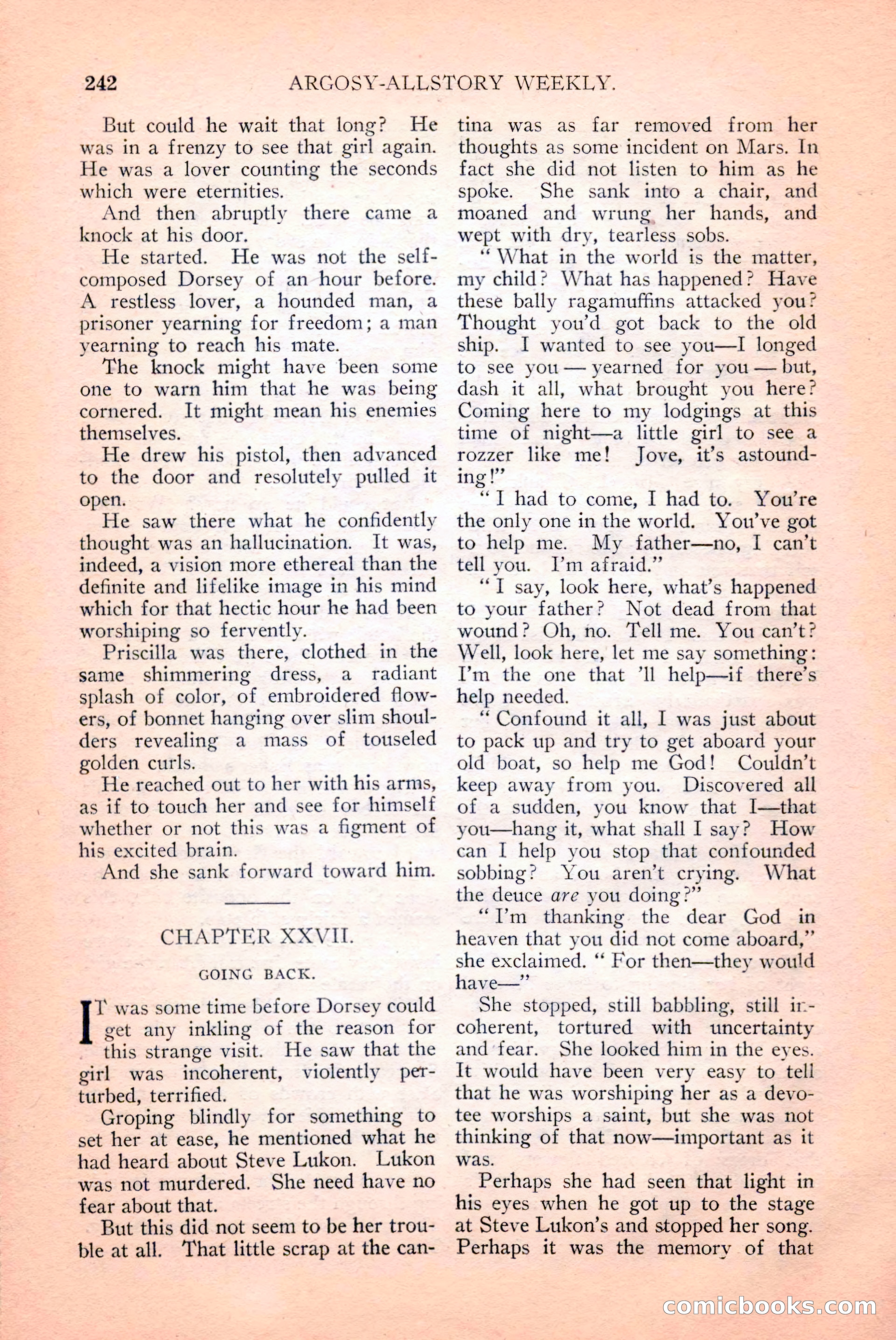
A restored page from Pulp Fiction, 1928. Page through the whole issue in the reader above.
📄 Transcribed text from this page (OCR, searchable)
Machine-transcribed from the original scan — historical spelling and the odd misread are preserved.
242 But could he wait that long? He was in a frenzy to see that girl again. He was a lover counting the seconds which were eternities. And then abruptly there came a knock at his door. He started. He was not the self- composed Dorsey of an hour before. A restless lover, a hounded man, a prisoner yearning for freedom; a man yearning to reach his mate. The knock might have been some one to warn him that he was being cornered. It might mean his enemies themselves. He drew his pistol, then advanced to the door and resolutely pulled it open. He saw there what he confidently thought was an hallucination. It was, indeed, a vision more ethereal than the definite and lifelike image in his mind which for that hectic hour he had been worshiping so fervently. Priscilla was there, clothed in the same shimmering dress, a_ radiant splash of color, of embroidered flow- ers, of bonnet hanging over slim shoul- ders revealing a mass of touseled golden curls. He reached out to her with his arms, as if to touch her and see for himself whether or not this was a figment of his excited brain. And she sank forward toward him. CHAPTER XXVIII. GOING BACK. T was some time before Dorsey could | get any inkling of the reason for this strange visit. He saw that the girl was incoherent, violently per- turbed, terrified. Groping blindly for something to set her at ease, he mentioned what he had heard about Steve Lukon. Lukon was not murdered. She need have no fear about that. But this did not seem to be her trou- ble at all. That little scrap at the can- ARGOSY-ALLSTORY WEEKLY. tina was as far removed from her thoughts as some incident on Mars. In fact she did not listen to him as he spoke. She sank into a chair, and moaned and wrung her hands, and wept with dry, tearless sobs. ‘“What in the world is the matter, my child? What has happened? Have these bally ragamuffins attacked you? Thought you'd got back to the old ship. I wanted to see you—lI longed to see you— yearned for you — but, dash it all, what brought you here? Coming here to my lodgings at this time of night—a little girl to see a rozzer like me! Jove, it’s astound- ing!’ “TIT had to come, I had to. You're the only one in the world. You've got to help me. My father—no, I can’t tell you. I’m afraid.” “TI say, look here, what’s happened to your father? Not dead from that wound? Oh, no. Tell me. You can’t? Well, look here, let me say something: I’m the one that ‘Il help—if there’s help needed. “ Confound it all, I was just about to pack up and try to get aboard your old boat, so help me God! Couldn’t keep away from you. Discovered all of a sudden, you know that I—that you—hang it, what shall I say? How can I help you stop that confounded sobbing? You aren’t crying. What the deuce are you doing?” “Tm thanking the dear God in heaven that you did not come aboard,” she exclaimed. “ For then—they would have—” She stopped, still babbling, still ir- coherent, tortured with uncertainty and ‘fear. She looked him in the eyes. It would have been very easy to tell that he was worshiping her as a devo- tee worships a saint, but she was not thinking of that now—uimportant as it was. Perhaps she had seen that light in his eyes when he got up to the stage at Steve Lukon’s and stopped her song. Perhaps it was the memory of that Gomichbooks (E@)