
Pulp Fiction, 1928 · page 99 of 160
Argosy All-Story Weekly, April 7, 1928 — page 99: what you’re looking at
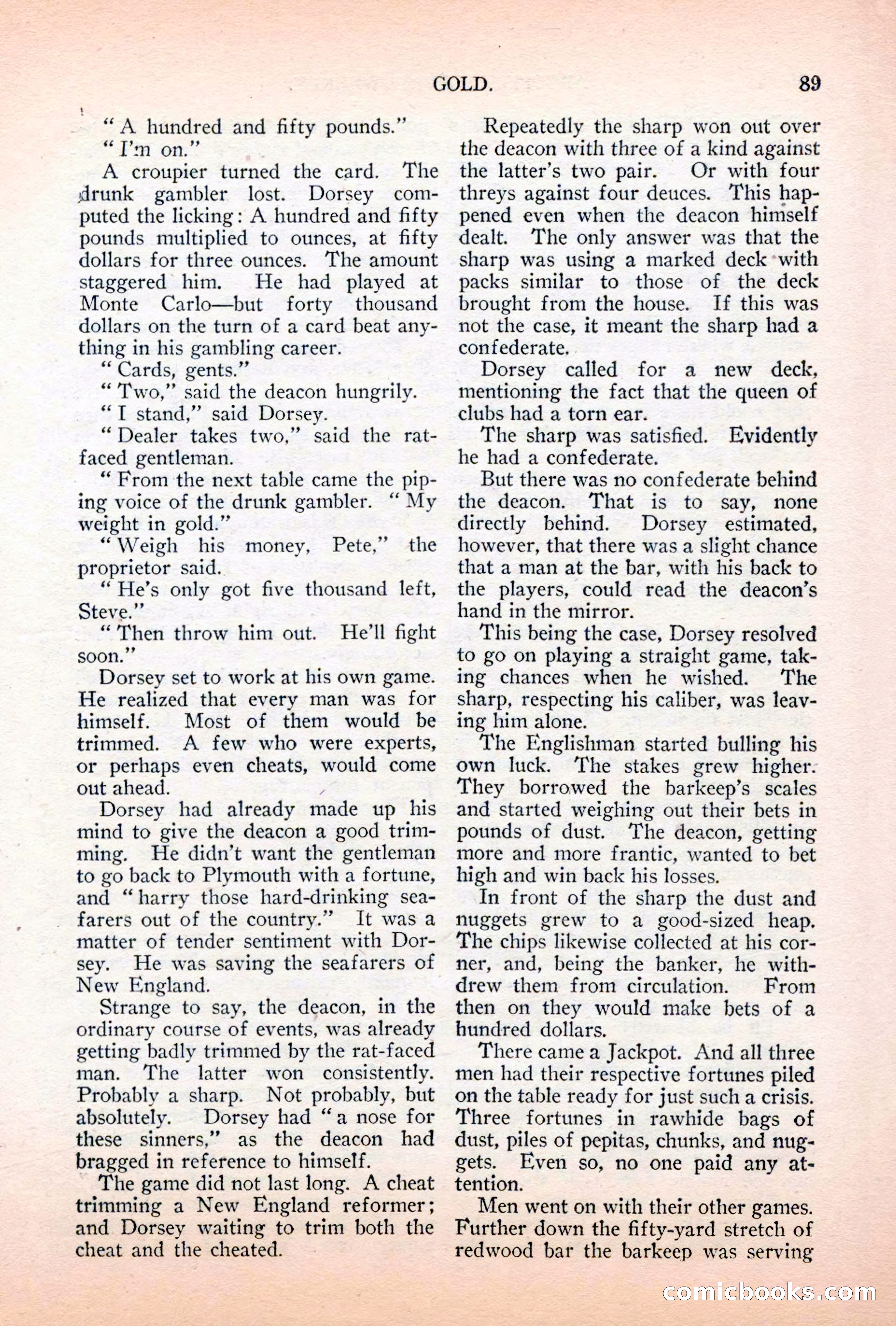
A restored page from Pulp Fiction, 1928. Page through the whole issue in the reader above.
📄 Transcribed text from this page (OCR, searchable)
Machine-transcribed from the original scan — historical spelling and the odd misread are preserved.
GOLD. “A hundred and fifty pounds.” “Fm on.” A croupier turned the card. The drunk gambler lost. Dorsey com- puted the licking: A hundred and fifty pounds multiplied to ounces, at fifty dollars for three ounces. The amount staggered him. He had played at Monte Carlo—but forty thousand dollars on the turn of a card beat any- thing in his gambling career. “ Cards, gents.” “Two,” said the deacon hungrily. “T stand,” said Dorsey. “Dealer takes two,” said the rat- faced gentleman. “From the next table came the pip- ing voice of the drunk gambler. “ My weight in gold.” “Weigh his proprietor said. “ He’s only got five thousand left, Steve.” “Then throw him out. soon.” Dorsey set to work at his own game. He realized that every man was for himself. Most of them would be trimmed. A few who were experts, or perhaps even cheats, would come out ahead. , Dorsey had already made up his mind to give the deacon a good trim- ming. He didn’t want the gentleman to go back to Plymouth with a fortune, and “harry those hard-drinking sea- farers out of the country.” It was a matter of tender sentiment with Dor- sey. He was saving the seafarers of New England. Strange to say, the deacon, in the ordinary course of events, was already getting badly trimmed by the rat-faced man. The latter won consistently. Probably a sharp. Not probably, but absolutely. Dorsey had “a nose for these sinners,” as the deacon had bragged in reference to himself. The game did not last long. A cheat trimming a New England reformer; and Dorsey waiting to trim both the cheat and the cheated. money, Pete,” the He'll fight 89 Repeatedly the sharp won out over the deacon with three of a kind against the latter’s two pair. Or with four threys against four deuces. This hap- pened even when the deacon himself dealt. The only answer was that the sharp was using a marked deck with packs similar to those of the deck brought from the house. If this was not the case, it meant the sharp had a confederate. Dorsey called for a new deck, mentioning the fact that the queen of clubs had a torn ear. The sharp was satisfied. Evidently he had a confederate. But there was no confederate behind the deacon. That is to say, none directly behind. Dorsey estimated, however, that there was a slight chance that a man at the bar, with his back to the players, could read the deacon’s hand in the mirror. This being the case, Dorsey resolved to go on playing a straight game, tak- ing chances when he wished. The sharp, respecting his caliber, was leav- ing him alone. The Englishman started bulling his own luck. The stakes grew higher. They borrowed the barkeep’s scales and started weighing out their bets in pounds of dust. The deacon, getting more and more frantic, wanted to bet high and win back his losses. In front of the sharp the dust and nuggets grew to a good-sized heap. The chips likewise collected at his cor- ner, and, being the banker, he with- drew them from circulation. From then on they would make bets of a hundred dollars. There came a Jackpot. And all three men had their respective fortunes piled on the table ready for just such a crisis. Three fortunes in rawhide bags of dust, piles of pepitas, chunks, and nug- gets. Even so, no one paid any at- tention. Men went on with their other games. Further down the fifty-yard stretch of redwood bar the barkeep was serving COLPMNIG OOO KS (E@)