
Pulp Fiction, 1928 · page 68 of 160
Argosy All-Story Weekly, April 7, 1928 — page 68: what you’re looking at
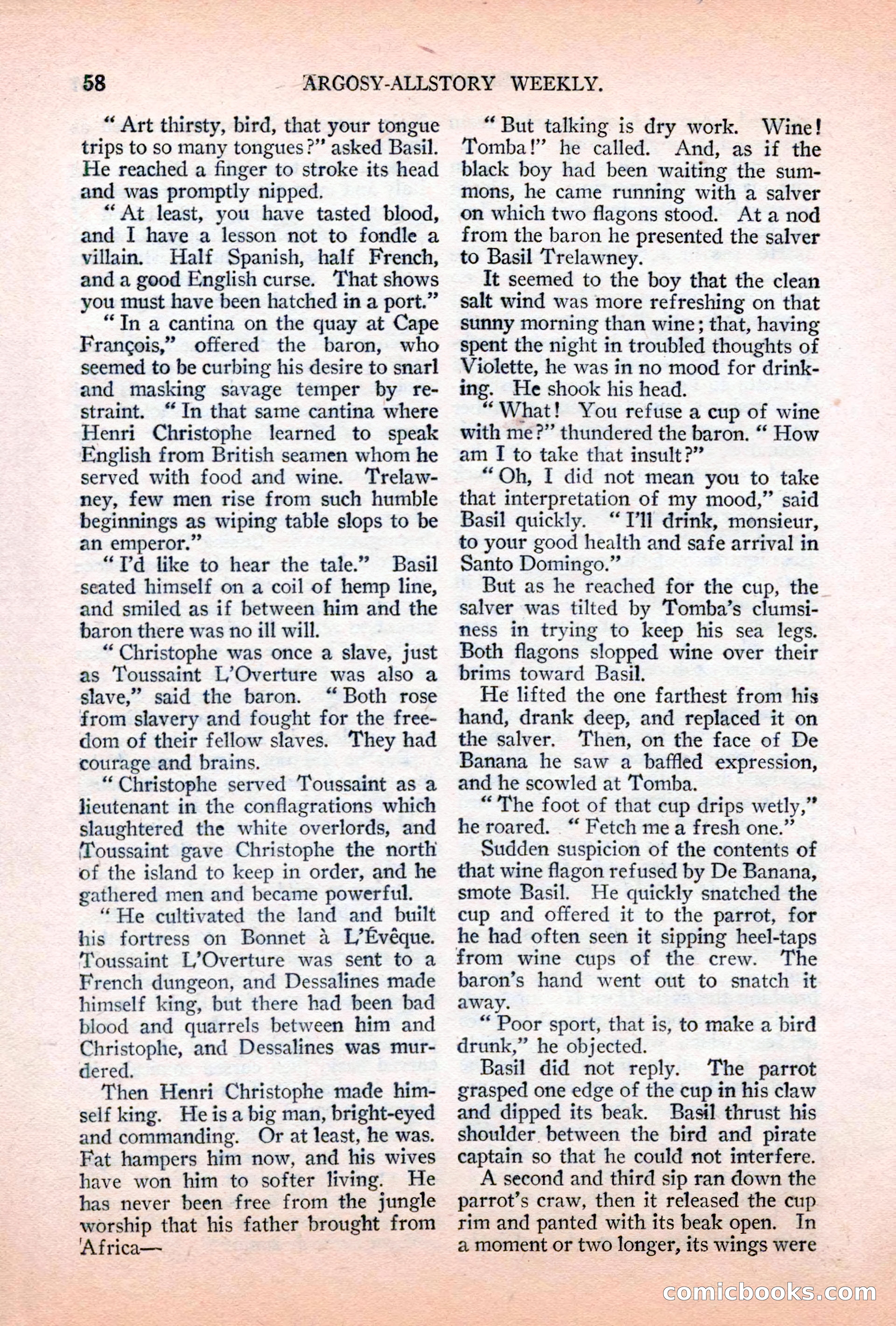
A restored page from Pulp Fiction, 1928. Page through the whole issue in the reader above.
📄 Transcribed text from this page (OCR, searchable)
Machine-transcribed from the original scan — historical spelling and the odd misread are preserved.
— 58 “ Art thirsty, bird, that your tongue trips to so many tongues?” asked Basil. He reached a finger to stroke its head and was promptly nipped. “At least, you have tasted blood, and I have a lesson not to fondle a villain. Half Spanish, half French, and a good English curse. That shows you must have been hatched in a port.” “In a cantina on the quay at Cape Francois,” offered the baron, who seemed to be curbing his desire to snarl and masking savage temper by re- straint. “In that same cantina where Henri Christophe learned to speak English from British seamen whom he served with food and wine. Trelaw- ney, few men rise from such humble beginnings as wiping table slops to be an emperor.” “Td like to hear the tale.” Basil seated himself on a coil of hemp line, and smiled as if between him and the baron there was no ill will. “ Christophe was once a slave, just as Toussaint L’Overture was also a slave,” said the baron. “ Both rose from slavery and fought for the free- dom of their fellow slaves. They had courage and brains. “Christophe served Toussaint as a lieutenant in the conflagrations which slaughtered the white overlords, and Toussaint gave Christophe the north of the island to keep in order, and he gathered men and became powerful. “He cultivated the land and built his fortress on Bonnet a L’Evéque. Toussaint L’Overture was sent to a French dungeon, and Dessalines made himself king, but there had been bad blood and quarrels between him and Christophe, and Dessalines was mur- dered. Then Henri Christophe made him- self king. Heis a big man, bright-eyed and commanding. Or at least, he was. Fat hampers him now, and his wives have won him to softer living. He has never been free from the jungle worship that his father brought from ‘A frica— ARGOSY-ALLSTORY WEEKLY. “But talking is dry work. Wine! Tomba!” he called. And, as if the black boy had been waiting the sum- mons, he came running with a salver on which two flagons stood. Ata nod from the baron he presented the salver to Basil Trelawney. Tt seemed to the boy that the clean salt wind was more refreshing on that sunny morning than wine; that, having spent the night in troubled thoughts of Violette, he was in no mood for drink- ing. He shook his head. “What! You refuse a cup of wine with me?” thundered the baron. “‘ How am I to take that insult?” “Oh, I did not mean you to take that interpretation of my mood,” said Basil quickly. “I'll drink, monsieur, to your good health and safe arrival in Santo Domingo.” But as he reached for the cup, the salver was tilted by Tomba’s clumsi- ness in trying to keep his sea legs. Both flagons slopped wine over their brims toward Basil. He lifted the one farthest from his hand, drank deep, and replaced it on the salver. ‘Then, on the face of De Banana he saw a baffled expression, and he scowled at Tomba. “The foot of that cup drips wetly,” he roared. “ Fetch mea fresh one.” Sudden suspicion of the contents of that wine flagon refused by De Banana, smote Basil. He quickly snatched the cup and offered it to the parrot, for he had often seen it sipping heel-taps from wine cups of the crew. The baron’s hand went out to snatch it away. “Poor sport, that is, to make a bird drunk,” he objected. Basil did not reply. The parrot grasped one edge of the cup in his claw and dipped its beak. Basil thrust his shoulder between the bird and pirate captain so that he could not interfere. A second and third sip ran down the parrot’s craw, then it released the cup rim and panted with its beak open. In a moment or two longer, its wings were Gomichbooks (E@)