
Pulp Fiction, 1928 · page 66 of 160
Argosy All-Story Weekly, April 7, 1928 — page 66: what you’re looking at
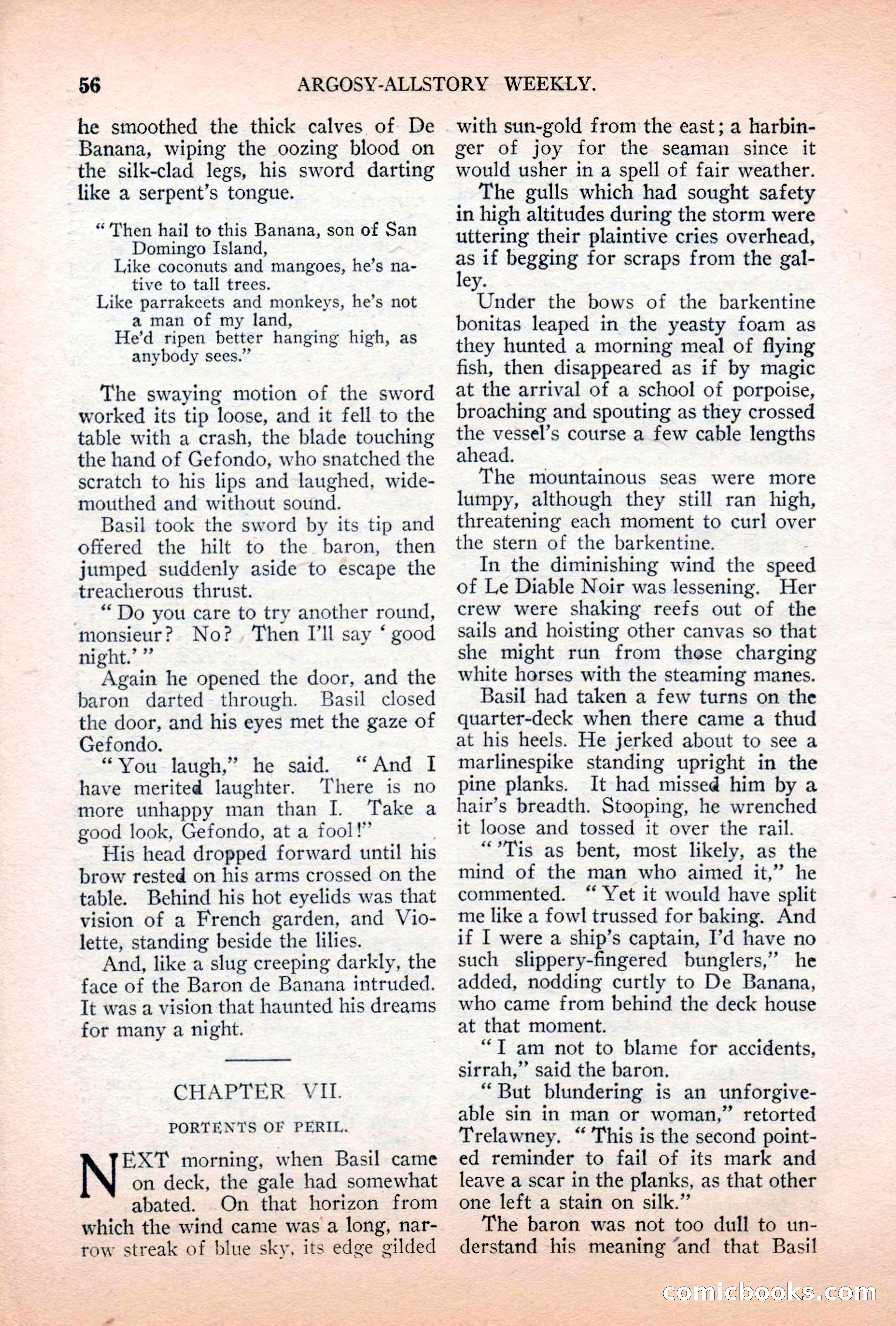
A restored page from Pulp Fiction, 1928. Page through the whole issue in the reader above.
📄 Transcribed text from this page (OCR, searchable)
Machine-transcribed from the original scan — historical spelling and the odd misread are preserved.
56 he smoothed the thick calves of De Banana, wiping the oozing blood on the silk-clad legs, his sword darting like a serpent’s tongue. “Then hail to this Banana, son of San Domingo Island, Like coconuts and mangoes, he’s na- tive to tall trees. Like parrakeets and monkeys, he’s not a man of my land, He’d ripen better hanging high, as anybody sees.” The swaying motion of the sword worked its tip loose, and it fell to the table with a crash, the blade touching the hand of Gefondo, who snatched the scratch to his lips and laughed, wide- mouthed and without sound. Basil took the sword by its tip and offered the hilt to the baron, then jumped suddenly aside to escape the treacherous thrust. “Do you care to try another round, monsieur? No?. Then I'll say * good night.’ ” Again he opened the door, and the baron darted through. Basil closed the door, and his eyes met the gaze of Gefondo. “You laugh,” he said. “And I have merited laughter. There is no more unhappy man than I. Take a good look, Gefondo, at a fool!” His head dropped forward until his brow rested on his arms crossed on the table. Behind his hot eyelids was that vision of a French garden, and Vio- lette, standing beside the lilies. And, like a slug creeping darkly, the face of the Baron de Banana intruded. It was a vision that haunted his dreams for many a night. CHAPTER. VII. PORTENTS OF PERIL. EXT morning, when Basil came on deck, the gale had somewhat abated. On that horizon from which the wind came was a long, nar- row streak of blue sky, its edge gilded ARGOSY-ALLSTORY WEEKLY. with sun-gold from the east; a harbin- ger of joy for the seaman since it would usher in a spell of fair weather. The gulls which had sought safety in high altitudes during the storm were uttering their plaintive cries overhead, as if begging for scraps from the gal- ley. "Wiauet the bows of the barkentine bonitas leaped in the yeasty foam as they hunted a morning meal of flying fish, then disappeared as if by magic at the arrival of a school of porpoise, broaching and spouting as they crossed the vessel’s course a few cable lengths ahead. The mountainous seas were more lumpy, although they still ran high, threatening each moment to curl over the stern of the barkentine. In the diminishing wind the speed of Le Diable Noir was lessening. Her crew were shaking reefs out of the sails and hoisting other canvas so that she might run from these charging white horses with the steaming manes. Basil had taken a few turns on the quarter-deck when there came a thud at his heels. He jerked about to see a marlinespike standing upright in the pine planks. It had missed him by a hair’s breadth. Stooping, he wrenched it loose and tossed it over the rail. “*Tis as bent, most likely, as the mind of the man who aimed it,” he commented. “ Yet it would have split me like a fowl trussed for baking. And if | were a ship’s captain, I’d have no such slippery-fingered bunglers,” he added, nodding curtly to De Banana, who came from behind the deck house at that moment. “T am not to blame for accidents, sirrah,”’ said the baron. “But blundering is an unforgive- able sin in man or woman,” retorted Trelawney. “ This is the second point- ed reminder to fail of its mark and leave a scar in the planks, as that other one left a stain on silk.” The baron was not too dull to un- derstand his meaning ‘and that Basil (€(0) .OOKS AMIN (E@)