
Pulp Fiction, 1928 · page 47 of 160
Argosy All-Story Weekly, April 7, 1928 — page 47: what you’re looking at
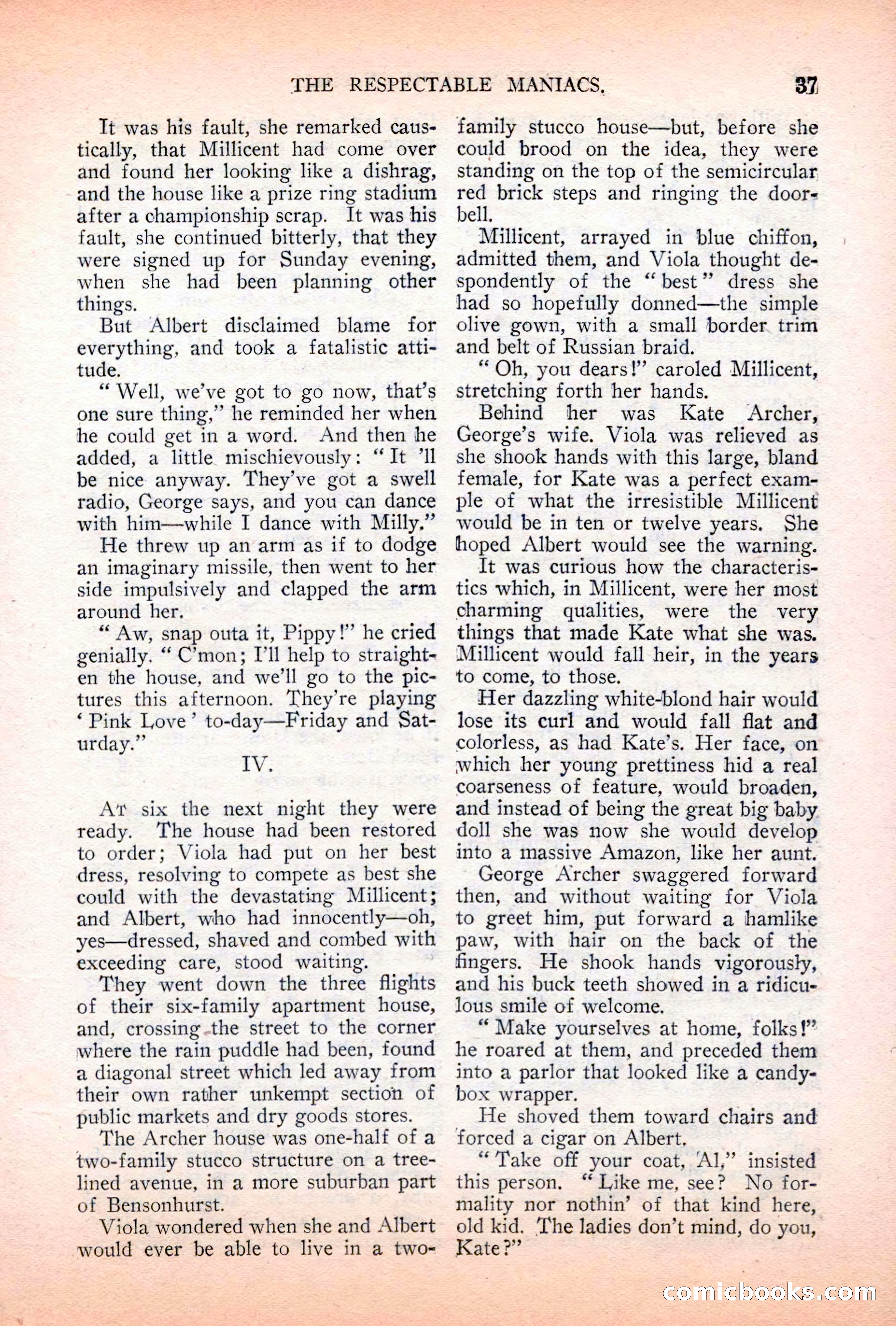
A restored page from Pulp Fiction, 1928. Page through the whole issue in the reader above.
📄 Transcribed text from this page (OCR, searchable)
Machine-transcribed from the original scan — historical spelling and the odd misread are preserved.
THE RESPECTABLE MANIACS, Tt was his fault, she remarked caus- tically, that Millicent had come over and found her looking like a dishrag, and the house like a prize ring stadium after a championship scrap. It was his fault, she continued bitterly, that they were signed up for Sunday evening, when she had been planning other things. But Albert disclaimed blame for everything, and took a fatalistic atti- tude. “Well, we’ve got to go now, that’s one sure thing,” he reminded her when he could get in a word. And then he added, a little mischievously: “It ‘ll be nice anyway. They’ve got a swell radio, George says, and you can dance with him—while I dance with Milly,” He threw up an arm as if to dodge an imaginary missile, then went to her side impulsively and clapped the arm around her. ““ Aw, snap outa it, Pippy!’’ he cried genially. “ C’mon; [’ll help to straight- en the house, and we'll go to the pic- tures this afternoon. They’re playing ‘Pink Love’ to-day—Friday and Sat- urday.” IV. At six the next night they were ready. ‘The house had been restored to order; Viola had put on her best dress, resolving to compete as best she could with the devastating Millicent; and Albert, who had innocently—oh, yes—dressed, shaved and combed with exceeding care, stood waiting. They went down the three flights of their six-family apartment house, and, crossing the street to the corner where the rain puddle had been, found a diagonal street which led away from their own rather unkempt section of public markets and dry goods stores. The Archer house was one-half of a two-family stucco structure on a tree- lined avenue, in a more suburban part of Bensonhurst. Viola wondered when she and Albert would ever be able to live in a two- on family stucco house—but, before she could brood on the idea, they were standing on the top of the semicircular ie brick steps and ringing the door- ell. Millicent, arrayed in blue chiffon, admitted them, and Viola thought de- spondently of the “best” dress she had so hopefully donned—the simple olive gown, with a small border. trim and belt of Russian braid. “Oh, you dears!’ caroled Millicent, stretching forth her hands. Behind her was Kate Archer, George’s wife. Viola was relieved as she shook hands with this large, bland female, for Kate was a perfect exam- ple of what the irresistible Millicent would be in ten or twelve years. She hoped Albert would see the warning. It was curious how the characteris- tics which, in Millicent, were her most charming qualities, were the very things that made Kate what she was. Millicent would fall heir, in the years to come, to those. Her dazzling white-blond hair would lose its curl and would fall flat and colorless, as had Kate’s. Her face, on which her young prettiness hid a real coarseness of feature, would broaden, and instead of being the great big baby doll she was now she would develop into a massive Amazon, like her aunt. George Archer swaggered forward then, and without waiting for Viola to greet him, put forward a hamlike paw, with hair on the back of the fingers. He shook hands vigorously, and his buck teeth showed in a ridicu- lous smile of welcome. “Make yourselves at home, folks!’ he roared at them, and preceded them into a parlor that looked like a candy- box wrapper. He shoved them toward chairs and forced a cigar on Albert. “Take off your coat, ‘Al,’ insisted this person. “ Like me, see? No for- mality nor nothin’ of that kind here, old kid. ‘The ladies don’t mind, do you, Kate?” DOOKS (EOL MCE (E@)