
Pulp Fiction, 1928 · page 32 of 160
Argosy All-Story Weekly, April 7, 1928 — page 32: what you’re looking at
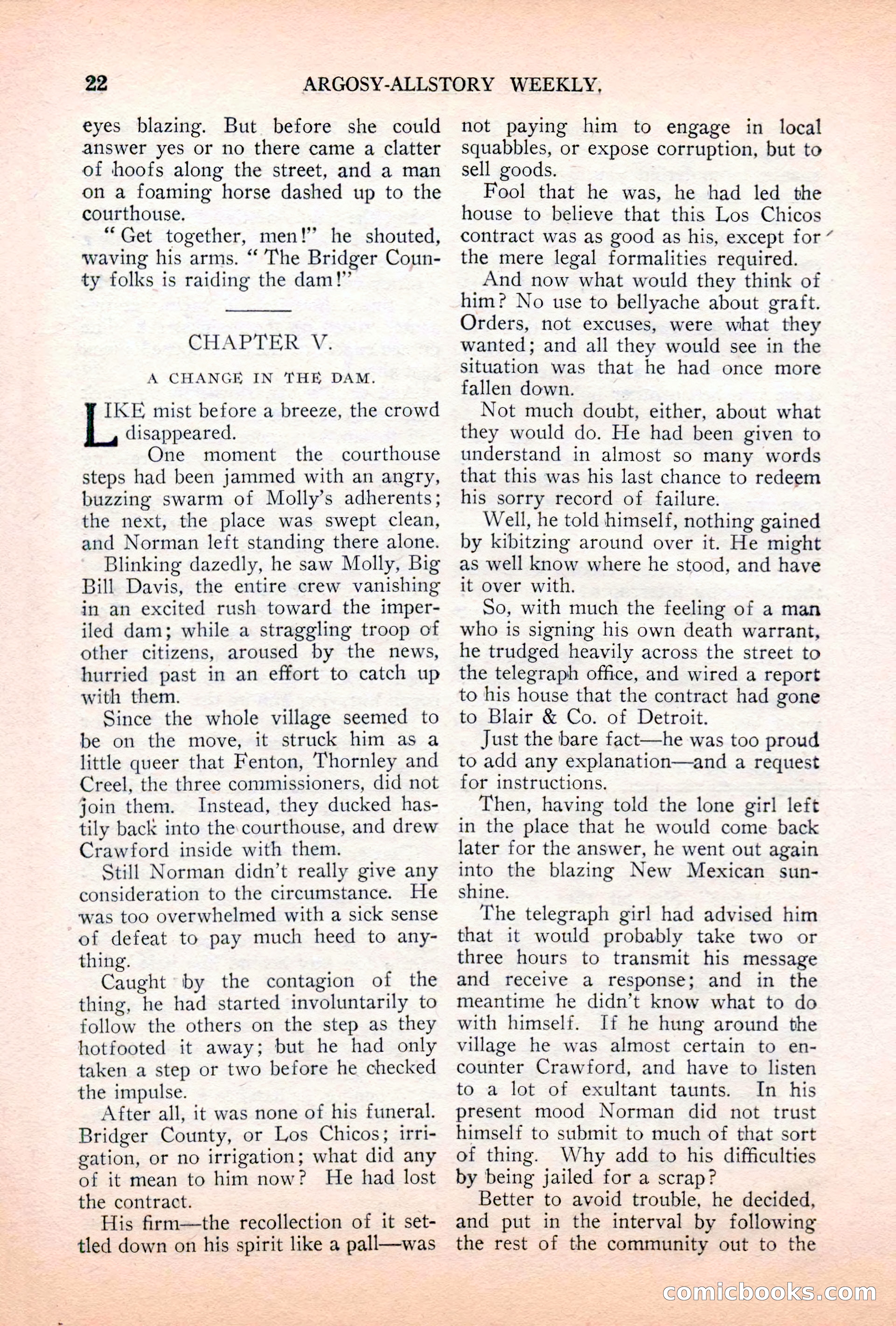
A restored page from Pulp Fiction, 1928. Page through the whole issue in the reader above.
📄 Transcribed text from this page (OCR, searchable)
Machine-transcribed from the original scan — historical spelling and the odd misread are preserved.
22 eyes blazing. But before she could answer yes or no there came a clatter of hoofs along the street, and a man on a foaming horse dashed up to the courthouse. “Get together, men!’’ he shouted, waving his arms. “‘ The Bridger Coun- ty folks is raiding the dam!” CHAPTER-V. A CHANGE IN THE DAM. IKE mist before a breeze, the crowd disappeared. One moment the courthouse steps had been jammed with an angry, buzzing swarm of Molly’s adherents; the next, the place was swept clean, and Norman left standing there alone. Blinking dazedly, he saw Molly, Big Bill Davis, the entire crew vanishing in an excited rush toward the imper- iled dam; while a straggling troop of other citizens, aroused by the news, hurried past in an effort to catch up with them. Since the whole village seemed to be on the move, it struck him as a little queer that Fenton, Thornley and Creel, the three commissioners, did not join them. Instead, they ducked has- tily back into the courthouse, and drew Crawford inside with them. Still Norman didn’t really give any consideration to the circumstance. He was too overwhelmed with a sick sense of defeat to pay much heed to any- thing. Caught by the contagion of the thing, he had started involuntarily to follow the others on the step as they hotfooted it away; but he had only taken a step or two before he checked the impulse. After all, it was none of his funeral. Bridger County, or Los Chicos; irri- gation, or no irrigation; what did any of it mean to him now? He had lost the contract. His firm—the recollection of it set- tled down on his spirit like a pall—was ARGOSY-ALLSTORY WEEKLY, not paying him to engage in local squabbles, or expose corruption, but to sell goods. Fool that he was, he had led the house to believe that this Los Chicos contract was as good as his, except for the mere legal formalities required. And now what would they think of him? No use to bellyache about graft. Orders, not excuses, were what they wanted; and all they would see in the situation was that he had once more fallen down. Not much doubt, either, about what they would do. He had been given to understand in almost so many words that this was his last chance to redeem his sorry record of failure. Well, he told himself, nothing gained by kibitzing around over it. He might as well know where he stood, and have it over with. So, with much the feeling of a man who is signing his own death warrant, he trudged heavily across the street to the telegraph office, and wired a report to his house that the contract had gone to Blair & Co. of Detroit. Just the bare fact—he was too proud to add any explanation—and a request for instructions. Then, having told the lone girl left in the place that he would come back later for the answer, he went out again into the blazing New Mexican sun- shine. : The telegraph girl had advised him that it would probably take two or three hours to transmit his message and receive a response; and in the meantime he didn’t know what to do with himself. If he hung around the village he was almost certain to en- counter Crawford, and have to listen to a lot of exultant taunts. In his present mood Norman did not trust himself to submit to much of that sort of thing. Why add to his difficulties by being jailed for a scrap? Better to avoid trouble, he decided, and put in the interval by following the rest of the community out to the COPMIC LOOKS (E@)