
Pulp Fiction, 1928 · page 21 of 160
Argosy All-Story Weekly, April 7, 1928 — page 21: what you’re looking at
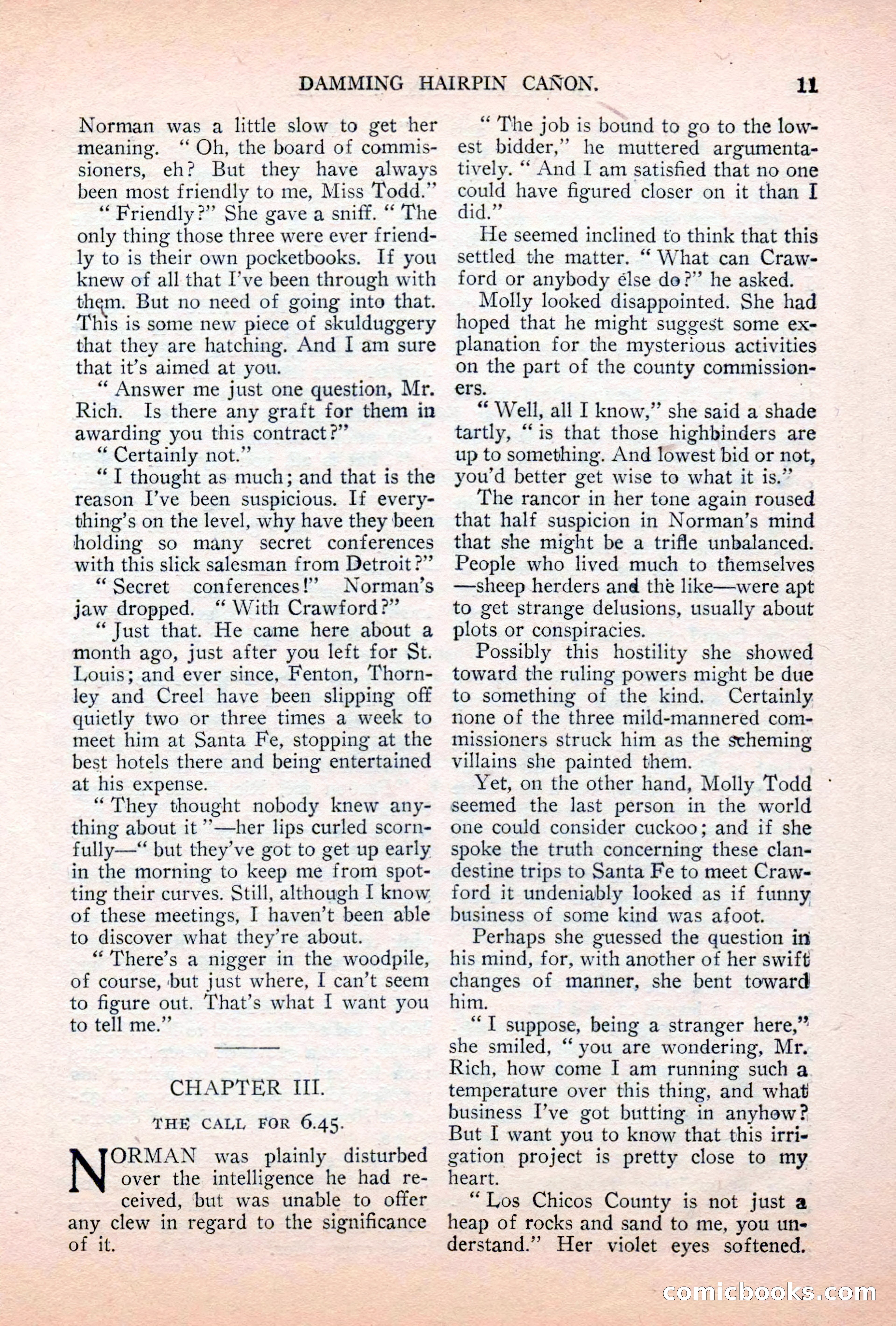
A restored page from Pulp Fiction, 1928. Page through the whole issue in the reader above.
📄 Transcribed text from this page (OCR, searchable)
Machine-transcribed from the original scan — historical spelling and the odd misread are preserved.
DAMMING HAIRPIN CANON, Norman was a little slow to get her meaning. ‘‘ Oh, the board of commis- sioners, eh? But they have always been most friendly to me, Miss Todd.” “Friendly?” She gave a sniff. “ The only thing those three were ever friend- ly to is their own pocketbooks. If you knew of all that I’ve been through with them. But no need of going into that. This is some new piece of skulduggery that they are hatching. And I am sure that it’s aimed at you. “‘ Answer me just one question, Mr. Rich. Is there any graft for them in awarding you this contract?” “ Certainly not.” “T thought as much; and that is the reason I’ve been suspicious. If every- thing’s on the level, why have they been holding so many secret conferences with this slick salesman from Detroit?” “Secret conferences!” Norman’s jaw dropped. “ With Crawford?” “Just that. He came here about a month ago, just after you left for St. Louis; and ever since, Fenton, Thorn- ley and Creel have been slipping off quietly two or three times a week to meet him at Santa Fe, stopping at the best hotels there and being entertained at his expense. “They thought nobody knew any- thing about it ’’—her lips curled scorn- fully—* but they’ve got to get up early in the morning to keep me from spot- ting their curves. Still, although [ know of these meetings, I haven’t been able to discover what they’re about. “ There’s a nigger in the woodpile, of course, but just where, I can’t seem to figure out. That’s what [ want you to tell me.” CHAPTER III. THE CALL FOR 6.45. ORMAN was plainly disturbed over the intelligence he had re- ceived, but was unable to offer any clew in regard to the significance of it. 11 “The job is bound to go to the low- est bidder,” he muttered argumenta- tively. “ And I am satisfied that no one could have figured closer on it than I did.” He seemed inclined to think that this settled the matter. “ What can Craw- ford or anybody élse de?” he asked. Molly looked disappointed. She had hoped that he might suggest some ex- planation for the mysterious activities on the part of the county commission- ers. : “Well, all I know,” she said a shade tartly, “is that those highbinders are up to something. And lowest bid or not, you'd better get wise to what it is.” The rancor in her tone again roused that half suspicion in Norman’s mind that she might be a trifle unbalanced. People who lived much to themselves —sheep herders and the like—were apt to get strange delusions, usually about plots or conspiracies. Possibly this hostility she showed toward the ruling powers might be due to something of the kind. Certainly none of the three mild-mannered com- missioners struck him as the scheming villains she painted them. Yet, on the other hand, Molly Todd - seemed the last person in the world one could consider cuckoo; and if she spoke the truth concerning these clan- destine trips to Santa Fe to meet Craw- ford it undeniably looked as if funny business of some kind was afoot. Perhaps she guessed the question in his mind, for, with another of her swift changes of manner, she bent toward him. “I suppose, being a stranger here,” she smiled, “you are wondering, Mr. Rich, how come I am running such a temperature over this thing, and what business I’ve got butting in anyhow? But I want you to know that this irri- gation project is pretty close to my heart. “Los Chicos County is not just a heap of rocks and sand to me, you un- derstand.” Her violet eyes softened. EORIIE OOOL<S (E©)