
Pulp Fiction, 1928 · page 150 of 160
Argosy All-Story Weekly, April 7, 1928 — page 150: what you’re looking at
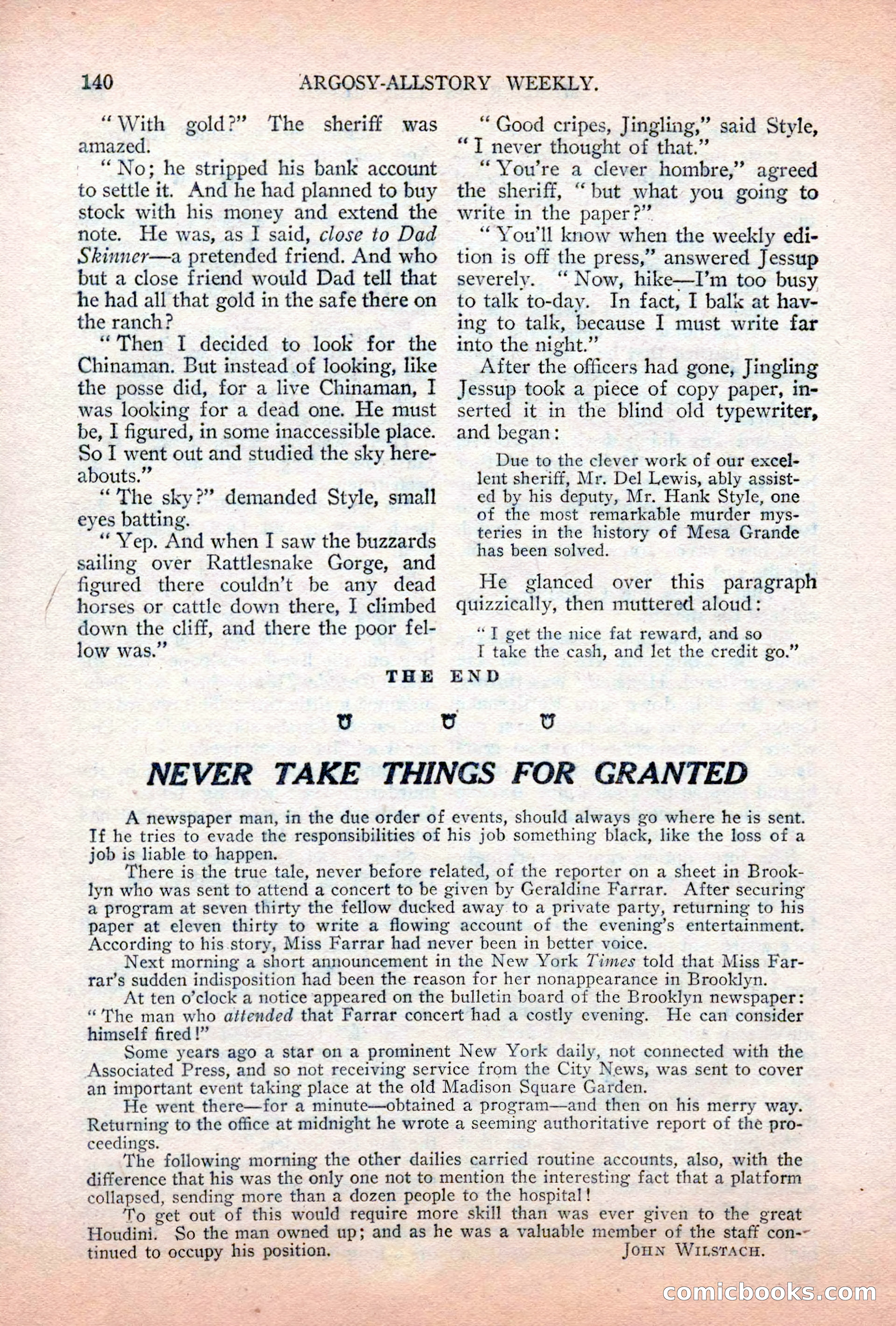
A restored page from Pulp Fiction, 1928. Page through the whole issue in the reader above.
📄 Transcribed text from this page (OCR, searchable)
Machine-transcribed from the original scan — historical spelling and the odd misread are preserved.
140 “With gold?” amazed. : “No; he stripped his bank account to settle it. And he had planned to buy stock with his money and extend the note. He was, as I said, close to Dad Skinner—a pretended friend. And who but a close friend would Dad tell that he had all that gold in the safe there on the ranch? “Then I decided to look for the Chinaman. But instead of looking, like the posse did, for a live Chinaman, I was looking for a dead one. He must be, I figured, in some inaccessible place. So I went out and studied the sky here- abouts.” “The sky?” demanded Style, small eyes batting. “Yep. And when I saw the buzzards sailing over Rattlesnake Gorge, and figured there couldn’t be any dead horses or cattle down there, J climbed down the cliff, and there the poor fel- low was.” The sheriff was ARGOSY-ALLSTORY WEEKLY. “ Good cripes, Jingling,” said Style, “T never thought of that.” “You're a clever hombre,” agreed the sheriff, “but what you going to ~ write in the paper?” “You'll know when the weekly edi- tion is off the press,” answered Jessup severely. “ Now, hike—I’m too busy to talk to-day. In fact, I balk at hav- ing to talk, because I must write far into the night.” After the officers had gone, Jingling Jessup took a piece of copy paper, in- serted it in the blind old typewriter, and began: Due to the clever work of our excel- lent sheriff, Mr. Del Lewis, ably assist- ed by his deputy, Mr. Hank Style, one of the most remarkable murder mys- teries in the history of Mesa Grande has been solved. He glanced over this paragraph quizzically, then muttered aloud: ‘“ T get the nice fat reward, and so I take the cash, and let the credit go.” THE END Le o U NEVER TAKE THINGS FOR GRANTED A newspaper man, in the due order of events, should always go where he is sent. Tf he tries to evade the responsibilities of his job something black, like the loss of a job is liable to happen. There is the true tale, never before related, of the reporter on a sheet in Brook- lyn who was sent to attend a concert to be given by Geraldine Farrar. After securing a program at seven thirty the fellow ducked away to a private party, returning to his paper at eleven thirty to write a flowing account of the evening’s entertainment. According to his.story, Miss Farrar had never been in better voice. Next morning a short announcement in the New York Times told that Miss Far- rat’s sudden indisposition had been the reason for her nonappearance in Brooklyn. At ten o’clock a notice appeared on the bulletin board of the Brooklyn newspaper: “The man who attended that Farrar concert had a costly evening. He can consider himself fired!” Some yeats ago a star on a prominent New York daily, not connected with the Associated Press, and so not receiving service from the City News, was sent to cover an important event taking place at the old Madison Square Garden. He went there—for a minute—obtained a program—and then on his merry way. Returning to the office at midnight he wrote a seeming authoritative report of the pro- ceedings. The following morning the other dailies carried routine accounts, also, with the difference that his was the only one not to mention the interesting fact that a platform collapsed, sending more than a dozen people to the hospital! To get out of this would require more skill than was ever given to the great Houdini. So the man owned up; and as he was a valuable member of the staff con-~- tinued to occupy his position, JoHN WILSTACH. -com Ghooks (E(0)