
Pulp Fiction, 1928 · page 141 of 160
Argosy All-Story Weekly, April 7, 1928 — page 141: what you’re looking at
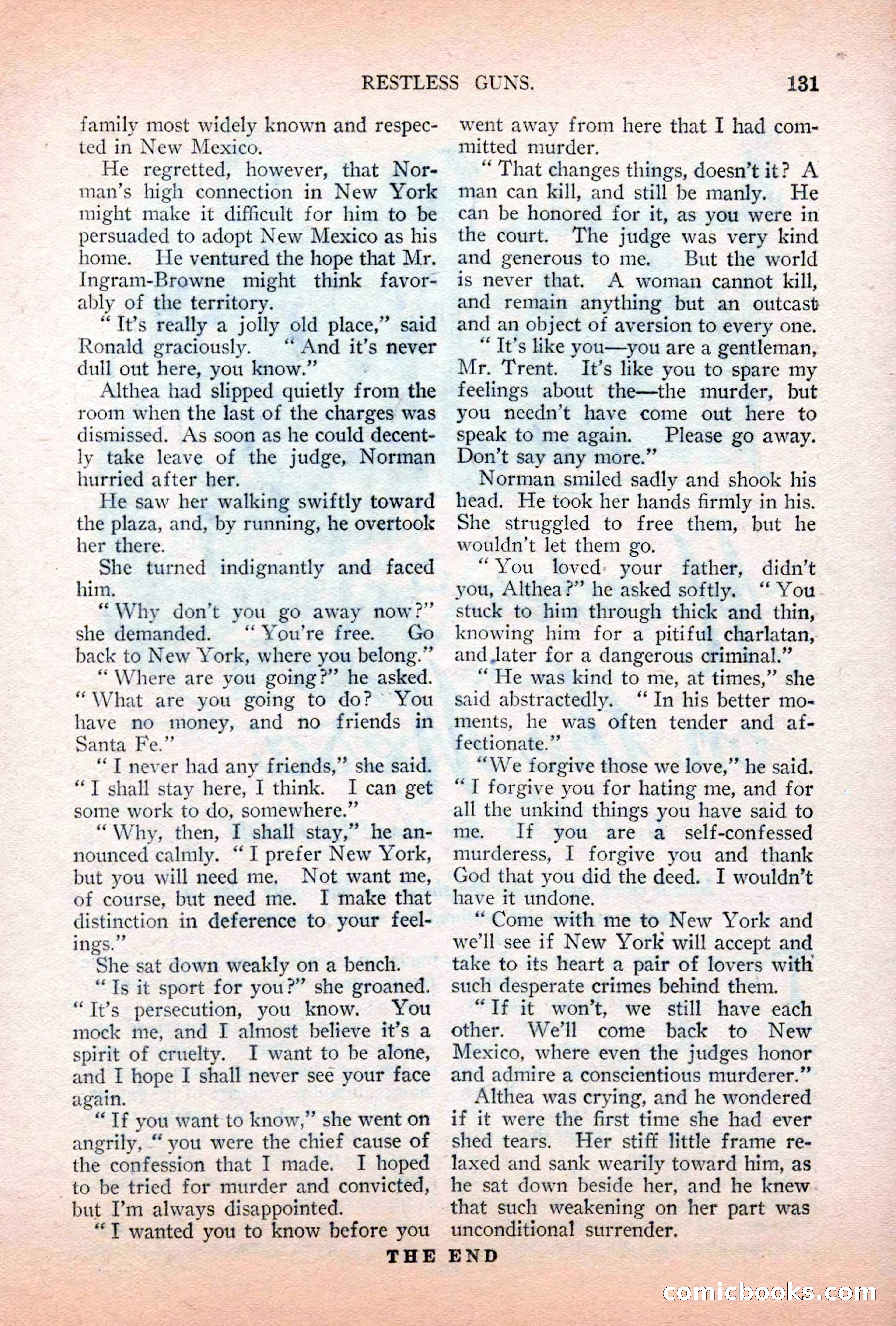
A restored page from Pulp Fiction, 1928. Page through the whole issue in the reader above.
📄 Transcribed text from this page (OCR, searchable)
Machine-transcribed from the original scan — historical spelling and the odd misread are preserved.
RESTLESS GUNS. family most widely known and respec- ted in New Mexico. He regretted, however, that Nor- man’s high connection in New York might make it difficult for him to be persuaded to adopt New Mexico as his home. He ventured the hope that Mr. Ingram-Browne might think favor- ably of the territory. “Tt’s really a jolly old place,” said Ronald graciously. “ And it’s never dull out here, you know.” Althea had slipped quietly from the room when the last of the charges was dismissed. As soon as he could decent- ly take leave of the judge, Norman hurried after her. He saw her walking swiftly toward the plaza, and, by running, he overtook her there. ; She turned indignantly and faced him, “Why don’t you go away now?” she demanded. ‘‘ You’re free. Go back to New York, where you belong.” “Where are you going?” he asked. “What are you going to do? You have no money, and no friends in Santa Fe.” ‘“T never had any friends,” she said. “T shall stay here, I think. I can get some work to do, somewhere.”’ “Why, then, I shall stay,” he an- nounced calmly. “I prefer New York, but you will need me, Not want me, of course, but need me. I make that distinction in deference to your feel- ings.” ‘She sat down weakly on a bench. “Ts it sport for you?” she groaned. “Tt’s persecution, you know. You mock me, and I almost believe it’s a spirit of cruelty. I want to be alone, and I hope I shall never see your face again. eS you want to know,” she went on angrily, “ you were the chief cause of the confession that I made. I hoped to be tried for murder and convicted, but I’m always disappointed. “T wanted you to know before you 33 131 went away from here that I had com- mitted murder. ‘“ That changes things, doesn’t it? A man can kill, and still be manly. He can be honored for it, as you were in the court. The judge was very kind and generous to me. But the world is never that. A woman cannot kill, and remain anything but an outcast and an object of aversion to every one. “ It’s like you—you are a gentleman, Mr. Trent. It’s like you to spare my feelings about the—the murder, but you needn’t have come out here to speak to me again. Please go away. Don’t say any more.” | Norman smiled sadly and shook his head. He took her hands firmly in his. She struggled to free them, but he wouldn’t let them go. “You loved: your father, didn’t you, Althea?” he asked softly. ‘“‘ You stuck to him through thick and thin, knowing him for a pitiful charlatan, and later for a dangerous criminal.” ‘He was kind to me, at times,” she said abstractedly. ‘In his better mo- ments, he was often tender and af- fectionate.” “We forgive those we love,” he said. “T forgive you for hating me, and for all the unkind things you have said to me. If you are a_ self-confessed murderess, I forgive you and thank God that you did the deed. I wouldn’t have it undone. “Come with me to New York and we'll see if New York will accept and take to its heart a pair of lovers with such desperate crimes behind them. “If it won't, we still have each other. We'll come back to New Mexico, where even the judges honor and admire a conscientious murderer.” Althea was crying, and he wondered if it were the first time she had ever shed tears. Her stiff little frame re- laxed and sank wearily toward him, as he sat down beside her, and he knew. that such weakening on her part was unconditional surrender. THE END GEomichooks €or