
Pulp Fiction, 1928 · page 130 of 160
Argosy All-Story Weekly, April 7, 1928 — page 130: what you’re looking at
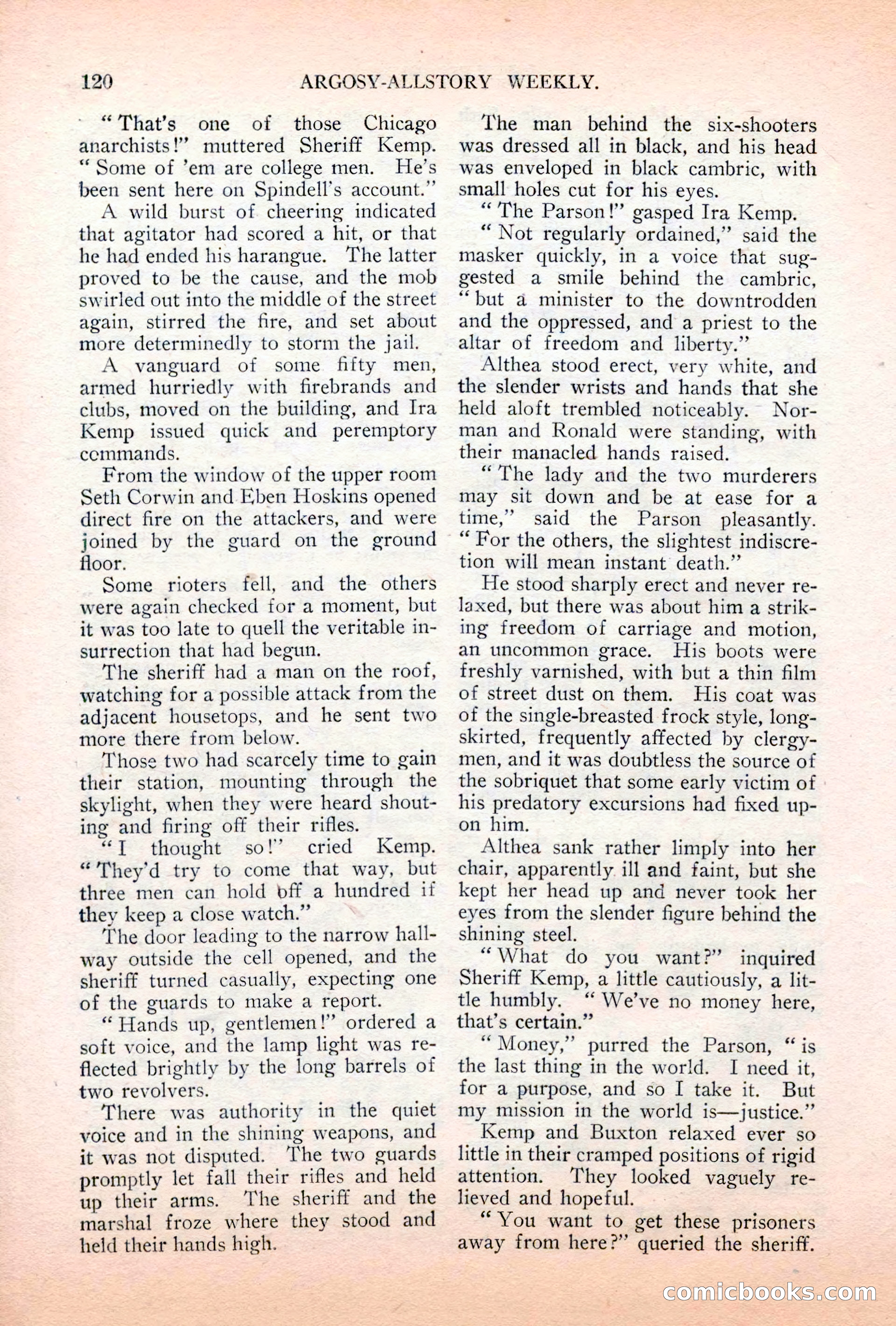
A restored page from Pulp Fiction, 1928. Page through the whole issue in the reader above.
📄 Transcribed text from this page (OCR, searchable)
Machine-transcribed from the original scan — historical spelling and the odd misread are preserved.
120 “That’s one of those Chicago anarchists!” muttered Sheriff Kemp. “Some of ’em are college men. He’s been sent here on Spindell’s account.” A wild burst of cheering indicated that agitator had scored a hit, or that he had ended his harangue. The latter proved to be the cause, and the mob swirled out into the middle of the street again, stirred the fire, and set about more determinedly to storm the jail. A vanguard of some fifty men, armed hurriedly with firebrands and clubs, moved on the building, and Ira Kemp issued quick and peremptory cemmands. From the window of the upper room Seth Corwin and Eben Hoskins opened direct fire on the attackers, and were joined by the guard on the ground floor. Some rioters fell, and the others were again checked for a moment, but it was too late to quell the veritable in- surrection that had begun. The sheriff had a man on the roof, watching for a possible attack from the adjacent housetops, and he sent two more there from below. Those two had scarcely time to gain their station, mounting through the skylight, when they were heard shout- ing and firing off their rifles. “TI thought so!’ cried Kemp. “They'd try to come that way, but three men can hold bff a hundred if they keep a close watch.” The door leading to the narrow hall- way outside the cell opened, and the sheriff turned casually, expecting one of the guards to make a report. “Hands up, gentlemen!” ordered a soft voice, and the lamp light was re- flected brightly by the long barrels of two revolvers. There was authority in the quiet voice and in the shining weapons, and it was not disputed. The two guards promptly let fall their rifles and held up their arms. The sheriff and the marshal froze where they stood and held their hands high. ARGOSY-ALLUSTORY WEEKLY. The man behind the six-shooters was dressed all in black, and his head was enveloped in black cambric, with small holes cut for his eyes. “The Parson!” gasped Ira Kemp. “Not regularly ordained,” said the masker quickly, in a voice that sug- gested a smile behind the cambric, “but a minister to the downtrodden and the oppressed, and a priest to the altar of freedom and liberty.” Althea stood erect, very white, and the slender wrists and hands that she held aloft trembled noticeably. Nor- man and Ronald were standing, with their manacled hands raised. “The lady and the two murderers may sit down and be at ease for a time,’ said the Parson pleasantly. “For the others, the slightest indiscre- tion will mean instant death.” He stood sharply erect and never re- laxed, but there was about him a strik- ing freedom of carriage and motion, an uncommon grace. His boots were freshly varnished, with but a thin film of street dust on them. His coat was of the single-breasted frock style, long- skirted, frequently affected by clergy- men, and it was doubtless the source of the sobriquet that some early victim of his predatory excursions had fixed up- on him. Althea sank rather limply into her chair, apparently ill and faint, but she kept her head up and never took her eyes from the slender figure behind the shining steel. “What do you want?” inquired Sheriff Kemp, a little cautiously, a lit- tle humbly. “ We’ve no money here, that’s certain.” “Money,” purred the Parson, “ is the last thing in the world. I need it, for a purpose, and so I take it. But my mission in the world is—justice.”’ IXemp and Buxton relaxed ever so little in their cramped positions of rigid attention. They looked vaguely re- lieved and hopeful. “You want to get these prisoners away from here?” queried the sheriff. Gomichbooks (E@)