
Pulp Fiction, 1928 · page 127 of 160
Argosy All-Story Weekly, April 7, 1928 — page 127: what you’re looking at
A restored page from Pulp Fiction, 1928. Page through the whole issue in the reader above.
📄 Transcribed text from this page (OCR, searchable)
Machine-transcribed from the original scan — historical spelling and the odd misread are preserved.
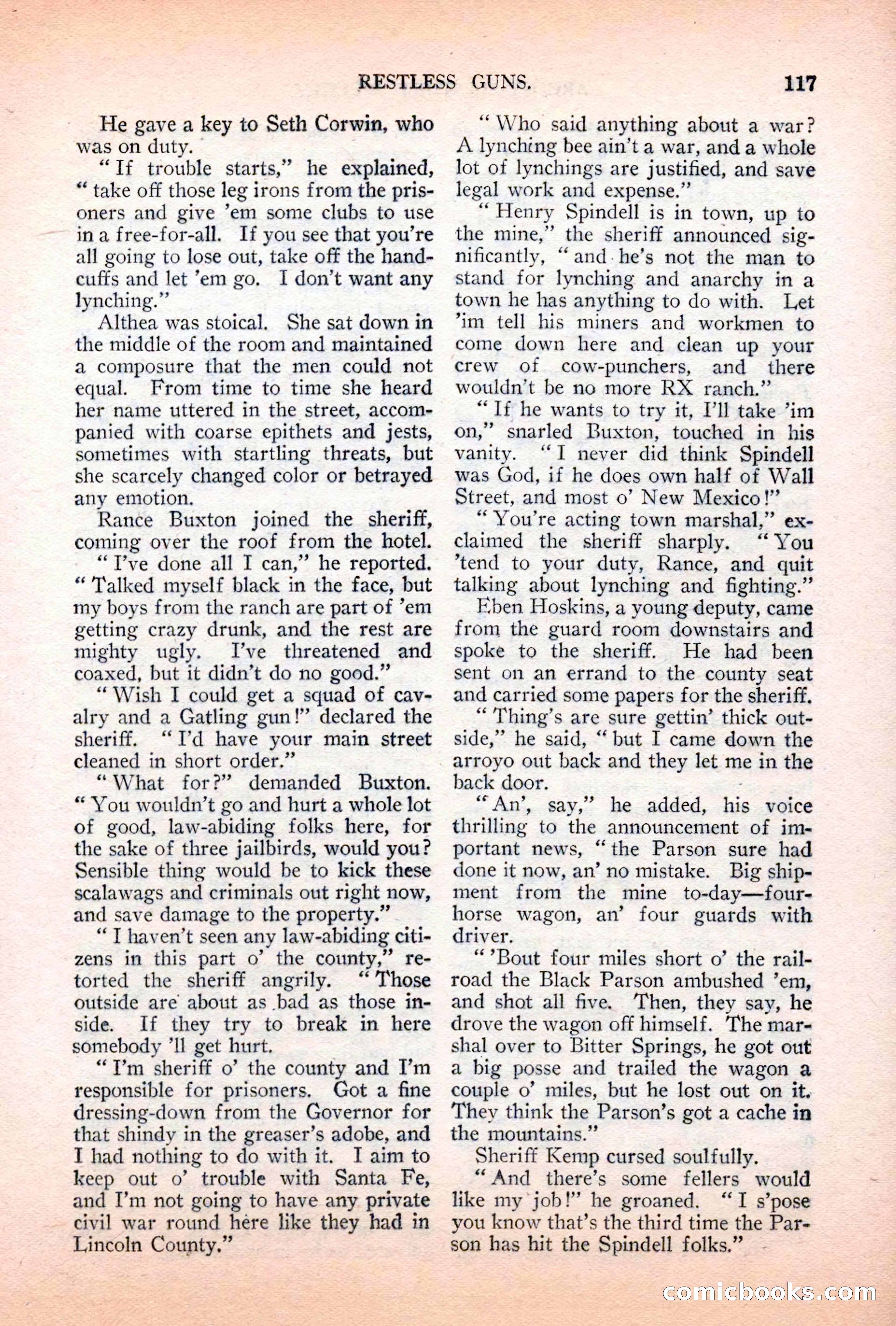
RESTLESS GUNS. He gave a key to Seth Corwin, who was on duty. | “Tf trouble starts,” he explained, “take off those leg irons from the pris- oners and give ’em some clubs to use in a free-for-all. If you see that you’re all going to lose out, take off the hand- cuffs and let ’em go. I don’t want any lynching.” Althea was stoical. She sat down in the middle of the room and maintained a composure that the men could not equal. From time to time she heard her name uttered in the street, accom- panied with coarse epithets and jests, sometimes with startling threats, but she scarcely changed color or betrayed any emotion. Rance Buxton joined the sheriff, coming over the roof from the hotel. “T’ve done all I can,’ he reported. “Talked myself black in the face, but my boys from the ranch are part of ’em getting crazy drunk, and the rest are mighty ugly. ve threatened and coaxed, but it didn’t do no good.” “Wish I could get a squad of cav- alry and a Gatling gun!” declared the sheriff. “Id have your main street cleaned in short order.” “What for?” demanded Buxton. “You wouldn’t go and hurt a whole lot of good, law-abiding folks here, for the sake of three jailbirds, would your Sensible thing would be to kick these scalawags and criminals out right now, and save damage to the property.” “T haven’t seen any law-abiding citi- zens in this part o’ the county,” re- torted the sheriff angrily. ‘ Those outside are about as bad as those in- side. If they try to break in here somebody ‘Il get hurt. “T’m sheriff o’ the county and I’m responsible for prisoners. Got a fine dressing-down from the Governor for that shindy in the greaser’s adobe, and T had nothing to do with it. I aim to keep out o’ trouble with Santa Fe, and I’m not going to have any private civil war round here like they had in Lincoln County.” 117 “Who said anything about a war? A lynching bee ain’t a war, and a whole lot of lynchings are justified, and save legal work and expense.” ‘“ Henry Spindell is in town, up to the mine,” the sheriff announced sig- nificantly, “and-he’s not the man to stand for lynching and anarchy in a town he has anything to do with. Let "im tell his miners and workmen to come down here and clean up your crew of cow-punchers, and _ there wouldn't be no more RX ranch.” “If he wants to try it, I’ll take ’im on,” snarled Buxton, touched in his vanity. “‘I never did think Spindell was God, if he does own half of Wall Street, and most 0’ New Mexico!” “You're acting town marshal,” ex- claimed the sheriff sharply. “You ‘tend to your duty, Rance, and quit talking about lynching and fighting.” Eben Hoskins, a young deputy, came from the guard room downstairs and spoke to the sheriff. He had been sent on an errand to the county seat and carried some papers for the sheriff. “Thing’s are sure gettin’ thick out- side,” he said, “ but I came down the arroyo out back and they let me in the back door. : “An’, say,” he added, his voice thrilling to the announcement of im- portant news, “the Parson sure had done it now, an’ no mistake. Big ship- ment from the mine to-day—four- horse wagon, an’ four guards with driver. “*Bout four miles short o’ the rail- road the Black Parson ambushed ’em, and shot all five. Then, they say, he drove the wagon off himself. The mar- shal over to Bitter Springs, he got out a big posse and trailed the wagon a couple o’ miles, but he lost out on it. They think the Parson’s got a cache in the mountains.” Sheriff Kemp cursed soulfully. “And there’s some fellers would like my job!’ he groaned. “TI s’pose you know that’s the third time the Par- son has hit the Spindell folks.” EOPMNIC LOOKS (E@)