
Pulp Fiction, 1928 · page 125 of 160
Argosy All-Story Weekly, April 7, 1928 — page 125: what you’re looking at
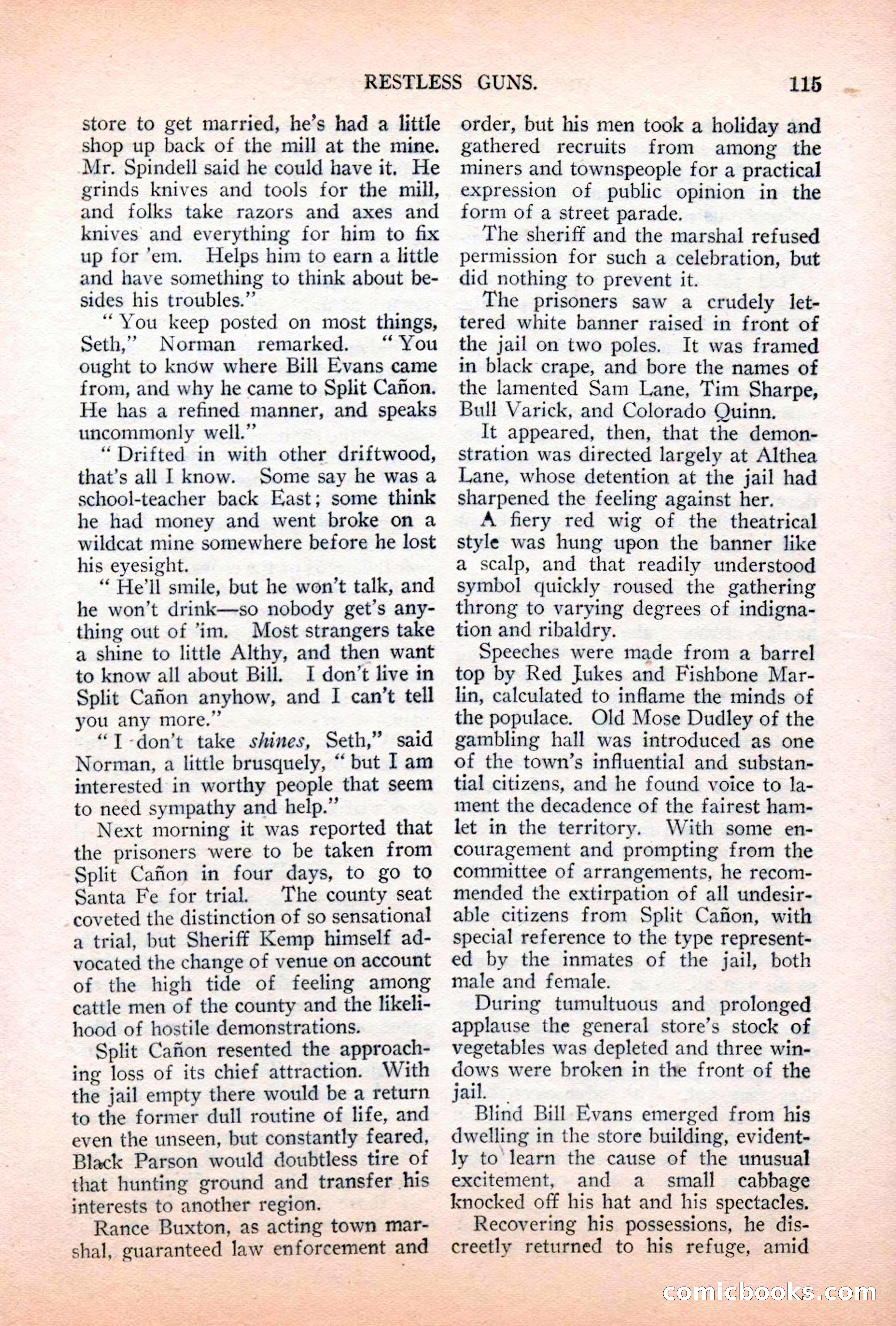
A restored page from Pulp Fiction, 1928. Page through the whole issue in the reader above.
📄 Transcribed text from this page (OCR, searchable)
Machine-transcribed from the original scan — historical spelling and the odd misread are preserved.
RESTLESS GUNS. store to get married, he’s had a litile shop up back of the mill at the mine. Mr. Spindell said he could have it. He grinds knives and tools for the mill, and folks take razors and axes and knives and everything for him to fix up for’em. Helps him to earn a little and have something to think about be- sides his troubles.”’ “You keep posted on most things, Seth,” Norman remarked. “ You ought to kndw where Bill Evans came from, and why he came to Split Cafon. He has a refined manner, and speaks uncommonly well.” “ Drifted in with other driftwood, that’s all I know. ‘Some say he was a school-teacher back East; some think he had money and went broke on a wildcat mine somewhere before he lost his eyesight. “ He'll smile, but he won’t talk, and he won’t drink—so nobody get’s any- thing out of ‘im. Most strangers take a shine to little Althy, and then want to know all about Bill. I don’t live in Split Cafion anyhow, and I can’t tell you any more.” “T-don’t take shines, Seth,” said Norman, a little brusquely, “‘ but I am interested in worthy people that seem to need sympathy and help.” Next morning it was reported that the prisoners were to be taken from Split Cafion in four days, to go to Santa Fe for trial. The county seat coveted the distinction of so sensational a trial, but Sheriff Kemp himself ad- vocated the change of venue on account of the high tide of feeling among cattle men of the county and the likeli- hood of hostile demonstrations. Split Cafion resented the approach- ing loss of its chief attraction. With the jail empty there would be a return to the former dull routine of life, and even the unseen, but constantly feared, Black Parson would doubtless tire of that hunting ground and transfer his interests to another region. Rance Buxton, as acting town mar- shal, guaranteed law enforcement and 115 order, but his men took a holiday and gathered recruits from among the miners and townspeople for a practical expression of public opinion in the form of a street parade. The sheriff and the marshal refused permission for such a celebration, but did nothing to prevent it. The prisoners saw a crudely let- tered white banner raised in front of the jail on two poles. It was framed in black crape, and bore the names of the lamented Sam Lane, Tim Sharpe, Bull Varick, and Colorado Quinn. It appeared, then, that the demon- stration was directed largely at Althea Lane, whose detention at the jail had sharpened the feeling against her. A fiery red wig of the theatrical style was hung upon the banner like a scalp, and that readily understood symbol quickly roused the gathering throng to varying degrees of indigna- tion and ribaldry. Speeches were made from a barrel top by Red Jukes and Fishbone Mar- lin, calculated to inflame the minds of the populace. Old Mose Dudley of the gambling hall was introduced as one of the town’s influential and substan- tial citizens, and he found voice to la- ment the decadence of the fairest ham- let in the territory. With some en- couragement and prompting from the committee of arrangements, he recom- mended the extirpation of all undesir- able citizens from Split Cafion, with special reference to the type represent- ed by the inmates of the jail, both male and female. During tumultuous and prolonged applause the general store’s stock of vegetables was depleted and three win- dows were broken in the front of the ail. Blind Bill Evans emerged from his dwelling in the store building, evident- ly to learn the cause of the unusual excitement, and a_ small cabbage knocked off his hat and his spectacles. Recovering his possessions, he dis- creetly returned to his refuge, amid GEomichbooks (E@)