
Pulp Fiction, 1928 · page 117 of 160
Argosy All-Story Weekly, April 7, 1928 — page 117: what you’re looking at
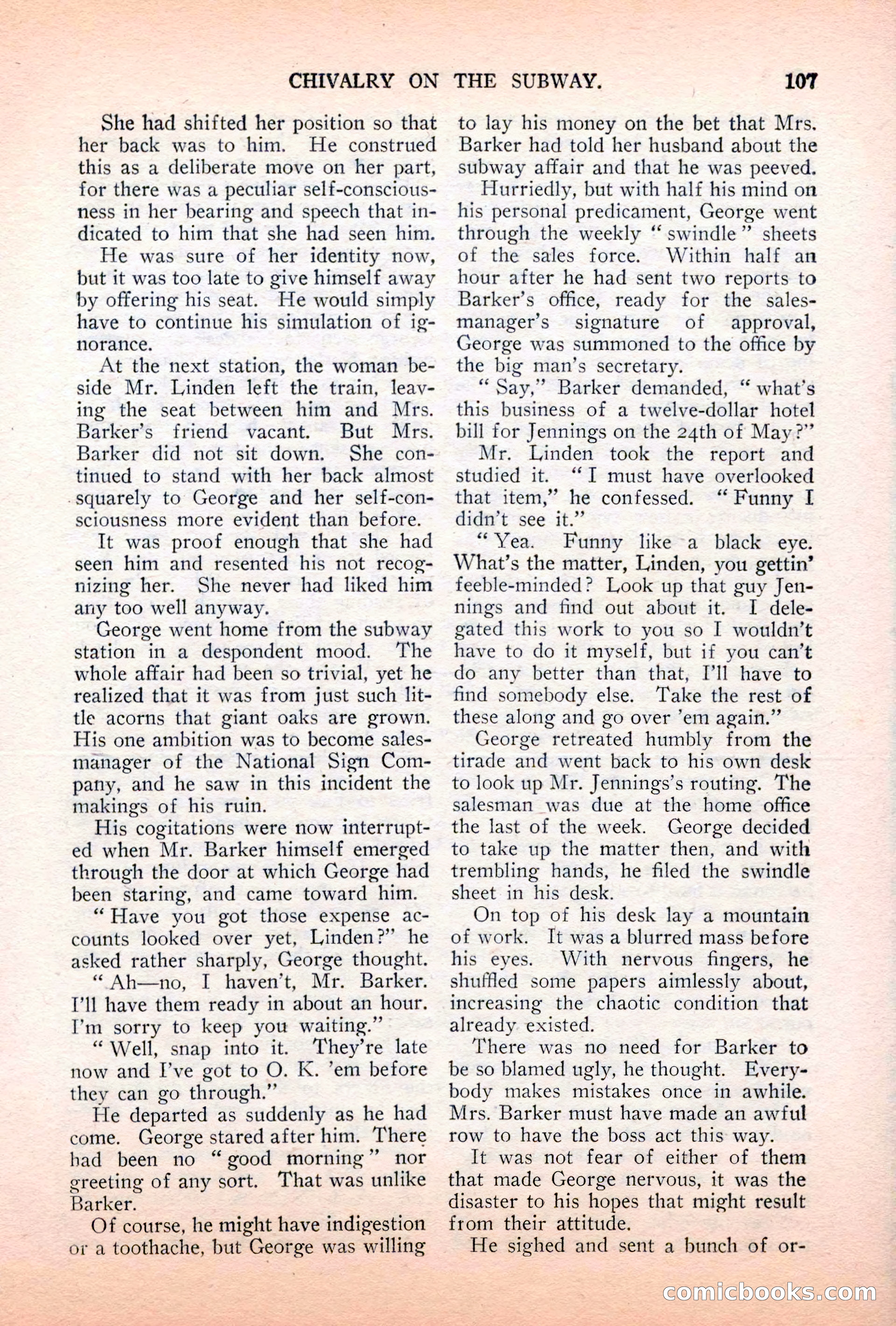
A restored page from Pulp Fiction, 1928. Page through the whole issue in the reader above.
📄 Transcribed text from this page (OCR, searchable)
Machine-transcribed from the original scan — historical spelling and the odd misread are preserved.
CHIVALRY ON She had shifted her position so that her back was to him. He construed this as a deliberate move on her part, for there was a peculiar self-conscious- ness in her bearing and speech that in- dicated to him that she had seen him. He was sure of her identity now, but it was too late to give himself away by offering his seat. He would simply have to continue his simulation of ig- norance. At the next station, the woman be- side Mr. Linden left the train, leav- ing the seat between him and Mrs. Barker’s friend vacant. But Mrs. Barker did not sit down. She con- tinued to stand with her back almost -squarely to George and her self-con- sciousness more evident than before. It was proof enough that she had seen him and resented his not recog- nizing her. She never had liked him any too well anyway. George went home from the subway station in a despondent mood. The whole affair had been so trivial, yet he realized that it was from just such lit- tle acorns that giant oaks are grown. His one ambition was to become sales- manager of the National Sign Com- patty, and he saw in this incident the makings of his ruin. His cogitations were now interrupt- ed when Mr. Barker himself emerged through the door at which George had been staring, and came toward him. “Have you got those expense ac- counts looked over yet, Linden?’ he asked rather sharply, George thought. “ Ah—no, I haven’t, Mr. Barker. I'll have them ready in about an hour. I’m sorry to keep you waiting.” “Well, snap into it. They’re late now and I’ve got to O. K. ’em before they can go through.” He departed as suddenly as he had come. George stared after him. There had been no “good morning” nor ereeting of any sort. That was unlike Barker. Of course, he might have indigestion or a toothache, but George was willing THE SUBWAY. 107 to lay his money on the bet that Mrs. Barker had told her husband about the subway affair and that he was peeved. Hurriedly, but with half his mind on his personal predicament, George went through the weekly “swindle” sheets of the sales force. Within half an hour after he had sent two reports to Barker’s office, ready for the sales- manager's signature of approval, George was summoned to the office by the big man’s secretary. “ Say,’ Barker demanded, “ what’s this business of a twelve-dollar hotel bill for Jennings on the 24th of May?” Mr. Linden took the report and studied it. “I must have overlooked that item,” he confessed. “ Funny I didn’t see it.” “Yea. Funny like a black eye. What’s the matter, Linden, you gettin’ feeble-minded? Look up that guy Jen- nings and find out about it. I dele- gated this work to you so I wouldn’t have to do it myself, but if you can’t do any better than that, I’ll have to find somebody else. ‘Take the rest of these along and go over ’em again.” George retreated humbly from the tirade and went back to his own desk to look up Mr. Jennings’s routing. The salesman was due at the home office the last of the week. George decided to take up the matter then, and with trembling hands, he filed the swindle sheet in his desk. On top of his desk lay a mountain of work. It was a blurred mass before his eyes. With nervous fingers, he shuffled some papers aimlessly about, increasing the chaotic condition that already existed. There was no need for Barker to be so blamed ugly, he thought. Every- body makes mistakes once in awhile. Mrs. Barker must have made an awful row to have the boss act this way. It was not fear of either of them that made George nervous, it was the disaster to his hopes that might result from their attitude. He sighed and sent a bunch of or- Gomichbooks (E@)