
Pulp Fiction, 1928 · page 97 of 164
Argosy All-Story Weekly, February 18, 1928 — page 97: what you’re looking at
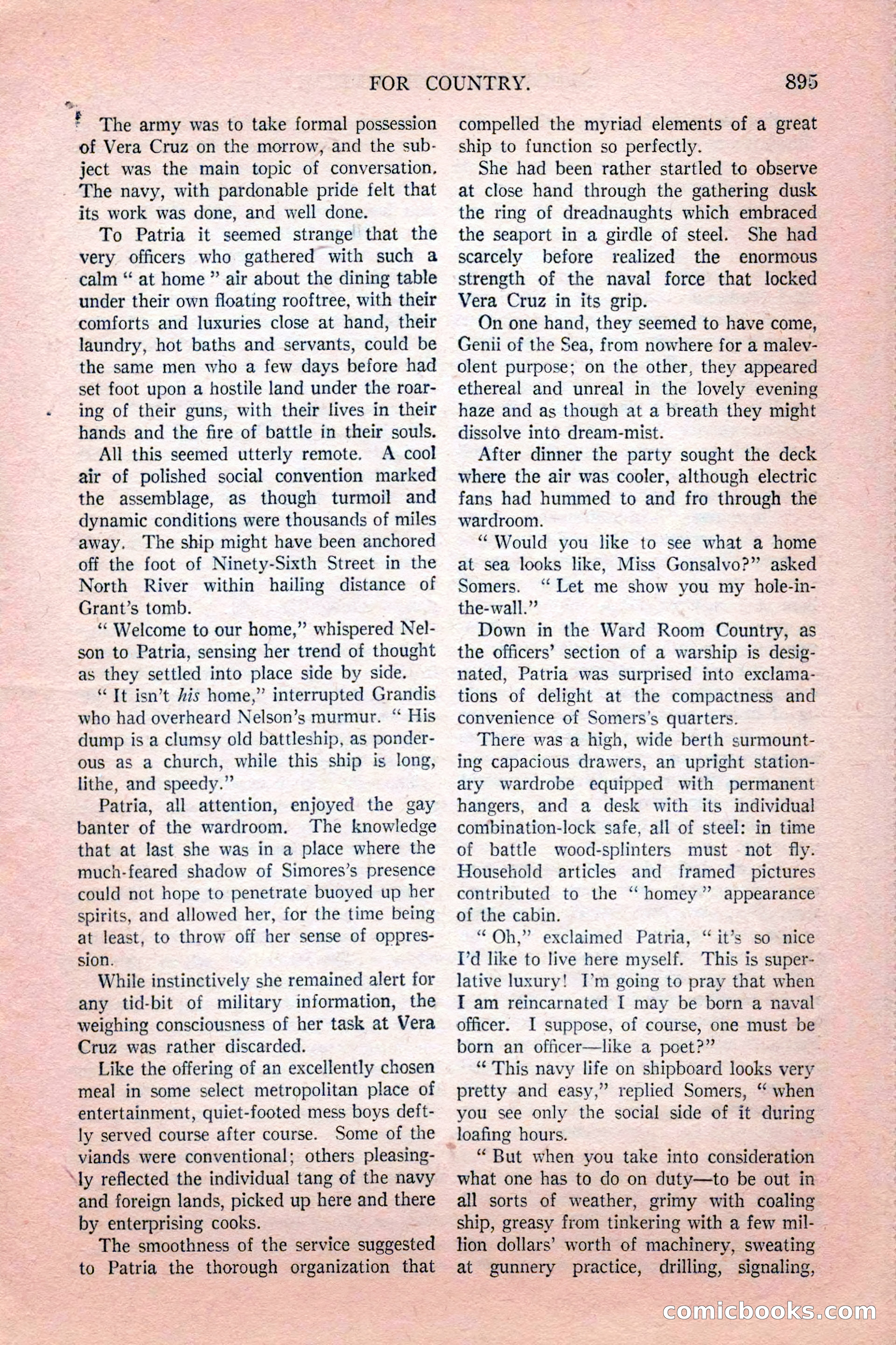
A restored page from Pulp Fiction, 1928. Page through the whole issue in the reader above.
📄 Transcribed text from this page (OCR, searchable)
Machine-transcribed from the original scan — historical spelling and the odd misread are preserved.
FOR COUNTRY. %. * The army was to take formal possession of Vera Cruz on the morrow, and the sub- ject was the main topic of conversation, The navy, with pardonable pride felt that its work was done, and well done. To Patria it seemed strange that the very officers who gathered with such a calm “ at home ” air about the dining table under their own floating rooftree, with their comforts and luxuries close at hand, their laundry, hot baths and servants, could be the same men who a few days before had set foot upon a hostile land under the roar- ing of their guns, with their lives in their hands and the fire of battle in their souls. All this seemed utterly remote. A cool air of polished social convention marked the assemblage, as though turmoil and dynamic conditions were thousands of miles away. The ship might have been anchored off the foot of Ninety-Sixth Street in the North River within hailing distance of Grant’s tomb. ‘Welcome to our home,” whispered Nel- son to Patria, sensing her trend of thought as they settled into place side by side. “Tt isn’t his home,” interrupted Grandis who had overheard Nelson’s murmur. “ His dump is a clumsy old battleship, as ponder- ous as a Church, while this ship is long, lithe, and speedy.” Patria, all attention, enjoyed the gay banter of the wardroom. The knowledge that at last she was in a place where the much-feared shadow of Simores’s presence could not hope to penetrate buoyed up her spirits, and allowed her, for the time being at least, to throw off her sense of oppres- sion. While instinctively she remained alert for any tid-bit of military information, the weighing consciousness of her task at Vera Cruz was rather discarded. Like the offering of an excellently chosen meal in some select metropolitan place of entertainment, quiet-footed mess boys deft- ly served course after course. Some of the viands were conventional; others pleasing- “ly reflected the individual tang of the navy and foreign lands, picked up here and there by enterprising cooks. The smoothness of the service suggested to Patria the thorough organization that 895 compelled the myriad elements of a great ship to function so perfectly. She had been rather startled to observe at close hand through the gathering dusk the ring of dreadnaughts which embraced the seaport in a girdle of steel. She had scarcely before realized the enormous strength of the naval force that locked Vera Cruz in its grip. On one hand, they seemed to have come, Genii of the Sea, from nowhere for a malev- olent purpose; on the other, they appeared ethereal and unreal in the lovely evening haze and as though at a breath they might dissolve into dream-mist. After dinner the party sought the deck where the air was cooler, although electric fans had hummed to and fro through the wardroom. “Would you like to see what a home at sea looks like, Miss Gonsalvo?” asked Somers. ‘“‘ Let me show you my hole-in- the- wall.” Down in the Ward Room Country, as the officers’ section of a warship is desig- nated, Patria was surprised into exclama- tions of delight at the compactness and convenience of Somers’s quarters. There was a high, wide berth surmount- ing capacious drawers, an upright station- ary wardrobe equipped with permanent hangers, and a desk with its individual combination-lock safe, all of steel: in time of battle wood-splinters must not fly. Household articles and framed pictures contributed to the “ homey” appearance of the cabin. “ Oh,” exclaimed Patria, “ it’s so nice I’d like to live here myself. This is super- lative luxury! I’m going to pray that when I am reincarnated I may be born a naval officer. born an officer—like a poet?” “This navy life on shipboard looks very pretty and easy,” replied Somers, “ when you see only the social side of it during loafing hours. “ But when you take into consideration what one has to do on duty—to be out in all sorts of weather, grimy with coaling I suppose, of course, one must be ship, greasy from tinkering with a few mil- | lion dollars’ worth of machinery, sweating at gunnery practice, drilling, signaling, Eomichooks (EO)