
Pulp Fiction, 1928 · page 9 of 164
Argosy All-Story Weekly, February 18, 1928 — page 9: what you’re looking at
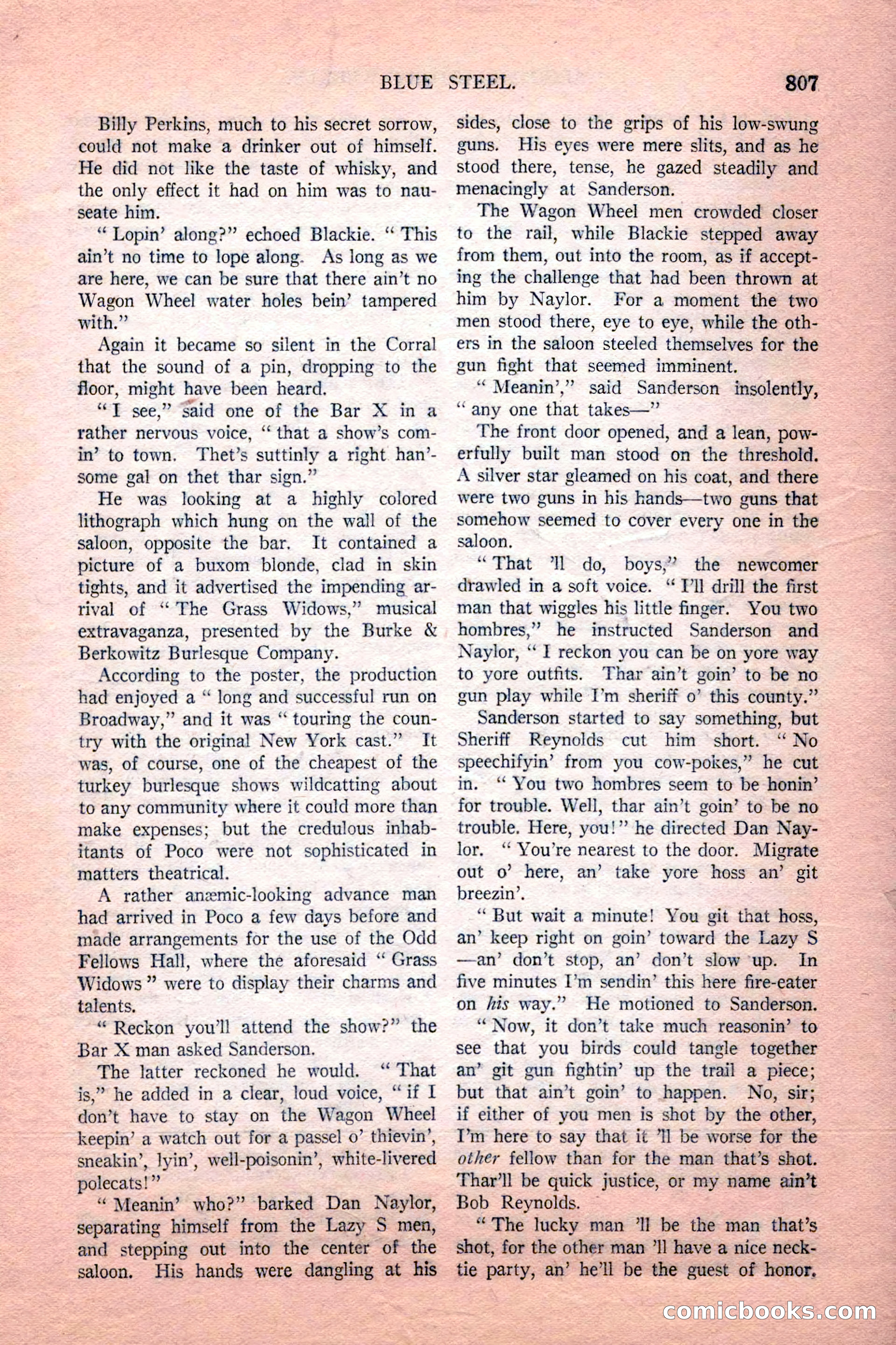
A restored page from Pulp Fiction, 1928. Page through the whole issue in the reader above.
📄 Transcribed text from this page (OCR, searchable)
Machine-transcribed from the original scan — historical spelling and the odd misread are preserved.
BLUE Billy Perkins, much to his secret sorrow, could not make a drinker out of himself. He did not like the taste of whisky, and the only effect it had on him was to nau- seate him. “ Lopin’ along?” echoed Blackie. “ This ain’t no time to lope along. As long as we are here, we can be sure that there ain’t no Wagon Wheel water holes bein’ tampered with.” Again it became so silent in the Corral that the sound of a pin, dropping to the floor, might have been heard. “T see,” Said one of the Bar X in a rather nervous voice, ‘“‘ that a show’s com- in’ to town. Thet’s suttinly a right. han’- some gal on thet thar sign.” He was looking at a highly colored lithograph which hung on the wall of the saloon, opposite the bar. It contained a picture of a buxom blonde, clad in skin tights, and it advertised the impending ar- rival of “‘ The Grass Widows,” musical extravaganza, presented by the Burke & Berkowitz Burlesque Company. According to the poster, the production had enjoyed a “ long and successful run on Broadway,” and it was “ touring the coun- try with the original New York cast.” It was, of course, one of the cheapest of the turkey burlesque shows wildcatting about to any community where it could more than make expenses; but the credulous inhab- itants of Poco were not sophisticated in matters theatrical. A rather anzemic-looking advance man had arrived in Poco a few days before and made arrangements for the use of the Odd Fellows Hall, where the aforesaid “ Grass Widows ” were to display their charms and talents. “Reckon you'll attend the show?” the Bar X man asked Sanderson. The latter reckoned he would. “ That is,” he added in a clear, loud voice, “if I don’t have to stay on the Wagon Wheel keepin’ a watch out for a passel 0’ thievin’, sneakin’, lyin’, well-poisonin’, white-livered polecats!” “ Meanin’ who?” barked Dan Naylor, separating himself from the Lazy 5 men, and stepping out into the center of the saloon. His hands were dangling at his STEEL. sides, close to the grips of his low-swung guns. His eyes were mere slits, and as he stood there, tense, he gazed steadily and menacingly at Sanderson. The Wagon Wheel men crowded closer to the rail, while Blackie stepped away from them, out into the room, as if accept- ing the challenge that had been thrown at him by Naylor. men stood there, eye to eye, while the oth- ers in the saloon steeled themselves for the gun fight that seemed imminent. ‘“ Meanin’,” said Sanderson insolently, ‘“any one that takes—” The front door opened, and a lean, pow- erfully built man stood on the threshold. A silver star gleamed on his coat, and there were two guns in his hands—two guns that somehow seemed to cover every one in the saloon. “That ‘ll do, boys,’ the newcomer drawled in a soft voice. “ Ill drill the first man that wiggles his little finger. You two hombres,” he instructed Sanderson and Naylor, “‘ I reckon you can be on yore way to yore outfits. Thar ain’t goin’ to be no gun play while I’m sheriff 0’ this county.” Sanderson started to say something, but Sheriff Reynolds cut him short. ‘“ No speechifyin’ from you cow-pokes,” he cut in. “ You two hombres seem to be honin’ for trouble. Well, thar ain’t goin’ to be no trouble. Here, you!” he directed Dan Nay- lor. ‘“ You’re nearest to the door. Migrate out o’ here, an’ take yore hoss an’ git breezin’. “But wait a minute! You git that hoss, an’ keep right on goin’ toward the Lazy S —an’ don’t stop, an’ don’t slow’up. In five minutes I’m sendin’ this here fire-eater on fis way.” He motioned to Sanderson. ‘““ Now, it don’t take much reasonin’ to see that you birds could tangle together an” git gun fightin’ up the trail a piece; but that ain’t goin’ to happen. No, sir; if either of you men is shot by the other, I’m here to say that it il be worse for the other fellow than for the man that’s shot. Thar’ll be quick justice, or my name ain’t Bob Reynolds. — “The lucky man ‘ll be the man that’s shot, for the other man ’!] have a nice neck- tie party, an’ he'll be the guest of honor. 7EO cbooks 807 mm For a moment the two (E(9)