
Pulp Fiction, 1928 · page 51 of 164
Argosy All-Story Weekly, February 18, 1928 — page 51: what you’re looking at
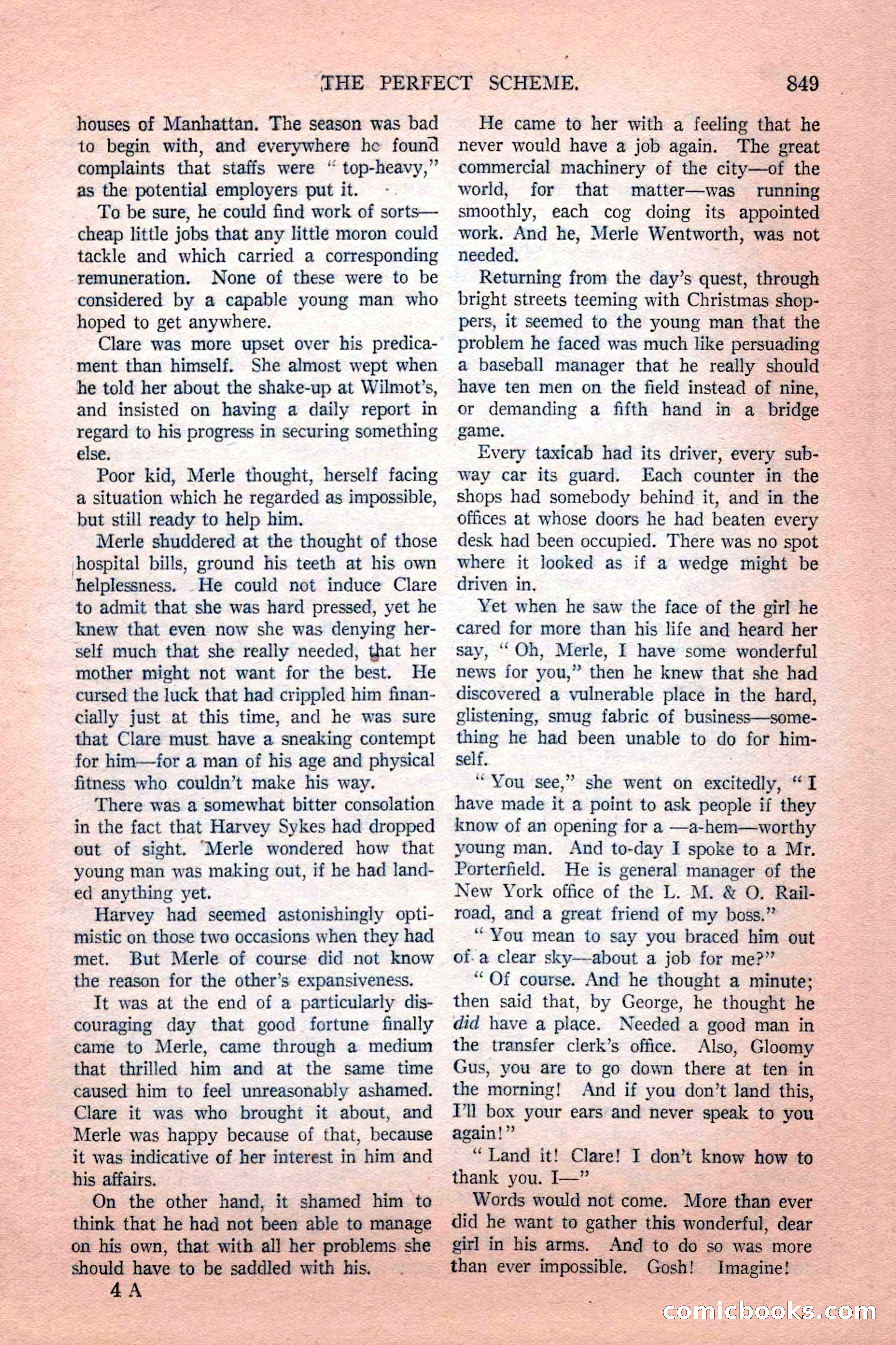
A restored page from Pulp Fiction, 1928. Page through the whole issue in the reader above.
📄 Transcribed text from this page (OCR, searchable)
Machine-transcribed from the original scan — historical spelling and the odd misread are preserved.
THE PERFECT SCHEME. houses of Manhattan. The season was bad to begin with, and everywhere he found complaints that staffs were “ top-heavy,” as the potential employers put it. To be sure, he could find work of sorts— cheap little jobs that any little moron could tackle and which carried a corresponding remuneration. None of these were to be considered by a capable young man who hoped to get anywhere. Clare was more upset over his predica- ment than himself. She almost wept when he told her about the shake-up at Wilmot’s, and insisted on having a daily report in regard to his progress in securing something else. Poor kid, Merle thought, herself facing a situation which he regarded as impossible, but still ready to help him. Merle shuddered at the thought of those hospital bills, ground his teeth at his own helplessness. _He could not induce Clare to admit that she was hard pressed, yet he knew that even now she was denying her- self much that she really needed, that her mother might not want for the best. He cursed the luck that had crippled him finan- cially just at this time, and he was sure that Clare must have a sneaking contempt for him—for a man of his age and physical fitness who couldn’t make his way. There was a somewhat bitter consolation in the fact that Harvey Sykes had dropped out of sight. “Merle wondered how that young man was making out, if he had land- ed anything yet. Harvey had seemed astonishingly opti- mistic on those two occasions when they had met. But Merle of course did not know the reason for the other’s expansiveness. It was at the end of a particularly dis- couraging day that good fortune finally came to Merle, came through a medium that thrilled him and at the same time caused him to feel unreasonably ashamed. Clare it was who brought it about, and Merle was happy because of that, because it was indicative of her interest in him and his affairs. , On the other hand, it shamed him to think that he had not been able to manage on his own, that with all her problems she should have to be saddled with his. AA $49 He came to her with a feeling that he never would have a job again. The great commercial machinery of the city—of the world, for that matter—was running smoothly, each cog doing its appointed work, And he, Merle Wentworth, was not needed. Returning from the day’s quest, through bright streets teeming with Christmas shop- pers, it seemed to the young man that the problem he faced was much like persuading a baseball manager that he really should have ten men on the field instead of nine, or demanding a fifth hand in a bridge game. Every taxicab had its driver, every sub- way car its guard. Each counter in the shops had somebody behind it, and in the offices at whose doors he had beaten every desk had been occupied. There was no spot where it looked as if a wedge might be driven in. Yet when he saw the face of the girl he cared for more than his life and heard her say, ‘““Oh, Merle, I have some wonderful news for you,” then he knew that she had discovered a vulnerable place in the hard, glistening, smug fabric of business—some- thing he had been unable to do for him- self. “You see,” she went on excitedly, “I have made it a point to ask people if they know of an opening for a —a-hem—worthy young man. And to-day I spoke to a Mr. Porterfield. He is general manager of the New York office of the L. M. & O. Rail- road, and a great friend of my boss.” ‘You mean to say you braced him out of-a clear sky—about a job for me?” “Of course. And he thought a minute; then said that, by George, he thought he did have a place. Needed a good man in the transfer clerk’s office. Also, Gloomy Gus, you are to go down there at ten in the morning! And if you don’t land this, I'll box your ears and never speak to you again!” ‘Land it! Clare! I don’t know how to thank you. I—” | Words would not come. More than ever . did he want to gather this wonderful, dear — girl in his arms. And to do so was more than ever impossible. Gosh! Imagine! — es Eomicbooks (E(8)