
Pulp Fiction, 1928 · page 31 of 164
Argosy All-Story Weekly, February 18, 1928 — page 31: what you’re looking at
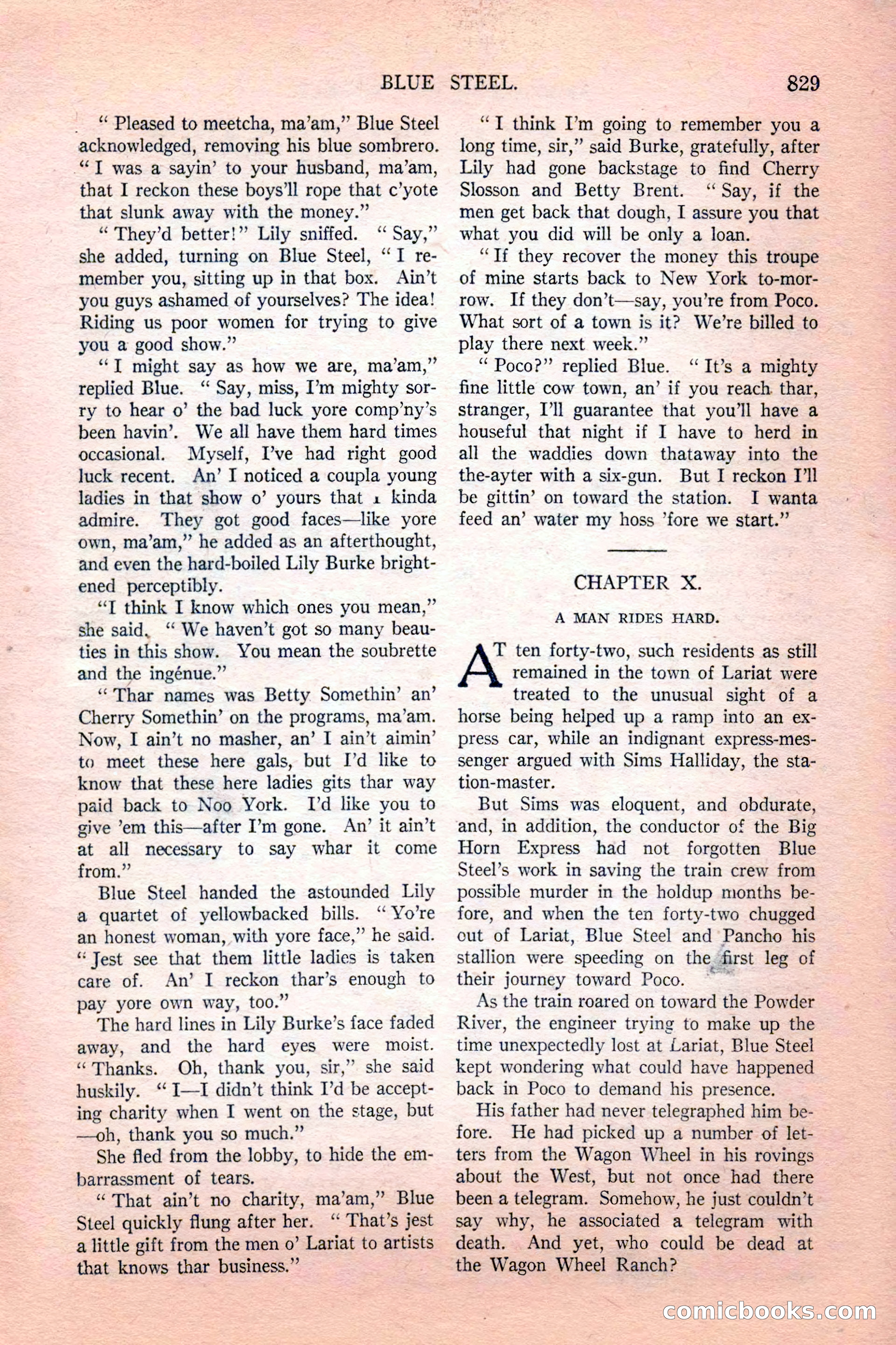
A restored page from Pulp Fiction, 1928. Page through the whole issue in the reader above.
📄 Transcribed text from this page (OCR, searchable)
Machine-transcribed from the original scan — historical spelling and the odd misread are preserved.
BLUE STEEL. _ * Pleased to meetcha, ma’am,”’ Blue Steel acknowledged, removing his blue sombrero. “T was a sayin’ to your husband, ma’am, that I reckon these boys’ll rope that c’yote that slunk away with the money.” “They’d better!” Lily sniffed. “Say,” she added, turning on Blue Steel, “I re- member you, sitting up in that box. Ain’t you guys ashamed of yourselves? The idea! Riding us poor women for trying to give you a good show.” ‘‘T might say as how we are, ma’am,” replied Blue. “Say, miss, I’m mighty sor- ry to hear o’ the bad luck yore comp’ny’s been havin’. We all have them hard times occasional. Myself, I’ve had right good luck recent. An’ I noticed a coupla young ladies in that show o’ yours that 1 kinda admire. They got good faces—like yore own, ma’am,” he added as an afterthought, and even the hard-boiled Lily Burke bright- ened perceptibly. “T think I know which ones you mean,” she said. ‘“ We haven’t got so many beau- ties in this show. You mean the soubrette and the ingénue.”’ “Thar names was Betty Somethin’ an’ Cherry Somethin’ on the programs, ma’am. Now, I ain’t no masher, an’ I ain’t aimin’ to meet these here gals, but I’d like to know that these here ladies gits thar way paid back to Noo York. Id like you to give ’em this—after I’m gone. An’ it ain’t at all necessary to say whar it come from.” Blue Steel handed the astounded Lily a quartet of yellowbacked bills. “ Yo’re an honest woman, with yore face,” he said. “Test see that them little ladies is taken care of. An’ I reckon thar’s enough to pay yore own way, too.” The hard lines in Lily Burke’s face faded away, and the hard eyes were moist. “Thanks. Oh, thank you, sir,’’ she said huskily. ‘‘ I—I didn’t think I’d be accept- ing charity when I went on the stage, but —oh, thank you so much.” She fled from the lobby, to hide the em- barrassment of tears. “That ain’t no charity, ma’am,” Blue Steel quickly flung after her. “ That’s jest a little gift from the men o’ Lariat to artists that knows thar business.” 829 “T think I’m going to remember you a long time, sir,” said Burke, gratefully, after Lily had gone backstage to find Cherry Slosson and Betty Brent. “Say, if the men get back that dough, I assure you that what you did will be only a loan. “Tf they recover the money this troupe of mine starts back to New York to-mor- row. If they don’t—say, you’re from Poco. What sort of a town is it? We're billed to play there next week.” “Poco?” replied Blue. “It’s a mighty fine little cow town, an’ if you reach. thar, stranger, I’ll guarantee that you'll have a houseful that night if I have to herd in all the waddies down thataway into the the-ayter with a six-gun. But I reckon Ill be gittin’ on toward the station. I wanta feed an’ water my hoss ’fore we start.” CHAPTER X. A MAN RIDES HARD. T ten forty-two, such residents as still remained in the town of Lariat were treated to the unusual sight of a horse being helped up a ramp into an ex- press car, while an indignant express-mes- senger argued with Sims Halliday, the sta- tion-master. But Sims was eloquent, and obdurate, and, in addition, the conductor of the Big Horn Express had not forgotten Blue Steel’s work in saving the train crew from possible murder in the holdup months be- fore, and when the ten forty-two chugged out of Lariat, Blue Steel and Pancho his stallion were speeding on the first leg of their journey toward Poco. ~~ As the train roared on toward the Powder River, the engineer trying to make up the time unexpectedly lost at Lariat, Blue Steel kept wondering what could have happened back in Poco to demand his presence. His father had never telegraphed him be- fore. He had picked up a number of let- ters from the Wagon Wheel in his rovings about the West, but not once had there been a telegram. Somehow, he just couldn’t | say why, he associated a telegram with death. And yet, who could be dead at the Wagon Wheel Ranch? Gomichooks (E@)