
Pulp Fiction, 1928 · page 19 of 164
Argosy All-Story Weekly, February 18, 1928 — page 19: what you’re looking at
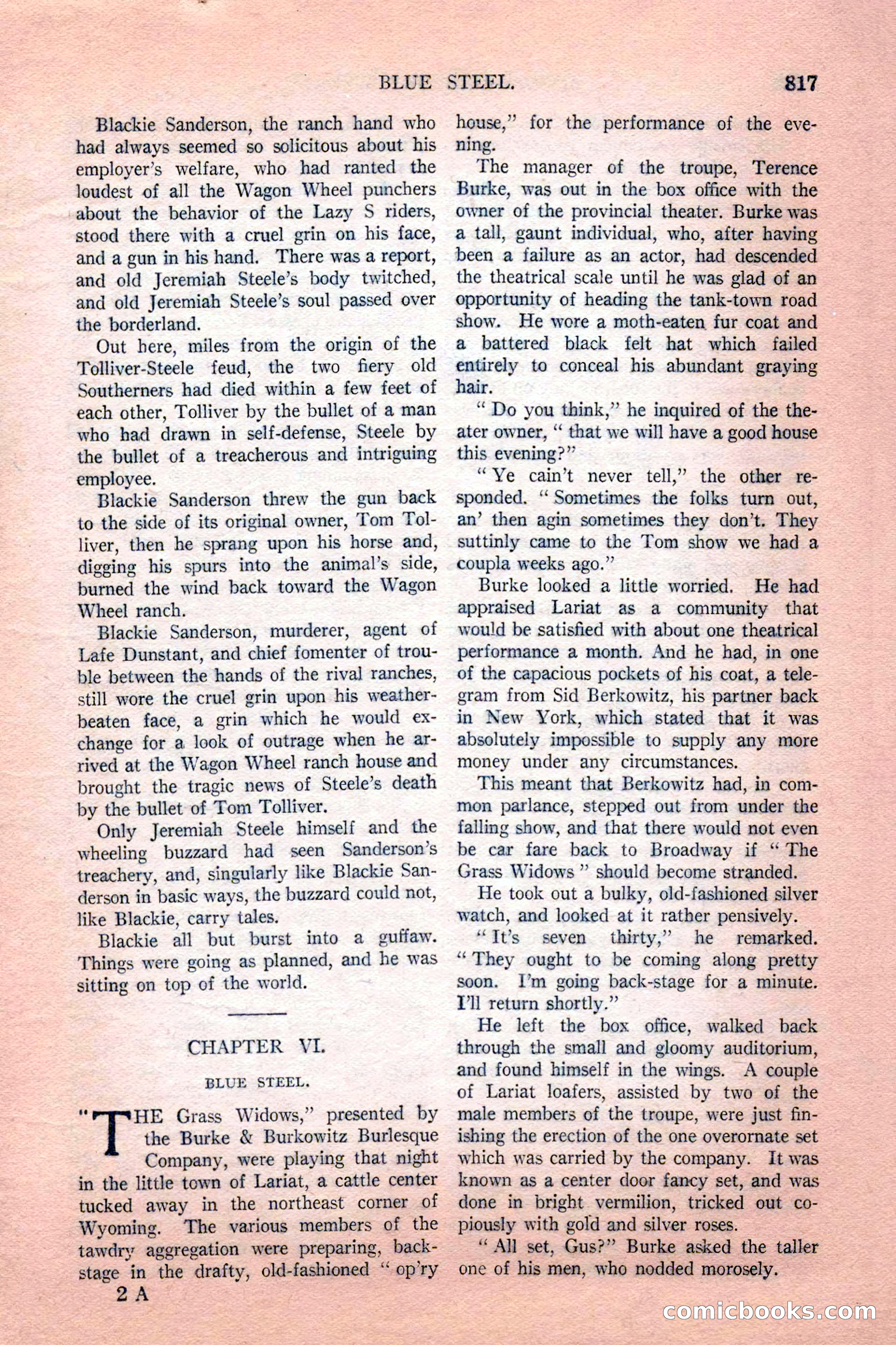
A restored page from Pulp Fiction, 1928. Page through the whole issue in the reader above.
📄 Transcribed text from this page (OCR, searchable)
Machine-transcribed from the original scan — historical spelling and the odd misread are preserved.
BLUE STEEL. Blackie Sanderson, the ranch hand who had always seemed so solicitous about his employer’s welfare, who had ranted the loudest of all the Wagon Wheel punchers about the behavior of the Lazy S riders, stood there with a cruel grin on his face, and a gun in his hand. There was a report, and old Jeremiah Steele’s body twitched, and old Jeremiah Steele’s soul passed over the borderland. Out here, miles from the origin of the Tolliver-Steele feud, the two fiery old Southerners had died within a few feet of each other, Tolliver by the bullet of a man who had drawn in self-defense, Steele by the bullet of a treacherous and intriguing employee. Blackie Sanderson threw the gun back to the side of its original owner, Tom Tol- liver, then he sprang upon his horse and, digging his spurs into the animal’s side, burned the wind back toward the Wagon Wheel ranch. Blackie Sanderson, murderer, agent of Lafe Dunstant, and chief fomenter of trou- ble between the hands of the rival ranches, still wore the cruel grin upon his weather- beaten face, a grin which he would ex- change for a look of outrage when he ar- rived at the Wagon Wheel ranch house and brought the tragic news of Steele’s death by the bullet of Tom Tolliver. Only Jeremiah Steele himself and the wheeling buzzard had seen Sanderson’s treachery, and, singularly like Blackie San- derson in basic ways, the buzzard could not, like Blackie, carry tales. Blackie all but burst into a guffaw. Things were going as planned, and he was sitting on top of the world. CHAPTER VL BLUE STEEL. HE Grass Widows,” presented by the Burke & Burkowitz Burlesque Company, were playing that night in the little town of Lariat, a cattle center tucked away in the northeast corner of Wyoming. The various members of the tawdry aggregation were preparing, back- stage in the drafty, old-fashioned “ op’ry 2A 817 house,” for the performance of the eve- ning. The manager of the troupe, Terence Burke, was out in the box office with the owner of the provincial theater. Burke was a tall, gaunt individual, who, after having been a failure as an actor, had descended the theatrical scale until he was glad of an opportunity of heading the tank-town road show. He wore a moth-eaten fur coat and a battered black felt hat which failed aw to conceal his abundant graying air. ‘Do you think,” he inquired of the the- ater owner, “ that we will have a good house this evening?”’ “Ye cain’t never tell,” the other re- sponded. ‘‘ Sometimes the folks turn out, an’ then agin sometimes they don’t. They suttinly came to the Tom show we had a coupla weeks ago.” Burke looked a little worried. He had appraised Lariat as a community that would be satisfied with about one theatrical performance a month. And he had, in one of the capacious pockets of his coat, a tele- gram from Sid Berkowitz, his partner back in New York, which stated that it was absolutely impossible to supply any more money under any circumstances. This meant that Berkowitz had, in com- mon parlance, stepped out from under the falling show, and that there would not even be car fare back to Broadway if ‘“ The Grass Widows ” should become stranded. He took out a bulky, old-fashioned silver watch, and looked at it rather pensively. “Tt’s seven thirty,” he remarked. “They ought to be coming along pretty soon. I’m going back-stage for a minute. I'll return shortly.” He left the box office, walked back through the small and gloomy auditorium, and found himself in the wings. A couple of Lariat loafers, assisted by two of the male members of the troupe, were just fin- ishing the erection of the one overornate set which was carried by the company. it was known as a center door fancy set, and was done in bright vermilion, tricked out co- piously with gold and silver roses. “ All set, Gus?” Burke asked the taller one of his men, who nodded morosely. cGomicbook a} EOr