
Pulp Fiction, 1928 · page 17 of 164
Argosy All-Story Weekly, February 18, 1928 — page 17: what you’re looking at
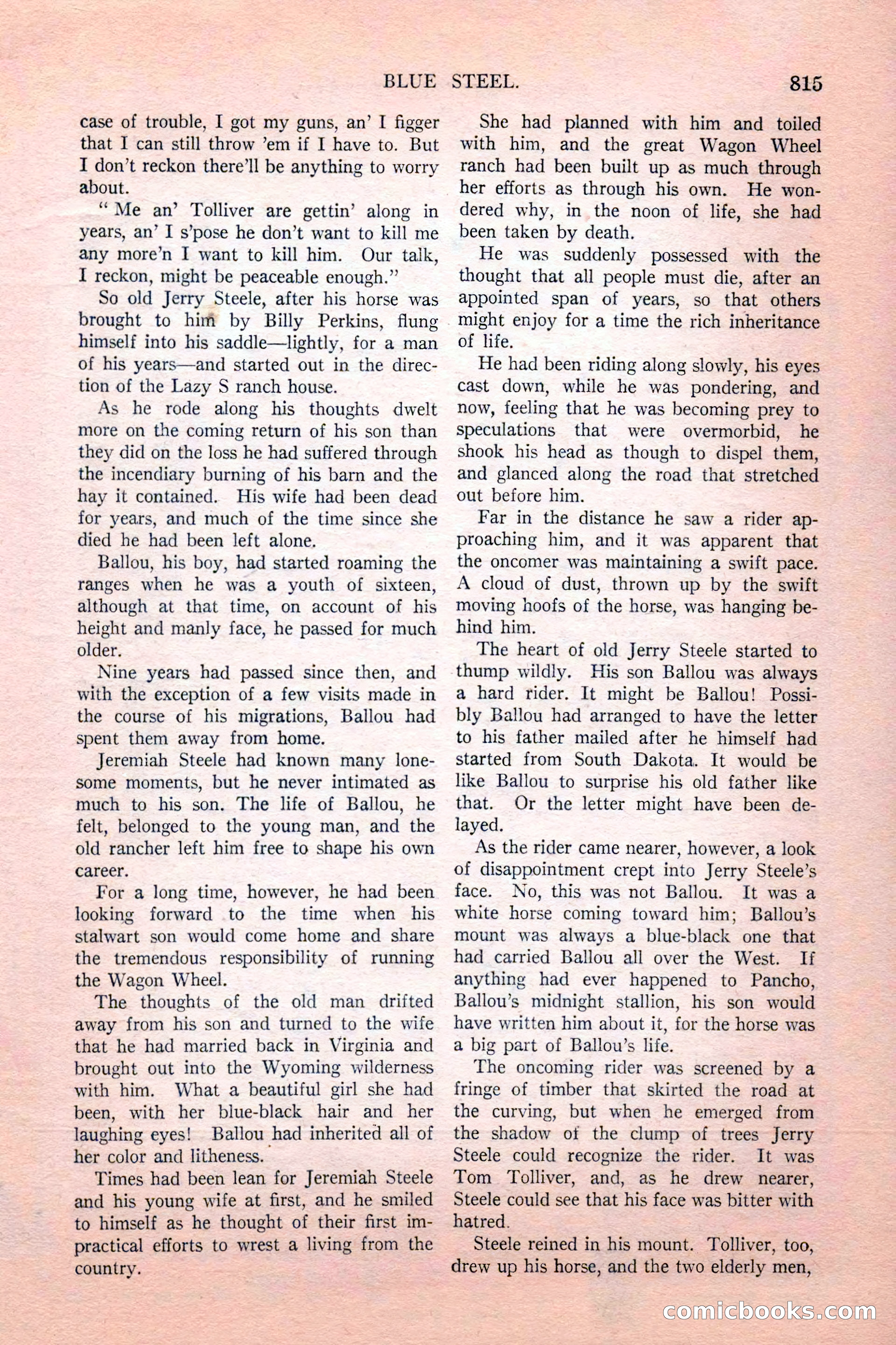
A restored page from Pulp Fiction, 1928. Page through the whole issue in the reader above.
📄 Transcribed text from this page (OCR, searchable)
Machine-transcribed from the original scan — historical spelling and the odd misread are preserved.
BLUE STEEL. case of trouble, I got my guns, an’ I figger that I can still throw ’em if I have to. But I don’t reckon there’ll be anything to worry about. ‘Me an’ Tolliver are gettin’ along in years, an’ I s’pose he don’t want to kill me any more’n I want to kill him. Our talk, I reckon, might be peaceable enough.”’ So old Jerry Steele, after his horse was brought to him by Billy Perkins, flung himself into his saddle—lightly, for a man of his years—and started out in the direc- tion of the Lazy S ranch house. As he rode along his thoughts dwelt more on the coming return of his son than they did on the loss he had suffered through the incendiary burning of his barn and the hay it contained. His wife had been dead for years, and much of the time since she died he had been left alone. Ballou, his boy, had started roaming the ranges when he was a youth of sixteen, although at that time, on account of his height and manly face, he passed for much older. Nine years had passed since then, and with the exception of a few visits made in the course of his migrations, Ballou had spent them away from home. Jeremiah Steele had known many lone- some moments, but he never intimated as much to his son. The life of Ballou, he felt, belonged to the young man, and the old rancher left him free to shape his own career. For a long time, however, he had been looking forward to the time when his stalwart son would come home and share the tremendous responsibility of running the Wagon Wheel. The thoughts of the old man drifted away from his son and turned to the wife that he had married back in Virginia and brought out into the Wyoming wilderness with him. What a beautiful girl she had been, with her blue-black hair and her laughing eyes! Ballou had inherited all of her color and litheness. Times had been lean for Jeremiah Steele and his young wife at first, and he smiled to himself as he thought of their first im- practical efforts to wrest a living from the country. 815 She had planned with him and toiled with him, and the great Wagon Wheel ranch had been built up as much through her efforts as through his own. He won- dered why, in the noon of life, she had been taken by death. He was suddenly possessed with the thought that all people must die, after an appointed span of years, so that others might enjoy for a time the rich inheritance of life. He had been riding along slowly, his eyes cast down, while he was pondering, and now, feeling that he was becoming prey to Speculations that were overmorbid, he shook his head as though to dispel them, and glanced along the road that stretched out before him. Far in the distance he saw a rider ap- proaching him, and it was apparent that the oncomer was maintaining a swift pace. A cloud of dust, thrown up by the swift moving hoofs of the horse, was hanging be- hind him. The heart of old Jerry Steele started to thump wildly. His son Ballou was always a hard rider. It might be Ballou! Possi- bly Ballou had arranged to have the letter to his father mailed after he himself had started from South Dakota. It would be like Ballou to surprise his old father like that. Or the letter might have been de- layed. As the rider came nearer, however, a look of disappointment crept into Jerry Steele’s face. No, this was not Ballou. It was a white horse coming toward him; Ballou’s mount was always a blue-black one that had carried Ballou all over the West. If anything had ever happened to Pancho, Ballou’s midnight stallion, his son would have written him about it, for the horse was a big part of Ballou’s life. The oncoming rider was screened by a fringe of timber that skirted the road at the curving, but when he emerged from the shadow of the clump of trees Jerry Steele could recognize the rider. It was Tom ‘Tolliver, and, as he drew nearer, Steele could see that his face was bitter with hatred. Steele reined in his mount. Tolliver, too, drew up his horse, and the two elderly men, Gomichooks (E@)